Agriculture, Energy Transition, Food, Biofuels, Sugar, Vegetable Oils, Grains, Oilseeds, Renewables
September 14, 2026
BRICS New Delhi declaration backs grain exchange plan

Editor:
HIGHLIGHTS
BRICS endorses Russia-led grain platform
Exchange may expand to biofuel feedstocks
44% of global grain output in member states
BRICS members have backed further development of a proposed grain trading platform that could eventually expand into other agricultural products and commodities, potentially creating a new pricing mechanism for grains and oilseeds used across food, feed and biofuel markets.
The BRICS New Delhi Declaration, adopted Sept. 12 at the grouping's 18th summit, acknowledged the importance of continued work on the BRICS Grain Exchange and called for further discussions on its functioning, development and possible expansion beyond grains.
The initiative, led by Russia, was first proposed in 2023 and gained momentum at the BRICS summit in Kazan in 2024. The declaration did not specify a launch date, trading contracts, settlement currency or governance structure.
"We acknowledge the importance of continued elaboration of the initiative to establish a grain trading platform within BRICS," the declaration said, while welcoming further discussions on its functioning and its expansion into other agricultural products and commodities.
Although the declaration did not identify biofuels or individual feedstocks as prospective contracts, any expansion beyond grains could bring products linked to ethanol, biodiesel and renewable diesel supply chains within the platform's scope.
Several BRICS economies are major producers, consumers or exporters of corn, sugar, soybeans and vegetable oils. The expanded grouping accounts for about 44% of global grain production and more than 25% of global grain consumption, according to published estimates. Its members include major exporters such as Brazil and Russia and consuming markets such as China, India and Egypt.
Price discovery ambitions
Russia has promoted the exchange as an alternative agricultural trading and price discovery platform at a time when internationally referenced grain futures are concentrated on exchanges in the US and Europe.
The proposed exchange could draw physical liquidity from trade among BRICS exporters and importers and support regional benchmarks aligned with trade flows across the Global South. Its relevance would depend on commercial participation, alignment with existing export markets and the ability of traders to hedge exposures.
The declaration did not commit members to a particular pricing, settlement or clearing system. Questions remain about whether contracts would be denominated in US dollars, local currencies or another settlement mechanism, as well as how quality specifications, delivery points and dispute resolution would be standardized.
BRICS countries have explored local-currency trade and more efficient cross-border payment systems separately, although officials have said the grouping is not proposing a common BRICS currency.
Biofuel feedstock implications
The platform's initial focus on grains makes the proposal most directly relevant to ethanol feedstocks. Brazil produces sugarcane- and corn-based ethanol, while India has expanded grain-based capacity alongside its sugar and molasses pathways. China also has a substantial grain and feed-processing industry.
A subsequent expansion into other agricultural products could increase its relevance to oilseed and vegetable oil markets. Brazil is a major soybean exporter with a large biodiesel program, while Indonesia is the leading palm oil producer and uses substantial volumes domestically for biodiesel. India and China are also major vegetable oil importers.
The declaration separately supported sustainability, inclusivity and equitable market access in the global sustainable vegetable oils sector, recognizing the effect of policy and regulatory changes on agricultural production, trade, food security and the livelihoods of small-scale producers
Food security focus
BRICS leaders presented the grain exchange primarily as a food security initiative, emphasizing the need to mitigate acute food-price volatility and abrupt supply disruptions, including fertilizer shortages.
Members also supported stronger food reserves and climate-resilient seed systems and agreed to establish the BRICS Agro-Inputs, Genetic Resources and Information Network, or BRICS AGRIN. The network was described as collaborative, nonbinding and farmer-centric.
BRICS also supported a Global Forum on Farmers' Rights in Seed Systems and networks focused on regenerative agriculture and digital farming. The grouping reaffirmed its commitment to agricultural negotiations at the World Trade Organization and called for a fair, balanced and development-oriented global agricultural trading system.
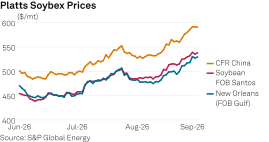
Platts, part of S&P Global Energy, assessed the SOYBEX FOB Santos soybean contract for October loading at $532.99/mt on Sept. 11, down $11.30/mt.
