Agriculture, Grains
September 02, 2026
Black Sea disruptions push wheat to record high; Australia, North America demand up
Editor:
HIGHLIGHTS
Black Sea attacks stall exports, lift prices
Australian wheat hits 3-year price peak
Canada sees record export program demand
Global wheat prices hit record highs as escalating tensions in the Black Sea pushed buyers to seek alternative origins to offset supply disruptions from Russia and Ukraine. Black Sea seep-sea exports have been repeatedly disrupted by near-continuous attacks, stalling shipments and widening the gap in global supplies.
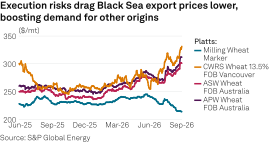
Platts, part of S&P Global Energy, assessed the Milling Wheat Marker at $214/mt on Sept. 1 amid low FOB demand and caution among ships operating from deep-sea ports. Alternative origins, such as Australian APW, are at a $98/mt premium to the MWM, while the CWRS FOB Vancouver price is at a $117/mt premium as of Sept. 1, reaching peak levels last seen in 2023.
Market participants said if exports remain constrained through the end of the year, Russian wheat shipments could fall below 40 million mt and Ukraine's wheat exports could total around 10 million mt.
Australian wheat at record high
Australian wheat prices rose amid a lack of Black Sea wheat supply to traditional destinations such as Southeast Asia and Bangladesh during the usual peak import period for the latter.
Platts Australian Standard White with no protein guarantee assessment, or ASW1, rose $35/mt to $301/mt FOB Kwinana on Sep. 1 since the intensification of drone attacks on ships and port infrastructure in the Black Sea on July 6. The price is the highest since March 7, 2023.
Meanwhile, Australian Premium White, or APW, rose by $40/mt since July 6 to reach $312/mt FOB Kwinana on Sept. 1, the highest assessment level since March 29, 2023.
Most Southeast Asian buyers switched to near-term September and October shipment of containerized wheat cargos from Australia. Significant demand remains for the November shipment period and onwards, keeping old and new crop price spreads stable, according to a Singapore wheat trader.
With wheat harvest taking place in spring and summer (September to February), the farmer's sales have been sluggish. "I think nobody wants to sell anyway, as everyone believes the market will continue to go up. Southeast Asia is already on November/December shipment coverage and will be waiting for further information on the harvest," said a Singapore-based miller source.
Uncertainty shifts demand to North America
The disruptions are also shifting the focus of demand to North America. Canadian and US market participants expect potential incremental buying into the Pacific Northwest and Vancouver, though tight nearby export capacity and elevated prices limit upside.
"I agree that the Black Sea situation is playing out in real time," one Canadian trader said. "I suspect PNW will get some low- to mid-protein business, and Vancouver will get hi-pro business."
Platts CWRS 13.5% FOB Vancouver wheat was assessed at $331.34/mt on Sept. 1 , the highest price since August 2023.
Canada enters the new marketing year with a strong export program. Agriculture and Agri-Food Canada estimated 2025-26 wheat exports, excluding durum, at nearly 24 million mt, up 2% year on year and the highest on record, with a forecast of 23.45 million mt for 2026-27. Key destinations include Indonesia, China, Japan and the US.
Broader signs of demand have surfaced in recent weeks, including interest from Taiwan and China, Japanese MAFF purchases, demand from Bangladesh, and some European interest, traders said.
However, additional nearby export opportunities remain constrained by capacity: traders said October is repeatedly full or nearly full, and one participant said sellers were holding their basis despite the futures rally.
"Demand is really quiet at these levels," the trader said, adding that Asian buyers were lagging and "buyers remain reluctant to engage at these levels."
With greater uncertainty over the Black Sea exports, traders will be watching how long alternative flows, especially from Australia and North America, can keep global tightness at bay.
