Refined Products, Agriculture, Jet Fuel, Biofuels
September 01, 2026
India needs SAF mandates, stronger demand signals to unlock investment: EDF

Editor:
HIGHLIGHTS
SAF costs 50-200% more than jet fuel
India has 210 biogas plants, targets 5,000
Carbon credit pricing remains unpredictable
India will struggle to build a meaningful, sustainable aviation fuel industry without mandates and long-term demand signals, according to Hisham Mundol, chief adviser for India at the Environmental Defense Fund, who said investors need clear market certainty before committing capital to large-scale projects.
In an interview with Platts, part of S&P Global Energy, on Aug. 31, Mundol said sustainable aviation fuel remains significantly more expensive than conventional jet fuel, making voluntary adoption unlikely despite growing interest in aviation decarbonization.
"At these cost levels, there's no airline that's going to pick up SAF. Only a mandate will make them feel the need to pick it up," Mundol said, estimating SAF currently carries a premium of between 50% and 200% over conventional aviation fuel, depending on the producer and market.
He said demand certainty would be critical to attracting investment in domestic production capacity.
"Capital will come when people will see that there is a short demand for it or some kind of reasonable demand signals that they can put into their spreadsheets," Mundol said.
According to Mundol, mandates could create the scale needed to lower costs over time.
"Once you get that mandate going and you get bigger economies of scale, those will bring down prices, it will incentivize more investment into larger SAF projects," he said.
Feedstock opportunity remains underutilized
Mundol said India has significant biofuel and biogas potential but lacks the organized feedstock collection systems needed to convert these resources into commercial-scale fuel production.
"Biofuel potential or the biogas potential in India is enough to cover all of our import requirements," he said. "That just gives you a sense of the scale of the opportunity."
However, he noted that India currently has only about 210 biogas plants, compared with a national target of 5,000.
The country needs better-structured collection networks for agricultural residues, municipal food waste and used cooking oil, he said.
"Let's have a national campaign that we don't lose a drop of cooking oil," Mundol said. "Use cooking oil from hotels and restaurants and find a way of collecting it."
He described India's biofuel sector as fragmented, with many projects remaining too small to materially affect the country's energy mix.
"Every major company will tell you about some initiative or another that they're doing, but it tends to be really small scale, not a significant enough contributor to their overall energy mix, because of the price premium," he said.
Energy security gaining prominence
Mundol said recent geopolitical developments have changed the way policymakers view biofuels and clean energy investments.
"Energy transition is now not regarded as just a climate agenda question, but it is as much about national security, economic stability, livelihoods protection, risk management for country and for companies," he said.
Biofuels and biogas can help reduce dependence on imported fossil fuels and improve resilience against external supply disruptions, he added.
Carbon market development
Mundol, whose organization is advising the government on the design of the Indian Carbon Credit Trading Scheme, said carbon pricing could play an important role in driving industrial decarbonization if implemented with robust monitoring and realistic targets.
"The fundamental reason for a carbon price of any kind is that if you put a more real price on carbon, you will incentivize climate action by rewarding those who act better and penalizing those who don't act as well," he said.
He cautioned, however, that it remains impossible to predict where carbon credit prices will settle.
"No one knows what the price of a credit will be. Anyone who tells you anything is engaging in optimistic guesswork," Mundol said.
The key challenge for policymakers will be finding what he described as a "sweet spot" between targets that are too weak to drive emissions reductions and targets that risk undermining industrial competitiveness.
Mundol said India's carbon market will ultimately need longer-term trajectories linked to the country's climate goals to provide the certainty required for investments with operating lives measured in decades.
For biofuel and SAF developers, that certainty may prove just as important as technological progress or feedstock availability. Without durable policy support and clear demand signals, he said, India's substantial bioenergy potential is unlikely to translate into the scale of investment required to decarbonize aviation.
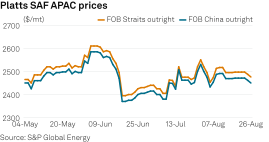
Platts assessed the sustainable aviation fuel HEFA-SPK FOB Straits benchmark at $2,484/metric ton on Aug. 31, up $15/mt from Aug. 28.
