Agriculture, Energy Transition, Electric Power, Refined Products, Biofuels, Renewables, Vegetable Oils, Non-Sugar Sweeteners, Jet Fuel
August 28, 2026
Asian SAF market focus shifts to carbon intensity as feedstock scrutiny grows

Editor:
HIGHLIGHTS
EcoCeres cuts emissions intensity by 11%
Feedstock traceability becomes critical factor
SAF producers face carbon verification pressure
For much of the past five years, competition in Asia's sustainable aviation fuel sector has been measured in announced capacity, project pipelines and investment commitments. Increasingly, however, the industry's next phase may be defined by a different metric of carbon performance.
The shift is becoming evident as airlines, regulators and corporate buyers move beyond questions of whether enough SAF can be produced and begin scrutinizing how it is produced, where feedstocks originate and whether emissions reductions can be independently verified.
Hong Kong-based renewable fuels producer EcoCeres provided a glimpse of that transition this week through the release of its 2025 Sustainability Report and GHG Accounting and Audit Report on Aug. 27, which focused less on new capacity announcements and more on operational emissions, renewable electricity use, governance and feedstock traceability.
The company said its Johor, Malaysia, facility was successfully commissioned to support growing demand for sustainable aviation fuel, hydrotreated vegetable oil and bio-naphtha in key markets.
While EcoCeres did not disclose production volumes or nameplate capacity, the company emphasized sustainability performance across its operating platform.
According to the reports, EcoCeres reduced combined Scope 1 and Scope 2 emissions intensity by 11% compared with its 2022 baseline despite expanding operations, while energy intensity fell nearly 19% to 695 kilowatt-hours/metric ton of output.
The company also reported that renewable electricity accounted for 69% of power consumption at its Jiangsu operations in 2025, up from zero in 2022, and reiterated a target of sourcing 100% renewable electricity across its operations by 2030.
Those metrics are becoming increasingly relevant as governments tighten sustainability requirements for aviation fuels and airlines seek suppliers capable of supporting compliance with evolving SAF mandates and carbon-accounting frameworks.
Feedstocks under the spotlight
The industry's growing focus on carbon intensity is being accompanied by heightened scrutiny of feedstock sourcing.
Questions surrounding used cooking oil traceability, waste-based feedstock availability and sustainability certification have become increasingly important as SAF demand accelerates across Europe, Asia and North America. Producers are under pressure to demonstrate not only emissions reductions but also transparent supply chains.
EcoCeres said it maintains 100% ISCC-certified traceability for feedstocks, including used cooking oil, animal fats, glycerine and agricultural residues. The company also highlighted strengthened supplier oversight and sustainability governance as part of its broader decarbonization strategy.
The company joined the UN Global Compact in October 2025 and received an EcoVadis Gold rating in January 2026, placing it among the top-rated companies assessed under the sustainability benchmarking framework.
From volume race to quality race
The disclosures come as SAF markets gradually evolve from a supply-constrained environment toward one where differentiation may increasingly depend on measurable sustainability credentials.
Early SAF market development was largely driven by the need to bring production capacity online.
As more facilities enter operation globally, buyers are beginning to compare suppliers based on emissions intensity, renewable energy integration, governance standards and feedstock provenance.
EcoCeres has set a target to reduce Scope 1 and Scope 2 emissions intensity by 30% by 2035 and to achieve net-zero emissions across Scopes 1, 2 and 3 by 2050. The company has also linked executive remuneration to ESG-related performance indicators, including sustainability and operational metrics.
What remains absent from the disclosures are lifecycle carbon-intensity values, SAF production volumes and long-term airline offtake agreements metrics that many fuel buyers will ultimately use when evaluating suppliers.
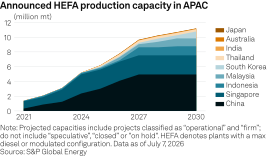
The reports point to a broader trend taking shape across the sector. As SAF production capacity expands globally, the next competitive divide may not be between companies that can produce fuel and those that cannot, but between producers that can demonstrate verified carbon reductions and feedstock transparency and those that cannot.
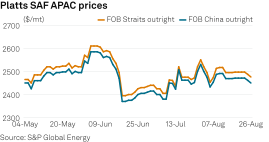
Platts, part of S&P Global Energy, assessed Sustainable Aviation Fuel HEFA-SPK FOB China at $2,443/mt on Aug. 28, down $7/mt from Aug. 27.
