Agriculture, Maritime & Shipping, Grains
August 27, 2026
Egypt faces wheat supply crunch as Black Sea conflict escalates

Editor:
HIGHLIGHTS
CIF East Med price hits record $301/mt
Private grain stocks cover only one month
Some buyers hold off purchases on high prices
The recent escalation of the Russia-Ukraine war since July has left Egypt, the world's largest wheat importer and heavily dependent on Black Sea supplies, in an increasingly precarious position, with logistical hurdles persisting and vessels shying away from the region, market participants said.
Buyers in Egypt face tightening wheat coverage and limited alternatives, prompting bids for optional-origin wheat at $300/metric ton for the 12.5% protein handy market, compared to offers at $305-$306/mt. Most executable business is now sourced from the Baltic rather than deep-sea ports, with freight rates in the low to mid-$40s/mt.
Platts wheat benchmark, the Milling Wheat Marker, was assessed at $215/mt as of Aug. 26 amid cautious sentiment among FOB buyers and shipowners. Meanwhile, the CIF East Med basis Egypt 12.5% assessment surged to a record $301/mt as of Aug. 26, driven by high freight costs and restricted supply routes.
The Ukrainian 11.5% CIF handy market saw bids at $291/mt, with offers at a $5/mt premium to the Egyptian market, executed from Constanta. Meanwhile, the 11.5% coaster market traded at $292-$295/mt, but a significant vessel queue at Sulina is exacerbating logistical constraints, market sources said.
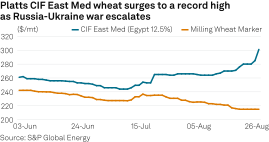
Some buyers are holding off on purchases, citing the risks for vessels calling at ports in Ukraine or Russia and record-high CIF prices. Despite Baltic ports being a viable option, concerns are rising that attacks could extend there, citing the Aug. 13 attack on the port of Ust-Luga, which adds further uncertainty. "It's a messy situation, but I think mid-September could see a resolution for sales from both sides," one local buyer said. "For now, we're just waiting and not buying."
Demand in Egypt is expected to rise, as private sector grain inventories provide only about one month's coverage, estimated at 500,000 mt. While corn supplies are less critical given alternative origins such as South America, Egypt's wheat supply remains vulnerable to disruptions in the Black Sea, the largest wheat export region. Since the start of the marketing year in July, the Egyptian state has refrained from buying internationally, with comfortable state stocks to cover six months and a record purchase from farmers of about 5 million mt of wheat.
Market participants anticipate a short-term price rally once the situation resolves, but expect prices to collapse in the longer term due to an oversupply of newly harvested wheat as it moves out of the Black Sea.
With the high-demand period approaching and schools resuming in early August, local market prices are already rising daily. The Russian 12.5% wheat is offered at 15,000 Egyptian pounds ex-warehouse as of Aug. 26. Importers face losses of 1,100 Egyptian pounds/mt at current replacement costs, a second local buyer said. In contrast, at the start of July, Russian 12.5% wheat traded at 14,200 Egyptian pounds and Ukrainian 11.5% at 13,900 Egyptian pounds. The Egyptian pound now stands at 50.2 to the US dollar, near levels seen before the Israel-Iran war in June.
Alternative origins, like Romania and Bulgaria, are facing a second year of quality concerns, with over 50% of the harvest classified as feed-grade and a scarce 12.5% wheat specifications. Egypt, traditionally a leading buyer, has not purchased Romanian or Bulgarian wheat since the start of the marketing year in July, although sellers remain hopeful that blended wheat could find a market there. The last Bulgarian wheat purchase by the Egyptian state was in June, and Romanian wheat landed in April.
With supply routes narrowing and logistical challenges mounting, Egypt's wheat market remains at the mercy of ongoing geopolitical tensions in the Black Sea region.
