Agriculture, Maritime & Shipping, Meat, Livestock, Containers
August 27, 2026
Brazilian beef stands to benefit from US import tariff suspension: market
Editor:
HIGHLIGHTS
US suspends tariffs on 300,000 mt lean beef
Brazil eyes 40%-50% export growth by year-end
Traders pause amid pricing benchmark confusion
Brazil-origin beef may benefit from the US government's decision to remove tariffs on lean beef trimming imports for 90 days, starting Sept. 1, according to agriculture market participants.
The suspension will allow up to 300,000 metric tons of lean beef trimmings over 90 days, according to a White House fact sheet published on Aug. 26. The quota allows 100,000 mt of imports per month and applies only to shipments to be combined with US-origin beef to produce ground beef, according to the White House.
President Donald Trump previously announced the measure on Aug. 21 to reduce retail prices amid historically high prices and tight cattle supplies.
Out of all countries, Brazil is widely expected to be the main beneficiary of the additional "other countries" quota volume, with Paraguay also seen as a possible supplier. The proclamation does not apply to country-specific quotas or free trade agreement commitments.
Brazil capacity in focus
Imports from Brazil are likely to increase, with some potential volumes from Paraguay, a beef importer based in Central America said, adding that both origins could compete below current values for Central American, Australian, and New Zealand products.
"Brazil is the main beneficiary," the importer said. "The main issue I see is whether end-users will be willing to consume beef from Brazil and Paraguay."
However, the additional volume would increase competition across the imported lean beef complex, the importer said.
"The import of 300,000 mt will affect all of us by simply bringing prices down," the importer said. "Maybe not by 25%, but it will certainly move prices significantly toward a more competitive level than they are currently [in the US]."
Analysts at S&P Global Energy CERA also said the outlook for Brazilian products is bullish.
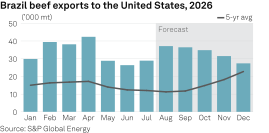
Brazilian shipments to the US have already risen year-over-year in 2026, CERA analyst Caroline Machado said, and there is room for shipments to grow by 40%-50% by year-end, given the tariff pause and a temporary halt in trade with China.
From a pricing standpoint, Brazil has a clear competitive advantage, Aron Ates, head of America Proteins at CERA, said.
Ates said discussions with analysts in South America suggest September volumes are likely to remain near recent monthly levels, around 25,000-30,000 mt, because the announcement came late in August. However, he said Brazil could potentially export up to 100,000 mt/month to the US in October and November.
"The timing is important because it coincides with Brazil satisfying its safeguard quota with China, which could free up export availability," Ates said. "Brazil also has 39 meatpacking plants authorized to export to the US, meaning industrial processing capacity is not expected to be a constraint."
On a more cautious tone, an analyst at the Brazilian Beef Exporters Association, or ABIEC, said the expansion of the US beef import quota is viewed as supportive of Brazil-based exporters, but the benefits may be limited by increased competition from other countries.
From a logistical perspective, a Brazil-based exporter said the quota expansion could benefit local suppliers, but warned that the 90-day implementation period may pose operational challenges, as the available production and shipment window could limit Brazilian meatpackers' ability to maximize participation in the quota volume.
"The transit time alone is around 20 to 25 days," the exporter said.
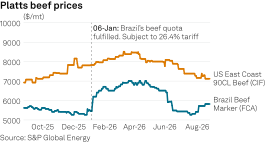
Platts, part of S&P Global Energy, assessed the Brazil Beef Marker at $5,820/metric ton FCA Santos on Aug. 26, up from $5,460/mt on Jan. 6, when Brazil fulfilled its US beef quota.
US beef import market stalls
The US imported beef market has slowed sharply after President Trump announced the tariff pause, with traders focused on how the administration will enforce a required 25% discount to the market price.
Uncertainty over implementation has left some importers reluctant to offer or book product, as participants wait for clarity on which benchmark local regulators will use to determine if product is being sold at the 25% discount.
Ates said the lack of clarity around the pricing benchmark remains one of the main unresolved questions for the trade.
"A key question for traders is whether the discount will be measured against domestic lean trimming prices, current import values, or another reference point," Ates said.
A US-based importer said market speculation has centered on how much eligible beef may already be in bonded warehouses or in transit to the US, but confirmed data remains limited.
"Everybody is really concerned about their inventory," the importer said. "What's on the water? Is there a bunch of Brazilian meat in bond? I have not been able to get that confirmed."
A second Brazilian beef exporter estimated about 30,000 mt of Brazilian beef was already either in-bond or in transit to the US under current trade flows.
US industry sources also raised logistical concerns, noting that 100,000 mt would amount to roughly 4,000 containers, raising questions about the ability to fill each monthly tranche, particularly given current uncertainty over eligible supply, ship timing and end-user demand.
Platts assessed 90CL beef CIF US East Coast at $7,121/mt on Aug. 26, down from $7,804/mt on Jan.6.
