Agriculture, Meat
August 25, 2026
Poland’s pork imports outpace exports by around 88% amid price volatility, shifting trade flows

By Iara Lima
Editor:
HIGHLIGHTS
New exports to Philippines, UAE signal market diversification
April exports drop 18%; lowest since July 2025
Denmark supplies 30% of Poland's pork imports
Exports: April slump, May recovery, structural shifts
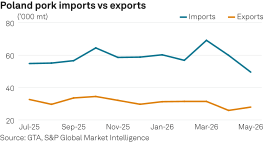
Polish pork exports reached their lowest point in April, falling to 25,884 metric tons, down 18% from March and the weakest monthly performance since July 2025, according to data from S&P Global's Global Trade Analytics Suite. "The decline in wholesale sales and Polish pork exports was driven by several factors, including weaker demand in key Asian markets, oversupply of pork in the EU and strong price pressure," said a Poland-based trader. "This situation put significant pressure on the profitability of wholesale transactions and forced processing plants to substantially adjust their prices." Exports to the UK, a key market, also fell by around 10% in April, further underscoring the breadth of the downturn.
May saw a partial recovery, with exports rebounding 8% to 27,940 mt. The Czech Republic (3,137 mt), Slovakia (2,858 mt), Romania (1,817 mt), Germany (1,793 mt) and Lithuania (1,481 mt) remained Poland's top destinations, collectively accounting for 43% of May exports. These flows highlight Poland's reliance on neighboring EU markets and the competitive landscape within the bloc.
Year in review: volatility, market realignment
From July 2025 to May 2026, monthly exports averaged 30,920 mt, peaking at 34,489 mt in October and bottoming out in April. The Czech Republic and Slovakia consistently ranked as top destinations, while demand from Romania was notably volatile—ranging from 853 mt in April to 3,297 mt in November. Germany, despite its own production strength, remained a steady buyer, reflecting regional price differentials and logistical advantages.
The Poland-based trader said Poland's current market position is partly the result of structural changes in domestic production. "Before the spread of African swine fever (ASF), Poland was a major pork producer. However, the situation deteriorated significantly, making pig farming increasingly risky and unprofitable for many farmers," the trader said. "As a result, a number of Polish farmers diversified their production and switched to other livestock species, particularly in eastern Poland." This shift has led to increased imports of young pigs from Denmark and the Netherlands and a move away from traditional closed-cycle pig farming, especially in regions such as Lublin and Podlasie.
Emerging markets: Philippines, UAE, Asia potential
The Philippines emerged as a new export destination in March, with volumes rising from zero to 491 mt in April and 311 mt in May. The trader said, "There have been emerging export flows to the Philippines since March 2026, as well as sporadic shipments to the UAE. These developments indicate that Polish companies are actively looking for alternative destinations as competition and price pressure within the EU increase." The UAE's sporadic demand, ranging from zero imports in some months to up to 107 mt in others, reflects niche expatriate market needs.
Polish exporters are also targeting South Korea and Japan. The Union of Producers and Employers of the Meat Industry (UPEMI) identifies Japan as a key potential market, with promotion focused on food safety and ASF-free-zone certification.
The trader said, "Promotion there focuses particularly on food-safety guarantees and the certification of zones free from African swine fever. This is important because regionalization and the recognition of ASF-free zones can have a significant impact on Poland's ability to maintain and expand access to Asian markets."
Imports: Poland's net importer status, EU integration
Poland's import volumes have consistently outpaced exports, averaging 58,200 mt per month versus 30,920 mt in exports.
Imports ranged from 49,513 mt in May to 69,113 mt in March, with Denmark (18,300 mt/month), Belgium (12,800 mt/month), Germany (10,800 mt/month), Spain (6,800 mt/month) and the Netherlands (5,200 mt/month) the top suppliers.
Denmark alone accounted for 30% of Poland's imports, driven by competitive pricing and logistics.
The trader said, "Polish processing plants and wholesalers increasingly turned to cheaper imported meat and cuts from Western European countries, including Germany, Denmark and Spain. The availability of these cheaper supplies, including surplus production, reduced demand for more expensive, domestically sourced raw materials and put additional pressure on Polish producers." Poland's role as a processing and distribution hub is reinforced by this import dependency, with imported pork often further processed and re-exported.
"There is a structural mismatch between what Polish farms produce and what the processing industry requires," the trader said. "While Poland remains a significant pork-producing country, domestic production does not always provide the right combination of cuts, volumes and price levels required by processors. As a result, companies may import particular cuts or raw materials while simultaneously exporting other parts of the carcass. Poland's strong processing sector means that imported pork can be further processed in the country and then sold both domestically and to other EU and international markets."
Price trends: volatility across cuts
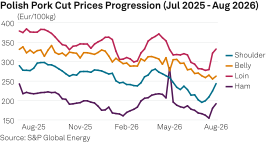
Shoulder prices ranged from €297.69/100 kg in August 2025 to €195.21/100 kg in July 2026, down 34.4%. Belly prices fluctuated between €255.29/100 kg and €341.31/100 kg, reflecting premium demand and shifting export flows. Loin prices, the highest-value cut, moved from €383.94/100kg in July 2025 to €277.36/100kg in July 2026, while ham prices were more stable overall, with a peak in May, according to the price indicators compiled by S&P Global CERA from the European Commission.
Market Outlook: Diversification, challenges, opportunities
Poland faces a delicate balancing act: managing domestic demand, competing with lower-cost producers, and diversifying exports. The trader sees export diversification as a long-term opportunity, not an immediate replacement for EU markets.
"Export diversification could reduce Poland's dependence on the highly competitive EU market and create additional outlets for specific cuts or products for which demand is limited in Europe," the trader said. "The Middle East may offer opportunities for higher-value and halal-certified products, while Asian markets could provide growing demand for both commodity pork and selected cuts."
Challenges remain, including regulatory hurdles, veterinary certification, halal requirements, ASF-related restrictions, and price competitiveness against global exporters. "Transport costs and longer delivery times to Asia and the Middle East can also reduce Poland's price advantage compared with suppliers located closer to these markets," the trader said.
Participation in international trade fairs and Polish national pavilions is helping to boost visibility and open new channels. "If market access can be secured and Polish companies can remain competitive in terms of price, quality and logistics, Asia could become an increasingly important destination for Polish pork," the trader said.
