Agriculture, Meat
August 21, 2026
Latin America shrimp growth intensifies competition in oversupplied market

Editor:
HIGHLIGHTS
Venezuela emerges as closely watched origin
Ecuador shipments rise despite pricing pressure
Latin America aquaculture grows 7.2% annually
Latin America's shrimp sector is expanding beyond Ecuador, adding competitive pressure to a global market already struggling with oversupply, weak demand and low prices.
Ecuador's export growth is the clearest sign of the shift, but the expansion is now reaching countries such as Venezuela and Brazil, while others, including Colombia, are seeking investments to increase their share. Aquaculture production in Latin America has expanded by an average of 7.2% annually since 2000, outpacing the global rate of 4.9%, according to the UN Food and Agriculture Organization.
The expansion comes as supply continues to increase faster than demand, putting pressure on prices and margins. FAO said global trade entered 2026 with weakened demand and lower prices, raising concerns among producers about the market's ability to absorb additional volumes.
Ecuador, the world's leading shrimp exporter, continues to increase shipments but higher volumes have not translated into stronger prices.
Platts, part of S&P Global Energy, assessed the Ecuadorian head-on shell shrimp 30-40 count FCA Guayaquil price at $3,990/mt Aug. 14, the lowest level since the assessment was launched in 2024, before recovering slightly to $4,050/mt on Aug. 20. Market participants attributed the stabilization to increased Chinese buying interest and stock rebuilding from historically low levels, although there is no evidence of a structural demand recovery.
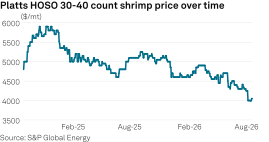
That raises an additional question for the industry: if the market is already struggling to absorb Ecuador's growth, how will it respond as other Latin American exporters expand?
New exporters, new strategies
Venezuela is among the most closely watched new regions by market participants, due to its available production areas, vertical integration and interest in export ambitions.
Market participants also point to opportunities for differentiation. A producer and exporter with experience in the European market said Venezuela-origin shrimp has a naturally darker coloration and may serve specific consumption niches.
"It comes out as black shrimp. And that's highly sought after for cocedero", the producer said, referring to European processors specializing in cooked shrimp.
Colombia is also trying to build scale. In August, the export-promoting government agency ProColombia launched a strategy to attract investment into the shrimp sector, focusing on technology upgrades, value-added production and output expansion. The goal is to increase volumes and develop an export-oriented industry to compete in higher-value segments.
Brazil remains supported primarily by domestic consumption, limiting direct competition with Ecuador in exports. Even so, expanding production and productivity gains could eventually generate surpluses or reduce the market share of foreign suppliers. Mexico continues to expand its production and retains important advantages, including proximity to the US and a robust domestic market.
The Latin American shrimp sector is thus not just seeing broad-based production growth, but also a reorganization with countries advancing at different speeds and adopting distinct strategies.
Beyond volume growth
Competition is unlikely to be driven solely by prices. Quality, certifications, market-specific specifications, logistical proximity and processing capabilities are expected to gain importance as more suppliers compete for buyers.
"The shrimp isn`t 100% commodity," a major Ecuadorian exporter said.
This differentiation may be crucial in a market where buyers increasingly seek specific products. Europe, the US and China require different product presentations, and not all shrimp from Latin America will compete directly for the same market space.
Over the long term, the region's expansion could strengthen its role in global aquatic food trade. In 2024, Latin America and the Caribbean recorded a $21 billion trade surplus in the sector, driven primarily by Chilean salmon, Peruvian anchoveta, and Ecuador's farmed shrimp.
The challenge will be matching supply growth with demand expansion. Otherwise, the dynamics that pushed Ecuadorian shrimp prices to record lows could spread to other countries, testing the industry's ability to find new consumers.
