Agriculture, Meat, Livestock
August 18, 2026
US lean beef import prices stay pressured despite tight cattle supply

Editor:
HIGHLIGHTS
Import prices steady amid sluggish buying
Cow slaughter drops 17% from 2024 levels
Packers close plants as cattle supply shrinks
US imported lean beef trimmings prices remained under pressure in mid-August as slow end-user demand and strong forward coverage capped CIF values, despite a widening year-over-year deficit in US cow and bull slaughter and limited nearby offers from New Zealand.
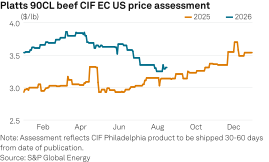
Platts, part of S&P Global Energy, assessed 90CL beef CIF East Coast at $3.31/lb Aug. 17, unchanged on the day but down 4 cents week on week and month on month, while still 17 cents above the year-earlier level, with New Zealand and Australia accounting for the largest share of observable CIF market data.
US cow and bull slaughter, the primary domestic source of lean beef, remained historically constrained through mid-August, reinforcing the structural support behind imported 90CL values.
Through Aug. 15, US cow and bull slaughter, the main source of lean beef, totaled an estimated 3.243 million head, down 4.9% from the same period in 2025 and 16% below the comparable period in 2024, according to USDA Daily Livestock and Poultry Slaughter reports and Weekly Actual Slaughter reports.
For the week ending Aug. 15, cow and bull slaughter was estimated at 92,000 head based on the accumulated Daily report. That was unchanged from the previous week but 2.1% below the prior six-week average and 8.6% below the corresponding week in 2025. Compared with the same week in 2024, slaughter was down 17.8%.
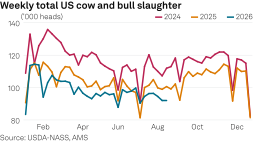
The deficit had narrowed from late May through mid-July, but the year-on-year gap widened again in recent weeks, keeping lean beef availability tight even as demand failed to generate a stronger price response.
According to S&P Global Energy data, based on the USDA's Weekly Actual Slaughter reports, most of the lift in non-fed slaughter numbers has come from dairy cows. During 2026, around 52% of the non-fed production was from dairy cows, compared to around 48% for the same period the previous year.
"Dairy cow slaughter declined slightly, falling slightly below year-ago levels," S&P Global Energy CERA said in its last US Dairy short-term outlook report Aug. 17. "For the week ending August 1, 2026, Federal Inspected dairy cow slaughter totaled 51,000 head, down 0.8% from a year ago and 1% below the previous week."
"Dairy cow slaughter has remained relatively subdued since the July 4 holiday," the report added. "Given favorable beef-on-dairy economics and a supportive dairy calf-to-cull cow price spread, dairy producers are expected to retain cows longer, keeping culling rates as a share of the herd below year-ago levels through the remainder of 2026."
Capacity adjusts to smaller cattle supply
The low non-fed slaughter base has developed alongside record-low beef cattle numbers, prompting packers to remove capacity and align operations with tighter cattle availability.
"Tyson Foods announced the closure of its Joslin, Illinois, processing facility as well as the case-ready plant in Eagle Mountain, Utah," S&P Global Energy CERA said in its latest US Beef and Cattle Short Term Outlook report. "Additionally, the Pasco, Washington, facility has been put up for sale."
"Amidst a record-low cattle supply, additional packing capacity has been removed from the system to strategically align the footprint," S&P Global Energy CERA said.
According to analysts, the removal of capacity underscores the longer-term supply constraint facing the US beef complex, but it has not been enough to lift import prices in the near term as buyers remain reluctant to extend coverage at higher levels.
Demand remained the limiting factor for imported lean beef, with market participants describing spot activity as quiet and end users well covered for the balance of 2026.
"Lean beef trimmings import prices have already reached their floor," a global beef trader said. "But demand is still slow as buyers are already well covered for the rest of the year, end users are now mostly buying for Q1 2027."
CIF US East Coast prices were supported by the lack of offers from New Zealand. "We're not offering much due to the low kill," a New Zealand beef exporter said.
According to a US lean beef trimmings trader, "Australia is also holding firm, and New Zealand is out of season, and their kill will remain a tiny fraction of what it was for the next 10-12 weeks."
South America competitive, but costs rise
In the port-of-entry market, Platts assessed 90CL beef FCA East Coast at $3.28/lb Aug. 17 for a 16- to 60-day delivery period, unchanged day on day but up 6 cents week on week and 3 cents month on month. South American shipments were heard as the most competitive in the FCA market.
"Market remains quiet, but a big week for important statistics," the US beef lean trimmings trader added. "Brazil released [export] shipments for July to the US and [were] far below what most were expecting."
"In addition, livestock prices continue to rise in all South American countries," the beef trader said. "This week again, South American prices are holding firm despite few orders; overseas packers need to raise prices to cover the current cost of livestock."
Domestic fresh 90CL values were steady to slightly mixed, offering limited directional pressure to the import market. USDA reported 24 trades at US national packing plants on the afternoon of Aug. 17, with fresh 90CLs averaging $455.47/cwt and trading in a $432.17-$468.34/cwt range.
The Aug. 17 weighted average was slightly above the week-ended Aug. 14 average of $455.14/cwt, but slightly below the week-ended Aug. 7 average of $455.87/cwt.
