Agriculture, Refined Products, Crude Oil, Energy Transition, Biofuels, Oilseeds, Diesel-Gasoil, Vegetable Oils, Gasoline, Renewables
August 14, 2026
Brazil targets B20 approval by early 2027 as producers push for higher blends

Editor:
HIGHLIGHTS
Brazil targets B20 approval by early 2027
Producers push for immediate B16 increase
Idle capacity exceeds 30% amid delays
Brazil's Ministry of Mines and Energy expects to complete technical feasibility tests for biodiesel blends up to 20% in diesel by February 2027, with potential regulatory approval at that time or by August 2027 if specification adjustments are required, as biodiesel producers argue the timeline is already behind schedule and push for immediate increases to 16% or higher.
The testing program began in August and evaluates blends from B16 to B20 in the first phase, with a second phase covering B21 to B25, Lorena Mendes, director of the Ministry of Mines and Energy's Biofuels Department, said Aug. 12 during Biodiesel Week, an industry event organized by the Brazilian Union of Biodiesel and Bio-kerosene, according to local media reports.
Brazil currently mandates a 15% biodiesel blend in diesel, known as B15, and the Fuel of the Future law proposes progressive 1-percentage-point annual increases until reaching B20 in 2030.
"By February 2027, we should finalize the entire execution phase of the testing plan and have the final report, which could lead to two major scenarios," Mendes said. "The first is direct approval, or we could also have regulatory recommendations, adjustments to the specification, and in this scenario, the expectation is around August 2027."
Biodiesel producers said the timeline falls short of expectations, and the country could already adopt an 18% blend by 2027. The sector is facing idle capacity exceeding 30% and has argued that delays in implementing blend increases are among the factors pressuring margins.
The sector attempted to implement B17 to alleviate rising fuel prices following the escalation of the war in the Middle East. In July, biodiesel producers delivered a letter arguing that Brazil is experiencing the most favorable moment to increase from the current 15% blend to B17, with the availability of raw materials and other supporting factors.
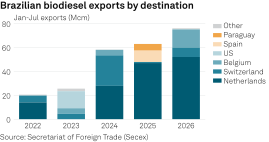
The Parliamentary Biodiesel Front and sectoral associations Abiove, Aprobio and Ubrabio argued that increasing the share of biofuels reduces Brazil's exposure to international oil market fluctuations, increases security of supply and creates an important buffer against fuel price volatility.
Brazil's soybean crushing reached 65 million mt in marketing year 2026-27, driven primarily by surging domestic biofuel demand as the country's biodiesel blend mandate increased to B15 in mid-2025, with soybean oil comprising nearly three-quarters of feedstocks used in the nation's biodiesel production.
The testing program aims to provide technical data to support future decisions by the National Energy Policy Council regarding increasing the share of biodiesel in diesel. The strategy allows for progressive evaluation of different percentages, with tests for B20 covering blends between 16% and 20% biodiesel, and the B25 stage covering blends between 21% and 25% biodiesel.
Mendes said the biodiesel case differs from recent litigation regarding anhydrous ethanol blending in gasoline. Although the decision for E32 had technical support, it was anchored in the upper limit of the E30 test margin and justified by the global gasoline market situation amid the war in the Middle East, she said. In the case of biodiesel, the tests will directly focus on the 20% content, more robustly supporting the National Energy Policy Council, according to Mendes.
In Brazil, Platts, part of S&P Global Energy, assessed soybean oil FOB Paranaguá for September loading at $1,196.89/mt on Aug.13, up 66 cents/mt from Aug.12.
Brazil's October market also moved higher. Platts assessed soybean oil FOB Paranaguá for October loading at $1,191.82/mt, up 88 cents/mt from Aug. 12.
