Metals & Mining, Non-Ferrous, Ferrous
August 10, 2026
Limestone buyers shift to China as Hormuz closure disrupts Gulf trade

Editor:
HIGHLIGHTS
UAE limestone exports fall 92% in March
China exports surge 377% as buyers diversify
Steel firms lock supply through 2026 on risk
The seaborne limestone trade is undergoing a sharp realignment as buyers that had long relied on the UAE turn increasingly to China for replacement supply after the Middle East war and the closure of the Strait of Hormuz disrupted one of the market's most important export corridors.
What began as an immediate response to the loss of UAE-origin material is now showing signs of becoming a broader shift in procurement strategy, particularly among steel producers and other industrial buyers that depend on a stable limestone supply and are seeking to reduce exposure to geopolitical chokepoints.
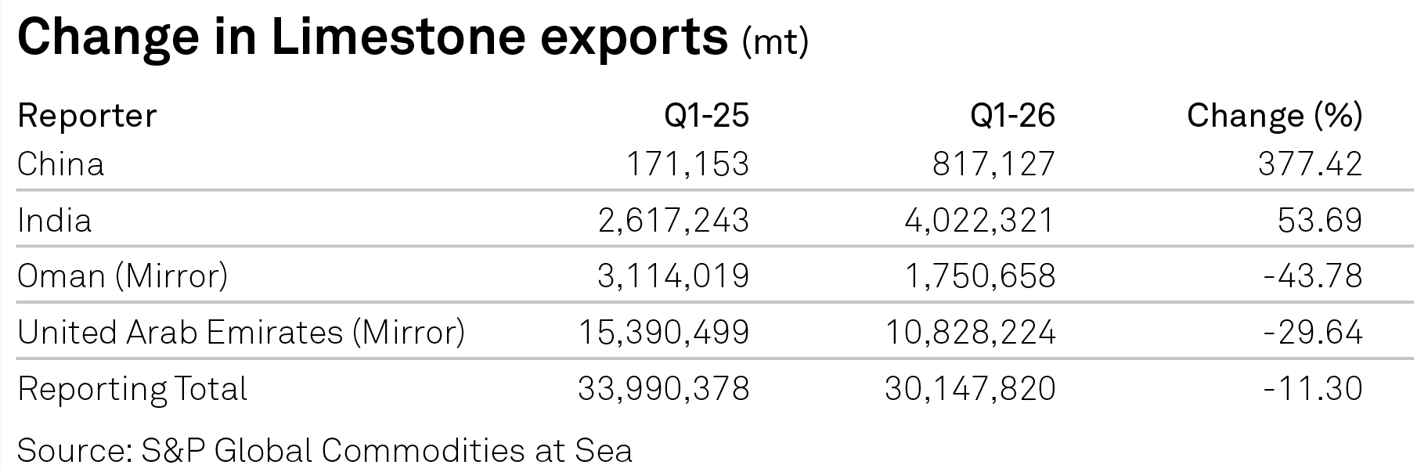
The UAE, the world's largest single-country exporter of limestone used in cement, lime and steel production, has been among the hardest hit by the disruption. Mirror trade data compiled by S&P Global's Global Trade Atlas show UAE limestone exports fell to 10.83 million metric tons in the first quarter of 2026, down 29.6% from 15.39 million mt in the same period of 2025.
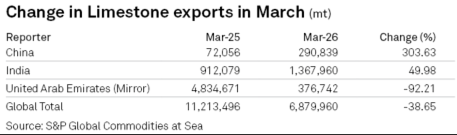
The deterioration became much more severe in March, when monthly mirror export volumes dropped to just 376,742 mt from 4.83 million mt a year earlier, a decline of 92.2%. The collapse underscored how exposed the UAE is to shipping through the Strait of Hormuz, through which an estimated 20% of global seaborne trade passes.
For buyers across Asia, the disruption has forced a rapid search for alternative origins. China has emerged as one of the clearest beneficiaries of that shift, with exporters there reporting increased inquiries and new shipments to customers that had not previously sourced from China.
A Chinese limestone producer said the market had seen noticeably stronger export activity since the conflict in the Middle East began to disrupt Gulf shipments.
"We have done many shipments — almost 10 — and heard others also sold many," the producer said, adding that buyers in India and Bangladesh were among those taking Chinese cargoes.
The producer's comments align with trade data showing China's limestone exports surged to 817,127 mt in the first quarter, up 377.4% from 171,153 mt in the same period a year earlier. The gain suggests Chinese suppliers have stepped into at least part of the gap left by the collapse in UAE exports, as buyers redirected purchases toward origins that do not depend on Hormuz transit.
India has also captured some of the displaced trade. Indian limestone exports reached 4.02 million metric tons in Q1 2026, up 53.7% year over year. But while India is also gaining, market participants said China has become an especially important alternative for certain buyers seeking immediate replacement volumes and additional supplier diversity.
The Chinese producer said the recent business had gone beyond one-off spot cargoes. Some customers had already fixed supply through the rest of the year, signaling that at least part of the shift reflects a reassessment of supply security rather than only a short-term reaction to disruption.
"They have fixed almost till the end of 2026," the producer said. "Mainly for steel companies. They cannot take the risk."
This points to a broader shift in how some industrial buyers are approaching limestone procurement. Limestone is a critical raw material not only for cement and lime production but also for steelmaking, where supply interruptions can have immediate operational consequences. For companies with continuous industrial demand, the disruption has highlighted the vulnerability of relying too heavily on one origin, even when that origin had previously been cost-competitive and dependable.
Shift's durability remains unclear
In this context, Chinese limestone is being viewed by some buyers less as a perfect substitute for UAE cargoes and more as part of a broader risk-management strategy. Traders and producers said some buyers are building more diversified sourcing portfolios so they are less exposed to any future disruption linked to war, shipping restrictions or political intervention in key transit channels.
The Chinese producer suggested that steel companies in particular are reassessing how they manage procurement risk.
"If someone wants to control the channel or play games, the steel company may need to prepare big storage or keep China as a supplier," the producer said.
That does not mean the trade shift is guaranteed to endure in its current form. The same producer said that Chinese limestone is not as competitive as UAE-origin material on price under normal market conditions, and that cost-sensitive buyers may revert to lower-priced supply if Gulf trade routes reopen and freight conditions stabilize.
"Not on price — that's why it cannot last," the producer said. "Especially for the Indian market ... too sensitive on the price."
That tension between cost and security may determine whether the current increase in Chinese exports becomes a lasting structural gain or fades once the immediate crisis passes. The producer said the market's next phase would depend heavily on the geopolitical outcome.
"All depends on the situation after [the] war," the producer said. "War stops, business gone."
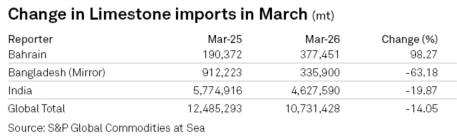
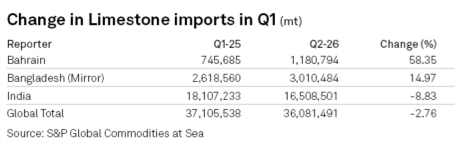
Even so, the disruption may leave a lasting mark on buyer behavior. Importing countries are already adjusting their procurement patterns. Bahrain's limestone imports rose 58.4% year over year to 1.18 million mt in the first quarter, potentially reflecting a push to secure material ahead of prolonged supply disruption. Bangladesh's imports rose 2.6% to 3.94 million mt, with market participants indicating that more of those flows are now being sourced from India and China rather than from Gulf exporters.
Elsewhere in the Gulf, Oman has also been affected by Hormuz-related shipping disruption. Omani limestone exports fell 43.8% year over year in the first quarter to 1.75 million mt from 3.11 million mt, highlighting the broader vulnerability of Gulf-origin supply chains to disruption in the strait.
At the global level, total reported limestone exports fell 11.3% in Q1 2026 to 30.15 million mt, while aggregate imports declined by a smaller 2.8% to 36.08 million mt. The gap suggests delayed reporting, rerouted cargoes or mirror data discrepancies as buyers and sellers adapted to rapidly changing trade patterns.
For now, the key development is that a trade once heavily anchored by UAE supply is no longer operating on the same assumptions. China has moved into the export gap quickly, and at least some buyers appear willing to maintain Chinese supply in their procurement mix beyond the immediate disruption as a hedge against future risk.
Whether that becomes a durable realignment will depend on several factors, such as the course of the conflict, the reopening of Gulf shipping routes, freight economics and the willingness of buyers to pay more for optionality. But the events of 2026 have already shown that low cost alone may no longer be enough to preserve market share in a trade where reliability and route security have become central to purchasing decisions.