Agriculture, Crude Oil, Energy Transition, Refined Products, Biofuels, Vegetable Oils, Renewables, Jet Fuel
August 10, 2026
Asia Pacific needs linear policy targets to scale SAF mandate: Neste executive

Editor:
HIGHLIGHTS
Singapore's levy model stands out among global frameworks
National policies emerge from 1% to 5% by 2032
Feedstock protectionism threatens industry growth
Asia-Pacific's diverse policy environment prevents a unified EU-style SAF mandate, but country-specific, progressively rising targets rather than the EU's stepped model present the most effective route for scaling sustainable aviation fuel, Stephen Bartholomeusz, senior executive at Neste Singapore, told Platts, part of S&P Global Energy.
The structural difference between the EU and Asia-Pacific is fundamental to understanding why a harmonized regional framework remains unlikely, Steven Bartholomeusz, head of Public and Regulatory Affairs, Asia Pacific at Neste, said Aug. 4.
"The EU operates as a supranational entity with legally binding regulations. The Commission drafts policy, it goes to Parliament, then Council, and it becomes law," he said. "ASEAN, by contrast, is decentralized. Decisions are reached through dialogue and consensus, but implementation comes down to individual countries."
Individual mandates emerging across the region
Rather than a unified bloc-wide mandate akin to ReFuelEU's 2% SAF target in 2025 rising to 6% by 2030, Bartholomeusz said Asia-Pacific will see a patchwork of national policies reflecting each market's stage of development.
He cited Singapore's 1% SAF target commencing in 2027, Japan's 5% SAF blend from 2032 for selected airports, and 1% mandates either implemented or announced in Indonesia, India, South Korea, and Thailand as evidence that the region is moving, albeit unevenly.
Australia's approach, he noted, is currently incentive-led, anchored by a $1.1 billion Future Made in Australia Fund tied to its Cleaner Fuels Program.
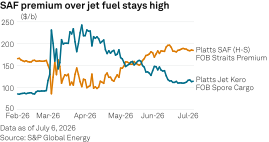
"All of these individual countries actually kicking off and bringing in regulation is really critical for the growth of the SAF market," Bartholomeusz said, while cautioning that building a harmonized government consensus across the Asia-Pacific region "could be challenging" given its diversity of cultures and economic development stages.
He highlighted Singapore's levy-based model, administered by the Civil Aviation Authority of Singapore across four geographic fare bands with lower charges for economy passengers than business class, as a genuinely unique approach among global frameworks.
But he argued the more important lesson from Europe is structural: policy should escalate in a straight line rather than in step-function plateaus. "If there's a learning from Europe, what's critical to ramping up production, is a linear mandate, rather than a step model where you hold at one target for five or six years before jumping up," he said, citing South Korea's and Thailand's roadmaps as closer to this linear approach.
Mandates, voluntary demand must work together
Bartholomeusz said policy-driven demand, whether mandates, incentives, or a blend of both, remains the foundation for scaling SAF, but voluntary corporate demand is equally necessary to build a durable market.
He cited the Association of Asia Pacific Airlines' commitment to a 5% SAF target by 2030 as an example of voluntary momentum building alongside regulation.
"Decarbonizing aviation cannot be the responsibility of one stakeholder. It requires governments to develop policy, airlines to adopt SAF, and businesses to pursue voluntary demand for their travel and freight," he said.
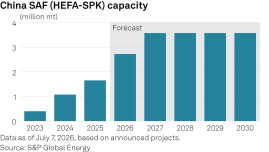
He linked demand certainty directly to Neste's own investment decisions, pointing to the company's expansion of its Singapore refinery, which doubled its renewable fuel capacity from 1.3 million metric tons to 2.6 million mt, including 1 million mt of dedicated SAF output, backed by a €1.65 billion investment.
He noted ICAO estimates the global aviation industry will require up to $3,200 billion in cumulative investment to reach net-zero emissions by 2050, a figure he said underscores why both mandated and voluntary demand signals are essential to unlocking capital at that scale.
Feedstock protectionism flagged as regional risk
On infrastructure, Bartholomeusz emphasized that SAF is fundamentally a "drop-in" fuel compatible with existing pipelines, storage and aircraft engines, meaning the primary technical constraint is the ASTM-approved blending ratio for the different SAF production pathways — currently capped at 50% for HEFA-based SAF.
He said readiness instead requires coordinated planning between regulators, fuel suppliers, airport operators and airlines, pointing to Neste's Rotterdam refinery expansion, which will lift total biofuel capacity to 6.8 million mt by the end of 2027, including more than 2 million mt of annual SAF production capability.
He cautioned against the growing trend of feedstock protectionism in the region, warning that used cooking oil, animal fats and other feedstocks act as global commodities similar to crude oil. "Any form of protectionism or restriction that limits feedstock to domestic-only use will be to the detriment of the industry," he said.
Lower oil prices unlikely to derail the policy push
Asked whether declining crude oil prices after the recent easing of Middle East tensions might dampen governments' urgency on biofuel mandates, Bartholomeusz said he does not expect momentum to slow.
He cited renewable diesel's 75%-95% and SAF's 80% lifecycle emissions reductions as enduring decarbonization benefits, regardless of oil price cycles, alongside fuel security, job creation and local economic gains.
"These biofuels are drop-in solutions, they can be used across vehicles, planes, data centers, heavy transport and construction to decarbonize today," he said.
