Agriculture, Maritime & Shipping, Grains
August 04, 2026
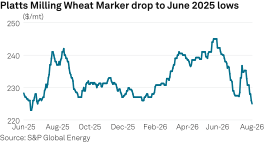
Platts Wheat Marker hits 13-month low amid Black Sea disruptions, weak demand

Editor:
HIGHLIGHTS
Wheat marker falls to 13-month low at $225.50/mt
Black Sea attacks halt ship calls at ports
Egypt's July imports drop 57.6% YOY
The Platts wheat benchmark, the Milling Wheat Marker, dropped to its lowest level since June 2025, assessed at $225.50/metric ton Aug. 4 for September loadings, weighed by subdued FOB demand and heightened security risks in the Black Sea region.
The market has seen a sharp decline in ship calls at Russian and Ukrainian ports amid intensified attacks, disrupting trade flows. This comes as the region looks to move a large harvest that began in July to global markets.
"I haven't seen any bids," one Russian-based seller. Russian FOB bids stood at $224/mt, compared to sellers at a $3/mt premium.
"Vessels are available but don't want to call at Russia or Ukraine," a trader said, underscoring the logistical challenges.
Strikes along the Don-Azov route and the Kerch Strait have resulted in no offers or bids to one of the biggest destinations, Turkey, and wheat is being diverted from the route to deep-sea terminals. Offers appeared for 5,000 metric tons from the Novorossiysk port, CIF Marmara coasters, at $255/mt, but without firm bids.
Currency fluctuations on top of a fuel crisis in Russia are adding to the market uncertainty. The ruble depreciated to 80 rubles/$1 Aug. 4, its weakest since April.
"This means the export tax will be 300-400 rubles," said a second Russian seller, anticipating an increase in the tax to offset lower FOB prices, which have remained at zero for several weeks. The CPT Novorossiysk market stood at 15,000 rubles/mt. Baltic ports are providing some optionality for Russian wheat, with 12.5% protein trades at $235/mt FOB Vystotsk for end-September shipment.
Meanwhile, the Ukrainian deep-sea ports of Pivdennyi, Odesa and Chornomorsk saw no firm FOB buyers. Some activity was noted at FOB Izmail and Reni, but draft restrictions on the Danube River are limiting trade.
"I'd be happy to look at POC ports, but there is no freight available," one Ukrainian seller said, adding that most business is now shifting to the Danube.
The 11.5% protein wheat coasters traded at $265/mt to Egypt, with freight at $60/mt. Traders are also exploring opportunities on the western borders.
Milling wheat activity in the CVB market remains limited, with traders focusing on feed wheat priced at €10/mt and €17/mt over Matif September.
Destination markets
In Turkey, buyers said the record domestic wheat harvest means there is little immediate need for imports, except for high-protein wheat after September. Some buyers are also considering imports from the Baltics, such as Latvia and Lithuania.
Egypt is another key destination, with 12.5% protein wheat in Handysize shipments offered at $267/mt versus $263/mt bids, and 11.5% coaster trades at $265/mt.
However, Egypt's wheat imports fell sharply to 305,978 mt in July, down 33.5% month over month and 57.6% year over year, according to the shipping agency LATT Trading & Shipping. The decline was attributed to healthy stock levels, ongoing disruptions in the Black Sea and higher freight costs.
In July, the Platts Milling Wheat Marker averaged $230.71/mt, down from $237.30/mt in June, reflecting ongoing price pressure amid challenging market conditions.
