Agriculture, Oilseeds
July 28, 2026
US soybean exporters shift to new markets as sales to China slump

By Sampad Nandy
Editor:
HIGHLIGHTS
Trade deals with US spur sales to other Asian nations
US soybean sales to China drop 45% YOY, total sales dip 19%
US traders not optimistic of China increasing buys substantially
US soybean exports remain substantially lower year over year due to a drop in shipments to China, its largest market, with just a little over a month left in its marketing year 2025-26 (August-September), market participants told Platts, part of S&P Global Energy.
Soybean exporters in the US have increased their sales to other markets, particularly in Asia, to partially offset the decline in overall sales, US-based soybean traders said.
As of July 16, total soybean export commitments from the US were 18.5% lower year over year at 41.4 million metric tons for MY 2025-26, according to data from the US Department of Agriculture. Of these volumes, China has booked 12.4 million mt of soybeans from the US, down 45% year over year, it showed.
According to the World Agricultural Supply and Demand Estimates, released on July 10, US soybean exports are already at the forecast level seen for MY 2025-26.
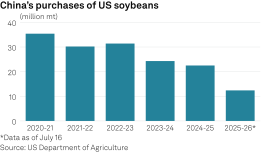
"It is largely impossible to meet China's shipments by selling to other destinations. But the increase is primarily to other Asian nations to meet the shortfall," a trader based in New Orleans said.
A primary positive factor in increasing the sales to Asian markets, including Japan, Indonesia, Taiwan, Pakistan, and Bangladesh, was the trade deals signed earlier this year with the US, market experts said.
Apart from these markets, soybean shipments from the US have increased to Egypt, too, USDA data showed.
"Egypt is a key market for soybeans globally, as it uses the oilseed for its domestic animal feed sector," a trader with a Switzerland-based multinational farm trading firm said.
Trade flow shifts to new markets
Amid the drop in shipments to China, US exports have been able to sell an additional 3.3 million mt of soybeans to different nations as of July 16, according to the USDA.
Most of these exports were spurred by trade deals signed by the countries with the US, US-based traders said.
On Oct. 28, 2025, the US announced that Japan would purchase $8 billion worth of agricultural products, including soybeans. Following the commitment, Japan has booked 2.3 million mt of US soybeans, up 10.2% year over year, for MY 2025-26, USDA data showed.
The US and Indonesia signed a trade deal in July 2025, with Indonesia agreeing to increase farm imports. Indonesia hiked its commitments to buy US soybeans by 19.8% year over year to 2.4 million mt, as of July 16, for MY 2025-26, according to the USDA.
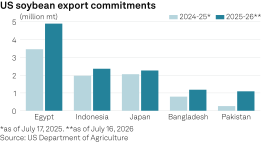
Bangladesh signed a trade deal with the US and agreed to purchase $3.5 billion worth of US agricultural products. Bangladesh has booked 1.2 million mt of US soybeans so far in MY 2025-26, up 49% year over year, USDA data showed.
So far in MY 2025-26, Egypt's purchase commitments for US soybeans have increased 41.6% year over year to 4.9 million mt, USDA data showed.
"While Egypt does not have a deal in place, they are increasing their purchases for domestic feed demand," a US trader based in Ohio said.
Pakistan's plant protection department removed the ban on imports of genetically modified crops, helping raise US soybean shipments to the Asian nation, the USDA said. So far in MY 2025-26, Pakistan increased its commitments by 317.9% to 1.1 million mt, USDA data showed.
US traders cautious of China purchases
US soybean traders have kept a close watch on China's purchases; however, they are not too optimistic.
China suspended US soybean purchases for nearly five months from June 2025 amid trade tensions between the two countries and opted for Brazilian soybeans, according to US-based soybean traders. While China resumed imports of US-origin soybeans in late October 2025, its imports have remained subdued, USDA data showed.
For MY 2026-27, China has made advance commitments to purchase 2.4 million mt of US soybeans, according to the USDA.
China also levies an additional 10% import duty on US goods, introduced in response to Trump's April 2025 tariffs.
"The additional duty on US soybeans is making exports uncompetitive against the Brazilian crop," another Ohio-based soybean exporter said.
US-based traders are not very optimistic about China hiking its purchases of US soybeans to 20 million mt in 2026, as US President Donald Trump announced in February following a conversation with Chinese President Xi Jinping.
"The overall purchases so far have been very low. At this level, we do not expect China to increase its purchases to that level," a trader with a US-based multinational agricultural trading company said.
The US is expected to harvest 115.99 million mt of soybeans in MY 2025-26, down 2.6% year over year, the USDA said.
For MY 2026-27, the US is likely to harvest 120.7 million mt of soybeans in MY 2026-27, up 4.1% year over year, the USDA said.
The USDA has also forecast soybean shipments from the US at 45.18 million mt in MY 2026-27, up 9.2% year over year.
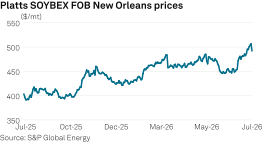
Platts, part of S&P Global Energy, assessed SOYBEX FOB New Orleans at $491.91/mt on July 27, up 21.4% year over year.
