Agriculture, Oilseeds
July 28, 2026
Record Brazilian soybean supply meets record demand as prices reach multiyear highs
Editor:
HIGHLIGHTS
Brazil soybean demand keeps pace with record harvest
Prices stay resilient despite record soybean crop
Brazil harvested its largest soybean crop on record in the 2025-26 season, with production exceeding 180 million metric tons, according to S&P Global Energy CERA estimates, yet prices remain remarkably resilient.
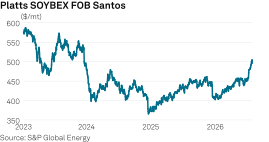
Instead of buckling under abundant supply, Brazilian soybean values have climbed to multiyear highs. Sources attribute this strength to a combination of robust export demand, expanding domestic processing, limited farmer selling and weather support from the US market.
The latest projections from Abiove, the Brazilian Association of Vegetable Oil Industries, highlight strong demand across the soybean complex. The association recently raised its forecast for Brazilian soybean exports in 2026 to a record 115.4 million mt, while also increasing its crushing estimate to an all-time high of 63.3 million mt. Higher exports and stronger domestic processing are expected to tighten available supplies, leading Abiove to reduce its ending stocks projection despite little change to production estimates.
Brazil's export program has continued at a robust pace. According to the Brazilian grain exporters' association, ANEC, soybean shipments in July are projected to reach 12.49 million mt, up 4.6% from July 2025. This would set a monthly record and push cumulative 2026 exports 6.3% above the same period a year-earlier, thereby absorbing a large share of the harvest.
At the same time, many market participants report uneven farmer selling in Brazil. With CBOT soybean futures trading at higher levels in recent weeks, producers have shown little urgency to market their remaining old-crop inventories, reducing spot availability and supporting export market values. The tighter commercial flow has coincided with rising international benchmarks, further strengthening FOB prices.
Export values have responded accordingly. Platts assessed the SOYBEX FOB Santos soybean contract for September loading at $504.24/metric ton on July 24, marking the highest spot value in more than two-and-a-half years. Market participants reported active interest for both old-crop and new-crop shipments, particularly in the FOB Paranaguá paper market, where trading activity has concentrated on February-March 2027 positions.
Chinese demand has also supported the market, though buyers have recently become more cautious, sources said. Trading activity in the CFR China market slowed as higher Brazilian soybean prices and weaker domestic crushing margins reduced buying appetite. Nevertheless, cargoes from both Brazil and the US continued to trade, as China still maintains substantial forward demand coverage requirements for the coming months.
Meanwhile, weather concerns in key US growing regions have provided additional support to CBOT soybean futures, analysts said. The rise in futures has lifted export values across major origins, including Brazil, helping offset the bearish implications of record supplies. As a result, Brazilian FOB prices have remained firm despite the country's unprecedented crop size.
The result is an unusual market dynamic, with record production being met by record demand. Strong exports, expanding crush capacity, slow farmer selling and weather-driven support from Chicago have combined to prevent the large crop from weighing on prices. For now, the market's focus remains less on how much soybeans Brazil has produced and more on how quickly the world continues to consume them.
Platts is part of S&P Global Energy.
