Agriculture, Meat
July 23, 2026
Imported beef prices stall as traders await China supply shift

Editor:
HIGHLIGHTS
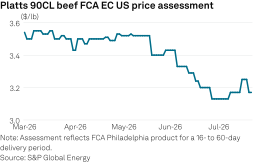
Import 90CL beef holds at $3.17/lb steady
South American supply redirects from China
Australian drought threatens price pressure
Imported 90CL beef in Philadelphia assessment remained unchanged day over day, as buyers held back amid weak spot demand and expectations of redirected supply from Argentina and Brazil.
Platts, part of S&P Global Energy, assessed imported 90CL beef FCA East Coast, basis Philadelphia, for 16- to 60-day delivery at $3.17/pound July 22, unchanged day over day but down 8 cents/lb week over week and 3 cents/lb month over month, as limited spot demand and expectations of redirected supply weighed on sentiment.
The assessment reflects 90% chemical lean beef, FCA Philadelphia, with terminal handling charges, customs fees and tariffs included. The market commonly refers to the basis as FOB port-of-entry, Philadelphia.
Argentina-origin product was heard as the most competitive in the FCA Philadelphia market, with buyers reluctant to step in aggressively while monitoring potential pressure from beef redirected from China to the US following safeguard-related trade disruptions.
"A lot of people originally went in and bought at that $3.17 level [for 90CL, FOB port-of-entry, South American origin], and now we're stuck holding because these buyers are long on me," a US beef trader said. "I think that the Brazilian and Argentine product will sell well south of three dollars here in the next few weeks."
Market participants said the port-of-entry market had been supported in prior weeks by buyers covering short positions after a fire at a Los Angeles cold storage facility, as well as the US Department of Agriculture's school lunch contract bookings. By July 21, buyers had largely stepped back, waiting to see whether China-related trade flows would push additional product into the US market.
"There is little demand," a US beef trader said. "Buyers are waiting, just using the inventory they already have."
"People [are] holding back due [to] the tariffs in China," the trader said.
A second US beef trader said selling remained difficult in the current environment. "I am trying to [sell] something, but the situation is very difficult," the second the trader said.
A US beef importer said values remained hard to pin down after recent buying interest.
"[Import beef] prices are all over the board right now," the importer said. "We had a pump last week, but it could be due to the USDA booking their school lunch contract."
Argentina has been more competitive than Brazil-origin product after an increase in its quota allowance from 20,000 metric tons/year to 20,000 mt/quarter, which has reduced tariff exposure for in-quota shipments. However, market participants said the benefit may be temporary if quota availability tightens.
"An Argentinian exporter told me they have already exhausted their Q3 quota," a Central American beef exporter said. "They are already offering beef out of the quota, which should support prices for other origins."
Broader international supply pressure also weighed on sentiment, with participants pointing to Brazil and Australia as potential sources of lower-priced lean beef.
"There is downward pressure from Brazil and Australia," the Central American beef exporter added. "Other countries are seeing a bit of interest from China, since they currently have available quotas."
"The markets are very quiet, and we expect more downside to this market," a global beef trader said. "With the El Niño in full swing, this might be the catalyst for markets to change."
The global beef trader said dry weather in Australia could increase cattle marketing and put upstream pressure on cattle and beef values.
"Drought will cause more cattle to be sent to the market here in Australia, and the processors won't have the capacity to keep up," the global beef trader said. "Cattle prices will drop, as will raw material and primal cuts."
The trader said a sharper decline had "yet to happen," but added that outside of China and South Korea returning more actively to the market in September, "I don't see anything changing in the short-to-medium term."
Domestic supply declines
Meanwhile, the US domestic lean beef supply remained limited, providing some underlying support to imported 90CL values.
Through July 18, US cow and bull slaughter — the main source of domestic lean beef — totaled an estimated 2.867 million head, down 4.6% from the same period in 2025 and 16.1% below the comparable period in 2024, according to USDA Daily Livestock and Poultry Slaughter and Weekly Actual Slaughter reports.
For the week ended July 18, cow and bull slaughter was estimated at 98,000 head based on accumulated daily data, up 6.5% from the previous week and 2.2% above the prior six-week average. However, slaughter was down 3.4% from the corresponding week in 2025 and 18.5% below the same week in 2024.
