Fertilizers, Chemicals, Agriculture, Maritime & Shipping, Meat, Grains
March 30, 2026
FACTBOX: Middle East war threatens food security in Gulf countries
By Sampad Nandy and Lalita Avd
Editor:
HIGHLIGHTS
GCC countries import up to 85% of their food
Fertilizer prices may rise 15%-20% in H1 2026: FAO
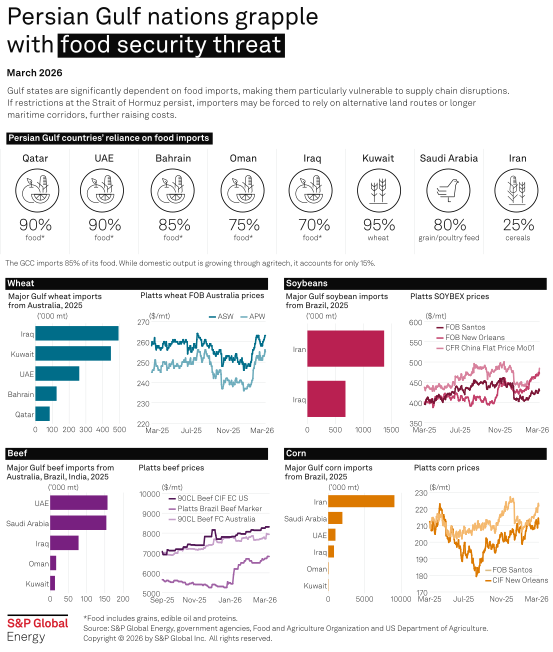
The war in the Middle East could threaten food security in countries neighboring the Persian Gulf, which are largely dependent on imports, including animal protein and other agricultural commodities.
The Gulf Cooperation Council countries import up to 85% of their food, according to the World Economic Forum.
The UN Food and Agriculture Organization has warned that disruptions to the Strait of Hormuz trade corridor are triggering one of the most severe shocks to global commodity flows in recent years, with significant implications for food security and agricultural production.
The Middle East also exports a significant quantity of fertilizers. FAO projections indicate that global fertilizer prices could rise 15%-20% in the first half of 2026 if the crisis persists.
Infrastructure
- According to S&P Global Commodities at Sea, 12 vessels passed through the Strait of Hormuz during March 28-29, compared with a daily average of 135 ships in February.
- Disruptions to traffic through the Strait of Hormuz have resulted in ships waiting offshore, rerouted shipments, and the introduction of war-risk surcharges on new bookings, according to traders.
- One alternative route recently adopted to reach Saudi Arabia and Jordan is via the Bab al-Mandab Strait, which offers access to the Red Sea and onward to the eastern coast of Saudi Arabia, said Ricardo Santin, president of the Brazilian Animal Protein Association, or ABPA.
- To reach Dubai, shipping companies are increasingly using the Port of Salalah in southern Oman, from where cargo can be transported overland to the city, according to Santin.
- Additionally, a third routing option has emerged, with shipments delivered to the Port of Khorfakkan on the UAE's eastern coast before proceeding to their final destinations, Santin said.
- Chicken exporters have said shipments to Saudi Arabia can be rerouted via the Cape of Good Hope in southern Africa, which, while longer and more expensive, offers a safer alternative. Some traders are also redirecting shipments originally bound for Middle Eastern countries to other markets.
- About 30%-40% of Brazil's beef exports could be disrupted by the Middle East conflict, Roberto Perosa, president of the Brazilian Beef Exporters Association, said.
- The region plays a critical role as a transit hub for Brazilian beef shipments bound for Asia, with ports in Bahrain, Qatar, Oman, and the UAE serving as stopovers, where cargo is redistributed to markets such as China, the largest importer of Brazilian beef, according to Perosa.
- War-risk surcharges of up to $4,000/container have further raised export costs, according to some exporters.
Trade
- Gulf countries depend on food exporters, including Australia, Russia, Brazil, and Ukraine, to meet their requirements, such as wheat, corn, beef, and poultry.
- In 2025, countries around the Persian Gulf imported over 1.4 million metric tons of wheat from Australia, a 40% increase year over year, according to the Australian Bureau of Agricultural and Resource Economics and Sciences.
- In 2025, Russia, the world's largest wheat exporter, supplied 7 million mt to Middle Eastern countries, according to CAS.
- Ukraine, a major wheat exporter in the Black Sea region, shipped 954,252 mt to the Middle East in 2025, data from the State Customs Committee of Ukraine showed.
- The EU exported 1.44 million mt of wheat to Saudi Arabia in the 2025-26 marketing year (July-June) as of March 22, according to the European Commission.
- In 2025, Brazil sold 12.9 million mt of corn to Gulf countries, nearly double the 6.6 million mt in 2024, data from Brazil's Foreign Trade Secretariat, or SECEX, showed.
- Ukraine shipped 1.12 million mt of corn to the Middle East in 2025, according to the State Customs Committee of Ukraine.
- In 2025, India exported 277,974 mt of beef to Gulf nations, down 19.5% year over year, data from the Agricultural and Processed Food Products Export Development Authority showed.
- Australia exported 37,804 mt of beef to Gulf nations in 2025, up 12.9% year over year, according to ABARES.
- Gulf nations imported 125,947 mt of beef from Brazil in 2025, down 37.4% year over year, SECEX data showed.
- Brazil-origin chicken exports to the UAE rose 13.5% year over year to 88,398 mt over January-February 2026, while those to Saudi Arabia increased 6.3% to 67,526 mt, according to SECEX.
- In 2025, the UAE imported 480,036 mt of Brazilian chicken, while Saudi Arabia purchased 397,910 mt, SECEX data showed.
- S&P Global Energy CERA forecasts that the Middle East will export 10 million mt of nitrogen in 2026, accounting for 23.4% of global outflows. CERA projects that the Middle East will export 23 million mt of urea this year, accounting for 38.5% of global outflows.
Prices
- Platts, part of S&P Global Energy, assessed chicken breast CIF Middle East at $2,700/mt on March 30, up 14.4% from Feb. 27 before the conflict began.
- Platts assessed the Brazil beef marker at $6,911/mt on March 30, up 3.5% from Feb. 27. Platts assessed 90CL beef FCA Australia at $8,210/mt on March 30, up 5.3% from Feb. 27.
- Platts assessed APW wheat FOB Australia at $265/mt on March 30, up 2.3% from Feb. 27. Platts assessed ASW wheat FOB Australia at $259/mt on March 30, up 2.8% from Feb. 27. Platts assessed Milling Wheat Marker at $239/mt on March 30, up 2.6% from Feb. 27.
- Platts assessed Ukraine corn FOB Black Sea at $227.5/mt on March 30, up 2.5% from Feb. 27. Platts assessed Brazil corn FOB Santos at $220.56/mt on March 20, up 0.3% from Feb. 27.
