LNG, Natural Gas, Agriculture, Chemicals, Metals & Mining Theme, Grains, Polymers, Non-Ferrous, Meat
January 20, 2026
COMMODITY TRACKER: 5 charts to watch this week

By Staff
Winter cold snaps are tightening European gas storage and causing shifts in pricing and supply dynamics. Meanwhile, Indonesia's nickel output cuts create uncertainty, and Brazil's poultry exports thrive under a new EU agreement.
1. Winter cold snap drives European gas dynamics
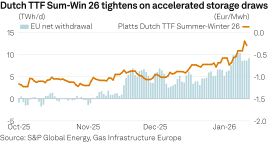
What's happening? Cold snaps across Europe have triggered elevated gas storage withdrawals, with reserves now over 12 percentage points lower year-on-year, according to data from Gas Infrastructure Europe. Following the downward revision of weather forecasts and increased geopolitical tensions, the Dutch TTF month-ahead contract surged above Eur30/MWh for the first time since November 2025, with Platts, part of S&P Global Energy, last assessing the instrument at Eur36.68/MWh on Jan. 19. Meanwhile, the Dutch TTF Summer-Winter 2026 spread flipped to a 37.5 euro cent/MWh premium on Jan. 15, as lower storage levels increased filling needs for the summer season.
What's next? With over two months remaining in the winter season, traders are closely monitoring shifts in weather forecasts and their impact on meeting summer needs, while ongoing geopolitical tensions continue to drive market volatility. However, the anticipated increase in LNG supply coming online is expected to cap the upside.
2. Nickel markets face supply shifts and demand uncertainty
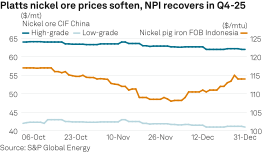
What's happening? Indonesia, the world's largest nickel producer, plans to reduce output in 2026, raising supply concerns. Vale Indonesia announced on Jan. 2 a mining halt due to regulatory delays, further complicating the market. According to Chinese customs data, nickel ore imports to China plummeted 28.7% month-on-month to 3.34 million metric ton in November 2025, with the Philippines remaining the top supplier. Platts assessed high-grade nickel ore at $63/wet metric ton and low-grade at $42/wmt on Jan. 19. Nickel pig iron prices rebounded since early Q4, with Platts assessing at $129.3/mtu FOB Indonesia on Jan. 19.
What's next? S&P Global Energy CERA analysts project a nickel market surplus in 2026. While supply cuts may support prices, subdued stainless steel demand in China could limit gains. Ongoing developments in Indonesia and downstream restocking trends will be key for price direction in Q1.
3. Chinese LDPE prices rise amid Iran supply concerns
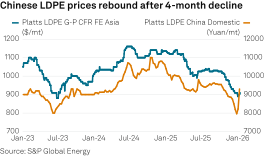
What's happening? Chinese domestic low density polyethylene prices have rebounded after four months of consecutive decline, driven by concerns over the unrest in Iran. Platts assessed Chinese domestic LDPE up Yuan 1,080/mt week over week on Jan. 15 at Yuan 9,300/mt ex-works east China, and CFR Far East Asia LDPE up $10/mt at $910/mt. According to Chinese trade data, Iran was the second-largest supplier of LDPE to China in the first 11 months of the year. For HDPE, Iran was the fifth-largest supplier in the period.
What's next? Market sources believe the bull run may be short-lived as it has been driven primarily by speculation and shifts in market sentiment, with no underlying support from fundamental demand-supply changes. S&P Global Energy analysts forecast China's LDPE nameplate capacity at 9.44 million mt/year in 2026, exceeding domestic demand of 8.92 million mt/year. Potential supply disruptions from Iran could impact the market, while Chinese LDPE capacity expansions at the end of 2025 and slow demand may further influence price dynamics.
4. Egypt's grain imports shift with market dynamics
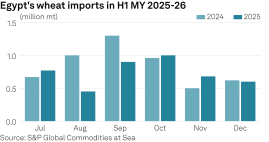
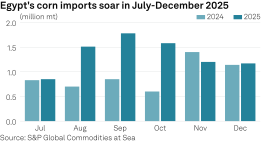
What's happening? Egypt's grain import landscape saw significant shifts in the first half of marketing year 2025-26, with wheat imports falling 13% to 4.4 million metric tons while corn imports increased 47% to 8.09 million mt, according to S&P Global Commodities at Sea data. Russia remained the largest wheat supplier at 2.7 million mt, alongside other key sources like Ukraine, France and Romania. Structural changes, including a new state grain agency and policy restrictions, impacted wheat procurement and trading. Platts, part of S&P Global Energy, assessed its milling wheat benchmark at $228/mt on Jan. 19.
What's next? The US Department of Agriculture projects Egypt's wheat imports at 12.7 million mt and corn imports at 9.5 million mt for the full marketing year. Market participants noted that any recovery in wheat imports will depend largely on global price levels, while corn is expected to see continued demand in early 2026. Traders anticipate gradual shifts in corn sourcing, with a potential return to Ukrainian supplies as shipments from Brazil slow down.
5. Brazil poultry exports gain with EU trade deal
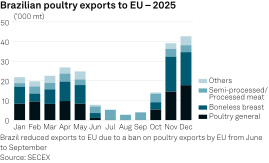
What's happening? After 25 years of negotiations, the EU-Mercosur partnership agreement was signed on Jan. 17 in Paraguay, introducing a new annual tariff-exempt export quota of 180,000 metric tons of poultry over six years. In 2025, EU countries represented 4.3% of Brazil's poultry exports, totaling 231,338 mt, despite a four-month bird flu-related import suspension. The Brazilian Association of Animal Protein celebrated the agreement's potential to increase export opportunities.
What's next? The interim trade agreement is expected to be ratified by the EU in the first half of 2026. While Brazilian exporters are optimistic, European poultry processors have raised concerns about potential market disruption. The Association of Poultry Processors and Poultry Trade in the EU warns that imports could reach 9% of total EU poultry consumption, potentially impacting local producers. Mercosur countries will need to coordinate allocation criteria for the new quota.
Reporting and analysis by Eniayo Adeniji, Roudy Dirani, Farhad Miah, Samantha Beh, Alessa Estorninos, Joenelle Donato, Charlene Goh, Lalita Avd, Augusto Neto
