Agriculture, Energy Transition, Electric Power, LNG, Natural Gas, Refined Products, Biofuel, Renewables, Jet Fuel
January 13, 2026
COMMODITY TRACKER: 5 charts to watch this week

By Staff
Europe imported record volumes of LNG from the US in 2025, with the fuel expected to remain key to the region's gas mix moving forward. In China, used cooking oil prices rebound.
1. Europe's gas market transformed by LNG imports
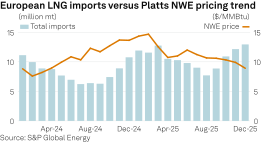
What's happening? Europe's LNG imports reached record levels in 2025, with the US being the leading supplier, accounting for over 77% of imports, according to S&P Global Energy CERA data. Price signals and regional competitiveness influenced cargo flows, while high regasification terminal utilization prompted traders to seek innovative, cost-effective routes, LNG traders based in Europe said. Oversupply widened the LNG-TTF spread, and the narrowing price gap with Asia encouraged more cargoes to remain in Europe. Northwest Europe averaged $11.423/MMBtu over 2025, up from $10.743/MMBtu over 2024, according to Platts data. The Platts DES Northwest Europe marker for February was assessed at $9.144/MMBtu Jan. 9. Platts is part of S&P Global Energy.
What's next? LNG will remain crucial to Europe's gas mix, with imports forecast to peak at 147.74 million metric tons in 2027, S&P Global Energy CERA data showed. Wider LNG-TTF spreads are expected in 2026, possibly prompting pipeline and storage traders to optimize supply, an LNG trader said. Europe's reliance on LNG will persist as the region continues to move away from Russian gas. Additional US supply will drive further changes in pricing and procurement strategies.
2. Simandou iron ore project unlikely to disrupt Pilbara market in 2026
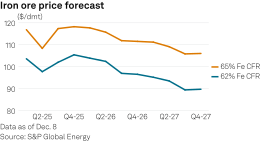
What's happening? The Simandou iron ore project in Guinea is expected to have limited immediate impact on Australia's Pilbara iron ore market in 2026. Logistical constraints and a gradual production ramp-up will restrict the project's market entry, according to market participants who spoke to Platts. Shipments are expected at 15 million mt-20 million mt, and 2027 at 40 million-50 million mt, skewed to the lower end, following the first cargo's delay out of Morebaya. China's iron ore market has been in surplus since 2024 amid sluggish steel demand, even as prices held firm in 2025.
What's next? The immediate price impact looks limited in 2026 at 15 million mt-20 million mt, with CERA analysts expecting IODEX to average around $100/dmt, as Chinese pig iron output drops 1.5%-2% year over year. Oversupply risk rises from 2027 as Simandou ramps up, with CERA analysts seeing a potential 16% price decrease to around $89/dmt by December 2027. With all-in sustaining costs around $55-$60/dmt, some higher-cost seaborne and domestic ore could be pushed out of the market. Simandou's high grade iron ore is expected to be sold largely as mid-grade blends that directly substitute for Pilbara Blend and Vale 62%-63% fines, but for now, Pilbara ore will sustain its competitiveness in China's steel supply chain.
Learn more: Platts IODEX explained
3. Northeastern US power, gas prices increase amid cold snap
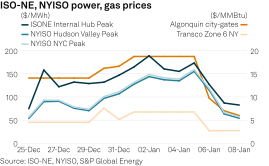
What's happening? Power prices climbed into triple digits across the New England and New York Independent System Operators as 2025 ended, with Platts pricing Jan. 1 delivery at $165/MWh and $127.69/MWh, respectively. Natural gas prices at Algonquin city-gates jumped to $18.76/MMBtu, driven by freezing temperatures that dramatically increased energy demand. The extreme cold pushed ISO-NE's December 2025 peakload demand to an average of 17.50 GW, a 4.4% increase, while NYISO load rose 3.5% to 20.51 GW, highlighting the direct impact of winter weather on regional energy consumption.
What's next? Power prices stabilized through the first week of 2026, with ISO-NE and NYISO power trading near $82.50/MWh and $54/MWh by Jan. 8. The price correction followed warmer temperatures and the expiration of winter weather advisories from the US National Weather Service. The rapid market shifts underscore the critical role of weather patterns in shaping power market fundamentals, demonstrating how supply and demand can quickly respond to temperature fluctuations.
4. China's domestic used cooking oil market shows signs of recovery...
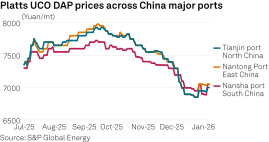
What's happening? China's domestic used cooking oil market is rebounding in early 2026 as producers increasingly supply feedstocks to local sustainable aviation fuel plants. On Jan. 9, Platts, assessed UCO prices at major Chinese ports: Tianjin Port at Yuan 7,000/mt, Nantong Port at Yuan 7,050/mt and Nansha Port at Yuan 7,050/mt. Weak export market demand, particularly from Europe, has pushed sellers to focus on domestic SAF plants, with Chinese SAF producers strategically pivoting to hydrotreated vegetable oil production, capitalizing on profitable margins despite antidumping duties. This strategic shift allows producers to maintain operations and cash flow while awaiting SAF whitelist approval.
What's next? Market activity is expected to pick up before the Lunar New Year, with domestic demand and HVO output likely to remain strong as the price spread between HVO and SAF widens, according to a Chinese UCO producer.
5. ...while RME gains premium over UCOME after Germany's RED III clarification
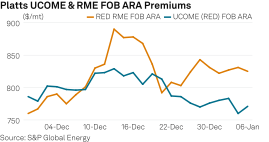
What's happening? Rapeseed methyl ester prices have traded above UCO methyl ester in ARA since Dec. 9, 2025, following Germany's Renewable Energy Directive III legislative clarification. The RME-UCOME spread widened to $54/mt Jan. 6, with Platts assessing FOB ARA RME at an $825/mt premium to ICE LSGO, up $24/mt from Dec. 9, 2025. The German Federal Cabinet's approval of RED III, which removes double-counting incentives for advanced biofuels starting in 2026, has renewed interest in first-generation biodiesel with high greenhouse gas savings.
What's next? Market participants anticipate continued price support for RME in the near term as a winter-spec fuel. In the lead-up to legislative changes, the market had anticipated that the removal of double-counting would create a bullish outlook for renewable diesel in 2026 and that demand for UCOME as a cost-effective alternative would consequently remain strong. With UCOME margins poor, key players are closely monitoring competition for used cooking oil feedstock across UCOME, renewable diesel and the sustainable aviation fuel markets.
Reporting and analysis by Megan Gildea, Clio Ho, Shivam Prakash,Ricardo Plata III, Daryna Kotenko, Chau Kit Boey, Yoke Mae Goh, Uzma Gulbahar
