LNG, Natural Gas
January 05, 2026
Europe's surging LNG imports in 2025 reshape gas supply dynamics: traders
By Megan Gildea and Clio Ho
HIGHLIGHTS
LNG imports surge 30% YOY in Europe in 2025: S&P Global Energy CERA
US dominates as supplier, accounting for 77.53% of imports
LNG-TTF spread widens in 2025: Platts data
Europe's LNG imports in 2025, surpassing volumes seen in prior years, have reshaped the continent's gas supply dynamics, according to LNG traders, as traditional pipeline sources recede and global LNG supply ramps up.
Price signals played a crucial role in determining cargo flows and regional competitiveness, LNG traders based in Europe said.
The region, which includes the UK and Turkey, saw countries seeking flexible supply to replace piped volumes lost from Russia and replenish storage ahead of winter, the traders said.
The US dominated as a supplier in 2025, accounting for 77.53% of the region's imports, up from 57.64% in 2024, according to S&P Global Energy CERA data.
According to Platts data, Northwest Europe averaged $11.423/MMBtu over 2025, up from $10.743/MMBtu over 2024. Across the basin, Platts JKM averaged $12.257/MMBtu in 2025, up from $11.912/MMBtu in 2024.
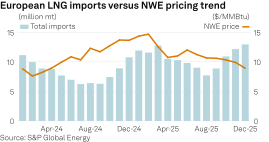
While prices were elevated in JKM relative to Northwest Europe for much of 2025, a tightening JKM-NWE differential weakened incentives to move flexible LNG cargoes toward Asia, encouraging Atlantic basin cargoes to remain in Europe. Platts data showed the JKM-NWE differential at 76.8 cents/MMBtu for 2025, down significantly from the $1.15/MMBtu seen on average for 2024.
More market participants gained access to European regas capacity in 2025 as portfolio suppliers, traders, and utilities competed for slots, Europe-based traders said. Additionally, European LNG arbitrage remained largely closed for much of the year, S&P Global Energy data showed. While Europe continued to attract cargoes, the economics increasingly reflected oversupply rather than scarcity, traders said.
Platts market assessments throughout 2025 showed the LNG–TTF spread widening compared with 2024. In 2025, the discount to TTF averaged 53.8 cents/MMBtu, compared to 26.5 cents/MMBtu in 2024. This divergence can be attributed to the sheer weight of imports, combined with improved storage positions and softer spot demand during shoulder months, Platts data showed.
"In case of more LNG coming, given already high total terminals' utilization, I see traders becoming more 'innovative' and creative in finding the most cost-effective routes to get LNG and gas to the demand," Alija Bajramovic, Principal Analyst at S&P Global Energy CERA.
This will require intra-European hub spreads to adjust accordingly, as well as the premium of some markets increasing further to facilitate those flows, Bajramovic said, adding, "And I agree, the premium of pipeline to LNG will rise as the cost of access to terminals for marginal cargoes will need to rise."
"We may see more relative growth in LNG flows toward Med rather than into NWE, judging by how the forward curve has been evolving last quarter."
"With all this spot supply coming into the market and players trying to get regas capacity in Europe, you will likely see [LNG-TTF] spreads widen out even further in 2026," an LNG trader said.
"One risk for LNG flows I see is that increased spreads will also create incentive for some short-term optimization from the side of pipeline suppliers and storage traders, so they may step in to fill the supply gap unless there is prolonged imbalance on the market," Bajramovic said.
LNG's growing footprint in Europe's gas mix
LNG is expected to play an increasingly important role in Europe's gas supply mix. After the record high LNG imports in 2025, S&P Global Energy CERA forecasts Europe to import 145.36 million mt of LNG in 2026.
Imports are expected to peak at 147.74 million mt in 2027 before falling slightly year over year through 2029, the data showed.
"About half of Europe's gas supply will come from LNG now, we see Europe increasingly relying on it over the next few years to fill the gap in supply as it leaves Russian gas and LNG behind," a second LNG trader said.
Market participants expect LNG to retain a high share of Europe's gas mix and are monitoring closely how additional US volumes entering the market this year will influence TTF differentials, procurement strategies and pricing dynamics.
Platts assessed the DES NWE marker for February at $9.398/MMBtu, a 55-cent/MMBtu discount to TTF on Jan. 2.

Editor: