Natural Gas, Electric Power, Coal, LNG, Crude Oil, Energy Transition, Thermal Coal, Renewables
November 24, 2026
Pakistan’s power mix shift: Distributed solar growth amid grid stagnation
As disruptions from the war in the Middle East affect fuel supplies, Pakistan's electricity sector is shifting from fossil fuel imports toward domestic resources and decentralized solar to meet growing power demand.
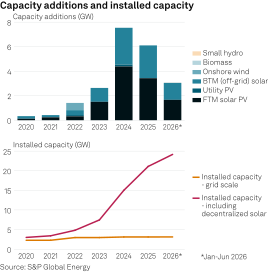
While grid demand has stagnated at about 135 terawatt-hours since 2021, a parallel energy system has emerged: households, businesses and industries have increasingly turned to rooftop and behind-the-meter (BTM) solar installations. By June 2026, solar net-metered and BTM capacity had grown to nearly half of the grid's capacity, according to S&P Global Energy's CERA analysis.
Supported by large imports of solar equipment from China and accelerated by foreign-exchange constraints, this shift toward decentralized generation and domestic fuel sources offers a model for other import-dependent economies navigating energy security challenges.
Grid masks demand growth
Pakistan's grid supplied 60.7 TWh in the first half, only 0.3% higher than the same period a year earlier, according to the National Electric Power Regulatory Authority (NEPRA). Higher coal generation output compensated for declines in output from gas, hydropower and nuclear power plants, according to a CERA analysis. Increased self-consumption by net-metering consumers kept grid demand lower, as solar generation met a growing share of daytime electricity needs,
Inflation, currency depreciation and the foreign-exchange constraints have weakened the country's purchasing power for LNG and imported coal. Electricity retail tariff reforms intended to address circular debt have raised grid-electricity costs, according to CERA. Consumers unable to absorb higher tariffs have reduced consumption, while those able to invest in alternatives have lowered their dependence on utility supply.
Electricity demand is increasingly migrating toward captive generation and decentralized solar, particularly rooftop and BTM systems. This shift is already visible, with non-utility demand rising from about 2 TWh in early 2020 to more than 20 TWh in 2026. Non-utility demand to grow at a 7.2% compound annual growth rate through 2035, increasing its share of total electricity demand from 15% to 20%, according to CERA.
Even as a growing share of demand moves toward non-utility sources, supply constraints continue to weigh on electricity consumption. Fuel shortages and high import costs routinely leave Pakistan unable to meet peak power demand, resulting in widespread load shedding and emergency conservation grids, according to CERA analysis.
Solar expands beyond grid
Pakistan's alternative renewable capacity reached about 24 GW by June, including decentralized solar, according to CERA estimates. More than 3 GW of capacity was added during the first half of the year, driven almost entirely by distributed front-of-the-meter captive and BTM solar systems. In comparison, grid-scale renewable capacity remained broadly stagnant.
Solar adoption is spreading across sectors. Net-metered and BTM systems are being used across urban and rural areas, including by agriculture-based households and industries of different sizes.
Inexpensive Chinese solar imports, declining module costs, high retail tariffs, and grid reliability concerns have strengthened the case for self-generation.
Together, these trends are changing not only how much solar capacity Pakistan has, but also where its electricity is produced and consumed, according to CERA. As rooftop, captive and off-grid systems expand, more solar output will remain outside the utility network and will not be fully captured in grid-generation data.
Non-utility-scale solar capacity will reach nearly 38 GW by 2035, making decentralized solar the principal driver of growth in overall electricity demand, which will exceed 4%, while grid-based demand represents a diminishing share of the market, according to CERA forecasts.
Related content: Decentralized solar PV adoption expected to drive Pakistan's electricity demand in the coming decade; grid supply to remain carefully managed
Fuel disruption drives domestic supply
The centralized system faces a different pressure. Pakistan's LNG imports fell to 1.83 million metric tons during the first half of 2026, nearly 50% below the same period in 2025, according to CERA, as disruption through the Strait of Hormuz reduced Qatari term cargoes. Recovering domestic gas production could not fully replace the lost LNG.
Coal became the grid's immediate shock absorber. Coal-fired generation reached 17.1 TWh during the first half, 34% more than a year-earlier. Local coal generation reached 8.4 TWh, while imported coal output rose to 8.7 TWh, according to NEPRA. The increase stabilized grid supply and moderated exposure to costlier regasified LNG and oil, but grid-emissions intensity increased by 17% year over year.
The immediate response relied heavily on imported coal, but the longer-term direction is different. Expanding coal output from the Thar coalfield in Pakistan's Sindh province, and planned rail connectivity are intended to move local lignite to power plants, including facilities dependent on imported coal, according to CERA analysis.
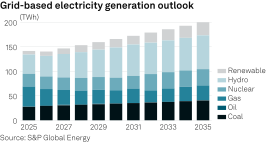
Coal generation is projected to rise from about 27 TWh in 2025 to about 40 TWh by 2035, according to CERA outlook. Further, the share of imported coal-based generation is expected to fall, as the country develops local coal mines. Domestic coal therefore supports fuel security rather than representing the transition's end point.
Related content: Can Pakistan's power sector absorb the loss of all its LNG supply from Hormuz Strait in the coming months?
Hydropower anchors transition
Pakistan's renewable energy transition differs within and beyond the grid. Decentralized solar is driving rapid growth beyond utility supply, while hydropower remains the principal renewable source within the centralized system, according to CERA.
Hydropower generation is projected to increase from about 39 TWh in 2025 to nearly 69 TWh by 2035, according to CERA's generation outlook. Solar, wind and other renewable generation rises from about 7 TWh to almost 27 TWh.
The mix becomes cleaner without immediately becoming fossil-free: coal remains, oil-fired generation exits after 2030 and gas retains a smaller balancing role. The result is lower exposure to imported fuel and foreign exchange.
Hydropower and nuclear power, along with other renewables, increase the role of clean domestic generation through 2035, even as thermal resources continue to support reliability and meet demand when variable renewable output is unavailable, according to CERA.
Integrating the transition
As decentralized solar expands, Pakistan's grid will increasingly serve a different function. Rooftop, captive and BTM systems reduce the electricity consumers draw from utilities during solar-generating hours, while the grid remains necessary for backup and evening supply.
The resulting shift in demand increases ramping requirements and the need for flexible generation, stronger networks and storage. NEPRA's Prosumer Regulations, 2026, which shifted from net metering to net billing with lower buyback rates, reflect efforts to manage the evolving interaction between self-generating consumers and utilities.
CERA's longer-term demand outlook indicates grid requirements are still projected to grow by about 3.6% annually through 2035 as economic activity and suppressed demand return, but non-utility demand will expand faster. The same solar growth that is moving electricity production beyond utilities is therefore also reshaping what consumers require from the grid.
Further reading:
