Electric Power, Coal, Natural Gas, LNG, Energy Transition, Renewables
November 06, 2026
Beyond capacity, Bangladesh faces fuel-security test
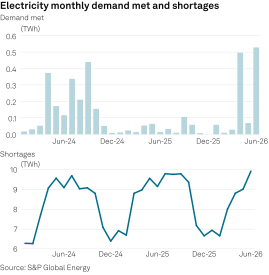
Bangladesh entered 2026 with about 30 gigawatts of installed capacity, implying a 66% reserve margin, according to Power Grid Bangladesh PLC (PGCB) data. As supply constraints worsened in late March amid geopolitical disruptions and limited generation due to plant outages, power shortages reached a three-year high of 1 terawatt-hour despite electricity demand falling 1.5% year over year in the first half.
Plant load factor of gas-fired capacity fell to 48% in H1 from 54% a year-earlier, while coal-fired plants increased from 47% to 54%, according to PGCB data and S&P Global Energy CERA analysis. Together, these trends of declining gas capacity utilization and increased dependence on coal generation highlight a key vulnerability: installed capacity alone cannot ensure reliable supply without adequate fuel security.
Moderating demand amid power expansion
Despite the near-term decline, Bangladesh's electricity demand has a longer-term growth outlook. Over the coming decades, according to the 2026 Power and Energy Sector Master Plan (PESMP), peak demand is expected to increase at a compounded average growth rate (CAGR) of 5% between 2025 and 2050, a slower pace than in the 2023 Integrated Energy and Power Master Plan (IEPMP). Grid electricity demand is expected to grow at a CAGR of about 3.8% between 2025 and 2060, with the domestic and industrial sectors remaining the largest sources of incremental consumption, according to CERA. Efficiency improvements are expected to gradually moderate electricity intensity.
Even with slower demand growth, the power system will expand substantially. Electricity demand is projected to reach about 362 TWh by 2060, while peak demand is projected to reach 62 GW, according to CERA. Installed capacity is expected to triple from about 30 GW in 2025 to 100 GW by 2060. However, the composition of this capacity will change significantly, with the system gradually moving away from its current reliance on gas and oil toward nuclear, solar, storage, and electricity imports.
Fuel security reshapes generation mix
Bangladesh's generation mix is exposed to fuel availability and international price volatility, due to its heavy reliance on imported LNG. Supply disruptions due to the Strait of Hormuz crisis intensified pressure on the power system in early 2026, resulting in shortages.
The capacity mix is dominated by gas and coal, which together accounted for 87% of the total. Renewable capacity continued to represent a relatively small share at 2.6%, with solar photovoltaic (PV) accounting for most of the renewable capacity — 1.5 GW out of 1.8 GW.
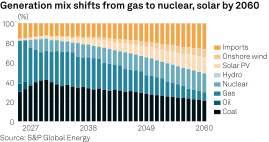
Beyond the next decade, the mix is expected to become more diversified as fuel availability and cost shape the role of different technologies, according to CERA. Declining domestic gas production will constrain gas-fired generation, while reliance on imported LNG exposes the system to international prices and supply disruptions. Coal is expected to remain important through the medium term, supported by Bangladesh's existing fleet and committed projects, although no new coal capacity is assumed after 2046.
Higher utilization of the existing coal fleet is expected in the near term as coal generation increases, while gas capacity factors decline amid shrinking fuel availability. Oil generation is expected to phase out by 2028, as its high cost makes it uncompetitive.
Nuclear power will become a growing source of firm domestic generation from the late 2020s, while electricity imports will remain an important part of the supply mix. By 2060, nuclear, solar and imports are expected to account for more than 60% of generation, according to CERA data.
In the decades following 2026, this shift is expected to reduce reliance on gas and oil, but imported fuels and electricity will continue to leave the system exposed to external supply and foreign-exchange risks.
Related podcast: Asian LNG under pressure: what comes next for prices amid the Middle East conflict?
Renewables emerge as growth area
Solar PV-led capacity additions gained momentum during the first half of 2026, although execution and financing constraints slowed deployment. The government's policy direction points to a gradual diversification of the power mix alongside improvements to transmission and distribution (T&D) infrastructure. The PESMP 2026-2050 targets renewable energy shares of 20% by 2030 and 30% by 2040, prioritizing utility-scale and rooftop solar, wind and storage.
Renewables, which have been a minor contributor, are expected to play a larger role, with solar leading the way. Installed capacity is projected to increase significantly, while storage becomes increasingly important as variable renewable generation grows. This shift is particularly relevant as the country seeks to reduce its exposure to costly fuels, according to CERA.
However, converting the renewable pipeline into operating capacity remains a key challenge. Limited land availability, grid connectivity, lengthy approval processes and difficulties accessing financing can delay project development. The near-term opportunity is not simply to expand the pipeline, but to improve project execution and to ensure that transmission and storage infrastructure develops alongside renewable capacity, according to CERA.
The financial year 2026-27 (July 1-June 30) budget includes incentives such as tax exemptions for solar generation and duty relief on solar and battery storage components to reduce project costs. However, T&D received the bulk of the Power Division's annual development allocation, underscoring the need to strengthen grid infrastructure.
Policy shifts toward diversification, energy security
Recent policy developments indicate that the government is responding to the fuel volatility challenges. The FY 2026-27 budget supports T&D investment, while incentives for solar equipment and generation aim to accelerate deployment. Domestic gas exploration remains a key priority to strengthen near-term fuel security.
The revised PESMP 2026 incorporates a more streamlined investment pathway, increasing the role of renewables, nuclear, storage and regional electricity trade to diversify the power system. However, the pace of the transition will depend on Bangladesh's ability to address fuel security, financing, grid and project-execution constraints.
As demand grows, Bangladesh should prioritize improving the availability and utilization of its existing fleet, while also strengthening fuel security and grid infrastructure. Maintaining adequate fuel supplies and continuing electricity imports as cross-border relations improve could help mitigate shortages. Raising PLFs where feasible could enable the existing fleet to meet demand more effectively. Future investment decisions should consider not only how much capacity is added, but also how reliably it can generate electricity at an affordable cost.
Further reading:
Bangladesh Gas and Power Market Briefing: H1 2026
Bangladesh Power Demand and Supply Long-Term Outlook, September 2026
This article contains data, views and forecasts from S&P Global Energy CERA analysts and does not represent reporting by Platts, part of S&P Global Energy.
