Electric Power, Energy Transition, Renewables
July 31, 2026
India's power and renewables market: Q2 brings record demand, rising curtailment
India's power sector during April-June was shaped by robust electricity demand growth and rapid renewable energy expansion. El Niño-driven heat waves boosted power consumption 13.2% year over year, according to Central Electricity Authority (CEA) data, while renewable capacity additions reached 13.25 gigawatts.
Although higher renewable generation helped meet rising demand, continued renewable curtailment highlighted ongoing challenges in grid integration, transmission infrastructure and system flexibility. Meanwhile, coal-fired generation increased to 361 terawatt-hours in the April-June period, up 8.4% year over year, supporting system reliability during peak demand and underscoring the continued role of conventional power in maintaining grid stability amid the energy transition.
El Niño-driven heat waves boost energy demand
Electricity demand during April-June increased by 13.2% year over year to 483 TWh, up from 427 TWh in the same period of 2025, and rose 14.6% quarter over quarter, according to CEA data. Reflecting increased consumption, India's peak power demand reached a record 271 GW during the quarter, up 11.6% year over year, according to CEA data. The strong demand growth was driven primarily by higher cooling requirements amid El Niño-induced heat waves across much of the country, according to S&P Global Energy CERA analysis.
While electricity demand growth was subdued in January-March, rising only 2% year over year due to milder winter conditions and weaker-than-expected industrial activity amid the Strait of Hormuz crisis, demand rebounded sharply in April-June. The strong growth during the second quarter drove electricity demand growth for January-June to 7.6% year over year, according to CEA data.
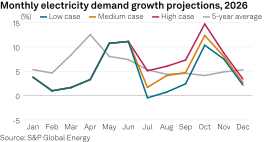
CERA forecasts electricity demand growth of 5.6%-7.6% during July-December. The upper-end growth scenario of 7.6% reflects the potential impact of El Niño-driven extreme weather conditions. Specifically, this high-demand case assumes a weaker-than-normal monsoon during July-September due to El Niño, followed by colder and more severe winter conditions during October-December, both of which are expected to increase electricity consumption.
Renewables drive capacity expansions
India's installed power capacity reached 549 GW by June, up 13.2% year over year from 485 GW, according to CEA data. Renewable energy remained the primary driver of capacity growth, accounting for 13.25 GW of the 16.2 GW added during April-June. As a result, installed renewable capacity increased to 236.5 GW in June, representing growth of 28.1% year over year and 5.9% quarter over quarter.
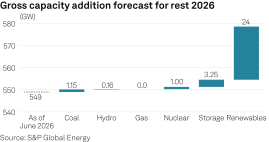
India is expected to add 29.6 GW of new capacity between July and December, with renewable energy accounting for 24 GW. As of June, India has an active pipeline of 23.4 GW of coal capacity. Of this, only 1.2 GW is expected to come online between July and December, according to CERA.
Other conventional capacity additions are projected at 0.2 GW of hydroelectric power, 1.0 GW of nuclear power and 3.3 GW of energy storage systems. High additions in renewables are driven by the rapid commissioning of solar photovoltaic (PV) projects in the later stages of the pipeline, according to CERA's analysis.
Generation mix shifts amid strong demand
During April-June, renewable generation rose by more than 26% year over year to nearly 98 TWh, driven by rapid capacity additions and strong availability of renewable resources, according to CEA data. This increase enabled renewables to capture a larger share of the overall generation mix.
For the January-June period, total electricity generation increased 6.1% year over year to 976 TWh. Renewable generation rose 23.7% to 173 TWh, lifting its share of the generation mix to 18% from 15% a year-earlier.
Strong electricity demand during El Niño-induced heat waves supported higher conventional generation, with coal-fired output increasing 8.4% year over year to 361 TWh during April-June, according to CEA data. For January-June, coal generation increased by 3.4%, according to CERA.
Nuclear generation rose 12.7% year over year to 16 TWh during April-June and increased 11.5% for the January-June period, according to CEA data.
In contrast, gas-fired generation fell by about 25% year over year to 7 TWh as gas supply constraints linked to the ongoing West Asia conflict continued to weigh on output, according to CEA data. For January-June, gas-fired output fell 15% year over year to 12 TWh, according to CERA.
Hydroelectric generation declined 6.6% year over year to 37 TWh, primarily due to lower reservoir levels from below-normal rainfall associated with El Niño, according to CEA data.
Power exchanges gain market share
Alongside changes in the generation mix, India's electricity trading market continued to deepen during April-June. Electricity traded through the country's three power exchanges — Indian Energy Exchange (IEX), Power Exchange India Ltd. (PXIL) and Hindustan Power Exchange Ltd. (HPX) — reached about 49.3 TWh during the quarter, equivalent to about 10.2% of India's total electricity demand, according to CERA.
While IEX remained the dominant platform, its market share declined to 75.15% from 82.68% a year-earlier, reflecting intensifying competition from PXIL and HPX. PXIL increased its share of traded volumes to 18.91%, while HPX accounted for the remaining 5.94%.
The term-ahead market saw increased liquidity, rising 60% year over year to 16.7 TWh in April-June, up from 10.5 TWh in 2025, according to CERA.
For overall volumes traded on power exchanges, April-June saw robust growth of 13.4% quarter over quarter and 27.2% year over year, supported by rising open access participation and greater emphasis by distribution companies on optimizing power procurement costs through exchange-based trading, according to CERA analysis.
Renewables' mixed momentum
Despite strong growth in renewable generation, activity in associated renewable energy markets was more mixed. In the renewable energy certificate (REC) market, trading activity weakened sharply during April-June, with trade volumes declining 71% year over year to 3.2 million certificates. The steep drop in market activity supported firmer pricing, with average REC prices increasing 4% year over year, driven by tighter certificate availability and resilient demand, according to REC trading data reported by Indian power exchanges.
On a broader basis, January-June REC trading volumes declined 27% year over year, reflecting continued weakness in market activity during the first half of the year.
Renewable energy procurement activity also remained subdued. During April-June, 4.5 GW of renewable energy capacity was awarded through competitive bidding, marking a 5% year-over-year decline and underscoring a slowdown in tendering activity. As a result, capacity awarded during January-June totaled just 12.1 GW, reflecting a 12.3% decline compared to the same period the previous year. indicating weak procurement momentum across the first half of the year.
The slowdown reflects growing caution among procurers as curtailment risks and integration challenges become more pronounced. Curtailment accounted for 1.29% of total variable renewable generation during the April-June period, according to National Load Despatch Centre (NLDC) data.
Renewable energy curtailment rose sharply by about 138% year over year to 557 GWh, up from 234 GWh, indicating that while seasonal demand provided some support, underlying grid integration and flexibility challenges remained unresolved.
Path forward
India's power sector faces a delicate balancing act. The country must sustain renewable capacity additions while simultaneously investing in transmission, storage and grid flexibility to ensure a reliable electricity supply.
The sector has proven it can deploy renewable capacity at record speed, adding 29.5 GW in January-June alone, up 33% from the same period a year-earlier. The harder challenge now is building the ecosystem to effectively utilize that capacity.
Further reading: India Power and Renewables Market Briefing: Q3 2026
This article contains data, views and forecasts from S&P Global Energy CERA analysts and does not represent reporting by Platts, part of S&P Global Energy.
