Energy Transition, Renewables, Emissions, Carbon
January 21, 2026
ET Highlights: EU hydrogen auction fallout, India debates energy transition, California EV sales plunge
Energy Transition Highlights: Our editors and analysts bring together the biggest stories in the industry this week, from renewables to storage to carbon prices.
Top story
European hydrogen industry digests failure of second EU auction
The bulk of renewable hydrogen projects that were offered subsidies under the second European Hydrogen Bank auction failed to sign final grant agreements, leaving most of the European Commission funds unallocated and the EU far short of the electrolysis capacity it had hoped to deliver under its flagship funding mechanism.
The second auction secured just 380 MW of electrolysis capacity, compared with the 2.3 GW initially awarded, and the final grant from the European Commission’s Innovation Fund amounted to less than a quarter of the original budget. The EC signed contracts worth Eur271 million, far below the Eur1.2 billion initial budget, and the almost Eur1 billion initially allocated to winners.
Only six projects signed grant agreements, the EC said on Jan. 20, down from the original 15 awarded last May. And the final list includes just two of the 10 reserve projects invited for funding after seven of the original winners withdrew ahead of a deadline to commit a bank completion guarantee.
Companies that have withdrawn from the process cited the inflexibility of the auction mechanism and the uncertain market outlook as major drivers.
Benchmark of the Week
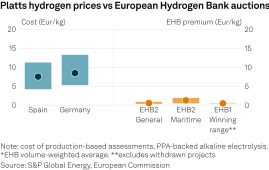
85 euro cent/kg (US 99 cents/kg)
The final clearing price for the general category of the second European Hydrogen Bank auction, compared with Platts cost-of-production assessments of Eur7.60/kg in Spain.
Learn more: Platts Carbon Markets Specifications Guide
Editor's Picks: Free and premium content
SPGlobal.com
IEW 2026: India deliberates energy transition next steps after landmark year
India is set to deliberate on the next steps for its energy transition after a pivotal year in which it tendered major renewable hydrogen/ammonia projects and added its highest-ever renewables capacity, pushing non-fossil fuels to over 50% of its installed power mix. At India Energy Week 2026 in Goa on Jan. 27-30, policymakers will share the stage with company heads and technology providers to outline India's priorities, offering a clearer view of how the country plans to accelerate clean fuel deployment.
Bio-naphtha, SAF economics drive waste-carbon palm oil substitute interest
Efforts to decarbonize aviation cannot rely solely on sustainable aviation fuel, and balancing fuel and chemical production will be crucial to improving project economics and scaling low-carbon pathways, LanzaTech's CEO Jennifer Holmgren told Platts. LanzaTech is pivoting to bridge the widening gap in SAF feedstocks by developing a synthetic palm oil substitute that could unlock a new, deforestation-free route to the hydroprocessed esters and fatty acids pathway.
S&P Global Energy Core
RWE, ITM Power to start second 100-MW hydrogen unit at Lingen, Germany, in 2026
ITM Power will start test operations at a second 100-MW renewable hydrogen production plant at RWE’s Lingen site later in 2026, following the ramp-up of the first phase currently underway, the electrolyzer manufacturer said on Jan. 22. The proton exchange membrane electrolyzer is the first part of the 300-MW GET H2 Nukleus project, and will supply hydrogen to TotalEnergies’ Leuna refinery in Germany.
Australia offers feasibility licenses for 4 GW offshore wind projects
Australia has offered feasibility licenses to three offshore wind projects in Western Australia that could deliver around 4 GW of renewable electricity capacity, the government said, marking a significant step forward for the emerging offshore wind industry. The licenses were awarded to Bunbury Offshore Wind for two projects and Westward Wind for one project, all located in the Bunbury offshore wind zone off Western Australia's coast, according to a statement from Energy Minister Chris Bowen and Assistant Minister Josh Wilson.
California Q4 electric vehicle sales fall 27% year over year: CEC
California, the state with the largest electric vehicle market in the US, saw a sharp decline in sales in the fourth quarter of 2025, capping off a year of bearish federal policy movements with the lowest quarterly sales count since 2022, data released by the California Energy Commission showed. Combined plug-in hybrid and battery electric EV sales in the state fell 27% year over year, according to Q4 data released on Jan. 20.