Electric Power, Natural Gas, Energy Transition, Coal, LNG, Renewables
August 25, 2026
Global gas turbine demand enters new growth cycle
The global gas turbine market has entered its most significant expansion phase in more than two decades. After years of modest growth, orders surged past 100 GW in 2025, according to S&P Global Energy data and McCoy Power Reports, making it the second-strongest year on record, behind the peak of the merchant power boom in the early 2000s.
While the recent rebound has been led by the US, the longer-term outlook is increasingly defined by growing power demand, renewable integration needs, and energy security priorities across Asia-Pacific and the Middle East.
Electricity demand is rising faster than many power systems can deploy firm capacity. Data centers, industrial electrification, population growth and renewable energy expansion are all driving demand for fast, reliable generation that can complement variable wind and solar resources.
North America is dominating this decade, with an 85 GW gas project pipeline expected online through 2030, according to S&P Global Energy CERA power outlooks, but the center of gravity shifts over time. New gas-fired capacity additions are expected to peak at 96 GW in 2030 on the back of US demand, after which Asia, the Middle East and Africa drive the majority of capacity additions, stabilizing at around 60 GW annually through the mid-century.
Some risk to the exact timing of this outlook remains. Slow interconnection and permitting processes remain a barrier in many parts of the globe, and the boom itself has driven new gas plant costs well above prior levels. The demand outlook driving much of the US boom is itself uncertain, as the rapid expansion of US data centers faces intensifying local and state-level resistance.
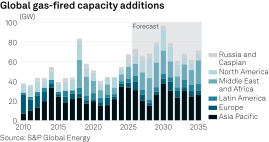
North American deployments and interconnection strategies
US gas turbine orders in 2025 reached levels last seen during the merchant power boom in the early 2000s, as manufacturers booked 51 GW of heavy-duty gas turbine orders. Over the past 20 years, orders averaged below 10 GW/year.
Of the 85 GW of gas-fired projects expected to reach commercial operation by 2030, the majority are in ERCOT, MISO and SERC. Developers are increasingly prioritizing speed-to-power, favoring simple-cycle and 1x1 combined-cycle configurations that can be developed faster than traditional large-scale power plants. To bypass lengthy interconnection timelines, operators are also deploying behind-the-meter and colocated facilities.
China uniquely focused on very large combined cycles
China's gas fleet is expected to expand from roughly 164 GW in 2025 to 270 GW by 2035, supported exclusively by continued additions of large combined-cycle gas turbine projects. Gas remains largely focused on coastal areas, supporting larger coal and renewable fleets.
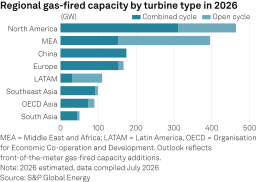
Rising renewable penetration is boosting demand for system flexibility, but Chinese planners continue to favor highly efficient combined-cycle units rather than large-scale deployment of open-cycle peaking plants, diverging from other countries' procurement trends.
Annual additions are expected to moderate after 2026 as higher gas prices and ongoing competition from coal influence investment decisions. The gas generation share remains quite small – growing from 3.2% in 2025 to 3.8% in 2035.
Middle East and Africa: The long-term growth story
The Middle East may define the next growth cycle, even more so than North America. The region's gas-fired capacity is projected to grow from 385 GW in 2025 to 530 GW by 2035, supported by a combination of fuel switching, population growth and industrial expansion.
Saudi Arabia is leading this transition through its Liquids Displacement Program, making low-cost domestic gas the preferred source of flexible capacity, replacing oil-fired generation. Large-scale competitive procurement programs are accelerating project development. While Saudi Arabia's tenders have favored combined cycle units for speed to power, other Gulf countries such as Oman and Qatar are driving investments in open cycle turbines to maintain system reliability.
Asia-Pacific's appetite for new turbines
Outside China, Asia-Pacific presents one of the most diverse gas turbine opportunities globally. Southeast Asia is emerging as the region's leading growth engine, with Indonesia, Malaysia, the Philippines and Vietnam expected to add approximately 20 GW of new gas capacity through 2030, even as Singapore and Thailand retire almost 7 GW of older plants.
Power consumption is rising across the region as economies industrialize and digital infrastructure expands. At the same time, renewable deployment is accelerating, creating a growing need for flexible thermal generation that can balance variable output.
High LNG import costs present a substantial risk for new baseload capacity, but gas continues to play a critical balancing role.
Manufacturing capacity expansion supports the new growth wave
The market for new gas turbines is being shaped by new sources of demand – data centers, electrification and industrial growth – alongside a massive surge in renewable investment. The industry is responding through expanded manufacturing capacity, adoption of highly efficient H/J-class turbines and increased interest in fast-to-deploy configurations.
Original equipment manufacturers' expansion plans could increase annual turbine production capacity by roughly 30% by 2030 according to S&P Global Energy CERA's data, helping alleviate current supply bottlenecks. While the US is driving awards this year, additions will continue to grow through 2030 alongside growing demand in China, the rest of Asia-Pacific and the Middle East.
Further reading: Global gas turbine market report
This article contains data, views and forecasts from S&P Global Energy CERA analysts and does not represent reporting by Platts, part of S&P Global Energy.
