Energy Transition, Electric Power, Agriculture, Carbon, Emissions, Meat, Vegetable Oils
February 03, 2026
COMMODITY TRACKER: 5 charts to watch this week

By Staff
US power prices hit records during freezing weather, while Alberta and Australia's carbon markets pause amid policy uncertainty. North China used cooking oil prices and US beef exports are also in focus.
1. Freezing temperatures push US power prices to record highs
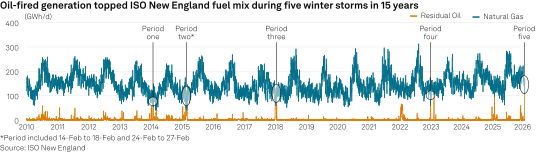
What's happening? US wholesale power prices reached record highs as days-long freezing temperatures drove up heating demand across the eastern two-thirds of the US starting Jan. 23. PJM West Hub on-peak reached $890.01/MWh for Jan. 27 delivery. Grid operators issued numerous weather-related grid notices and alerts spanning Jan. 23-Feb. 2. In the ISO New England footprint, oil-fired generation spiked, surpassing natural gas, which has happened on less than 30 days in the past 15 years.
What's next? Power prices mostly trended lower in trading for Feb. 3 delivery as weather-related grid notices ended. The US Department of Energy announced extensions of four emergency orders for Duke Energy Carolinas and Duke Energy Progress through Feb. 3, and PJM Interconnection through Feb. 2, to mitigate the risk of blackouts on below-freezing temperatures expected, while ISO-NE listed more than 30 generation units to be operated under the Federal Power Act Section 202(c) authority from DOE.
2. Alberta TIER prices stall as market awaits policy clarity
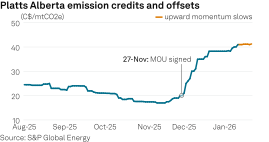
What's happening? The Alberta Technology Innovation and Emissions Reduction market experienced significant price volatility following a memorandum of understanding between Alberta and the Canadian federal governments on Nov. 27, 2025. Since the publication of the MOU, compliance offset and credits have increased by 105.7%, or C$21.20/metric ton of CO2e, to reach record assessment highs on Jan. 23, according to data from Platts, part of S&P Global Energy.
What's next? Market participants will continue to wait for clarifying policy documents from the Alberta provincial and federal governments to be released by April 1, as outlined in the MOU.
3. Australia's carbon market faces policy clarity challenges
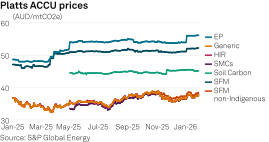
What's happening? Australia's emissions reduction target of 62%-70% for 2035 lacks clear investment guidance, according to an EY Net Zero Centre report. Platts assessed Generic ACCUs at A$37.75/mtCO2e on Feb. 2, down 5 cents. The market faces uncertainty for capital investments in ACCUs market due to gradual Safeguard Mechanism implementation and the weak near-term ACCU price outlook. Gross emissions from safeguard entities have fallen 2% primarily through low-cost operational measures rather than capital-intensive abatement investments.
What's next? The 2026 Safeguard review will assess the ACCU scheme's effectiveness in meeting decarbonization goals. EY recommends policy refinements, including expanding safeguard mechanism coverage to smaller facilities and transport fuels, which could increase ACCU demand by 9%. The report projects ACCU prices to remain flat at A$30-35/mtCO2e for the next two to three years, potentially rising to approximately A$70/mtCO2e by 2035.
4. North China used cooking oil prices rebound
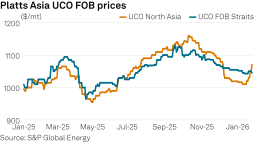
What's happening? North China UCO prices have rebounded sharply as Chinese buyers stock up ahead of the Lunar New Year, pushing UCO FOB North China back to a premium over FOB Straits for the first time in more than a month. Platts assessed UCO FOB North China at $1,065/mt Feb.3, UCO FOB Straits, assessed at $1,052/mt . Chinese sellers are also favoring domestic sales over exports due to similar pricing and the ability to avoid export costs, while Straits offers soften amid Malaysia ringgit strength and subdued overseas buying, according to multiple market sources.
What's next? Pre-holiday restocking could keep China UCO-supported prices firm, attributing to higher local logistics costs and the upcoming holiday. In the Straits, the market may remain quiet until after the Lunar New Year, with some participants expecting demand to improve after the Lunar celebration.
5. US beef exports down amid global market challenges
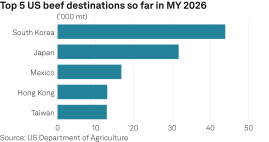
What's happening? Total commitments for beef shipments from the US, through the week ended Jan. 22, reached a total of 145,900 mt, 11.3% lower on year, in marketing year 2026 (January-December), according to US Department of Agriculture data released Jan. 29. Globally, US beef exports are facing competition from Brazil and Australia as China effectively shut the US out of its market, traders said. On March 16, 2025, China's system of approval for US meat exporters failed to renew their export registrations, according to US beef exporters.
What's next? Beef exporters from the US face a higher duty of 22%, which includes the 12% most-favoured-nation duty and the 10% reciprocal tariff imposed on US beef. China has set a quota of 164,000 mt of US beef for imports at the "most favored nation" tariff. The USDA estimates beef exports from the US in MY 2026 at 1.1 million mt, down 5.6% from MY 2025, according to its World Agricultural Supply and Demand Estimates report published Jan. 12.
Reporting and analysis by Kassia Micek, Madeline Ryan, Himanshu Chauhan, Boey Chau Kit, Goh Yoke Mae and Sampad Nandy.
