Electric Power, Natural Gas, Refined Products
January 30, 2026
Oil generation tops ISO New England fuel mix as power prices hit record high
By Kassia Micek and Humza Mirza
HIGHLIGHTS
Oil tops fuel mix during five winter storms
Internal Hub LMP hits $660.37/MWh Jan. 27
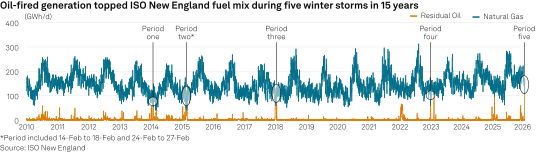
Oil-fired generation led the ISO New England fuel mix during the January winter storm that swept across a majority of the nation, driving up heating demand and power prices as temperatures plummeted.
The last time oil topped the ISO-NE fuel mix was three days in December 2022, then six days in January 2018, four days in December 2017, nine days in December 2015 and two days in January 2014, according to ISO-NE data going back to 2010. That makes less than 30 days in the past 15 years.
"ISO New England chooses resources to produce just the right amount of electricity to meet the region's demand, but we also choose the least expensive resources available to meet that demand," ISO-NE spokesperson Randy Burlingame said Jan. 30. "Demand for natural gas can go up during cold weather as folks use it to heat their homes, resulting in oil being a more economical option during that time."
The ISO planned to submit a request to the US Department of Energy on Jan. 30 to extend the application of the existing 202(c) provisions by two weeks, according to a statement. If approved, the provisions, which are currently set to expire on Jan. 31, would run through Feb. 14. The ISO sought the order to ensure that all available power resources in New England, including those subject to emissions or other permit limitations, can operate if needed.
The ISO on Jan. 28 listed more than 30 generation units to be operated under the Federal Power Act Section 202(c) authority from DOE.
"The ISO is forecasting sustained high energy demand to continue throughout the coming weeks, making the replenishment of stored fuels critical for system reliability," ISO-NE said in the statement.
| Oil-fueled generation output tops ISO New England resource mix during five winter storms (MWh/d): | |||
| Period | Dates | Oil max | Natural gas max |
| Period one | 1/25/14 | 79,764 | 64,369 |
| 1/26/14 | 70,697 | 54,702 | |
| Period two | 2/14/15 | 86,774 | 51,142 |
| 2/15/15 | 82,999 | 49,672 | |
| 2/16/15 | 110,962 | 56,441 | |
| 2/17/15 | 115,013 | 65,071 | |
| 2/18/15 | 93,867 | 71,895 | |
| 2/24/15 | 121,467 | 62,875 | |
| 2/25/15 | 103,941 | 40,289 | |
| 2/26/15 | 99,527 | 47,007 | |
| 2/27/15 | 71,549 | 54,893 | |
| Period three | 12/28/17 | 104,187 | 73,238 |
| 12/29/17 | 100,896 | 74,889 | |
| 12/30/17 | 88,587 | 80,627 | |
| 12/31/17 | 89,853 | 76,186 | |
| 1/1/18 | 95,572 | 85,016 | |
| 1/2/18 | 117,398 | 92,128 | |
| 1/3/18 | 106,142 | 77,740 | |
| 1/4/18 | 79,958 | 89,692 | |
| 1/5/18 | 118,898 | 59,430 | |
| 1/6/18 | 125,591 | 71,733 | |
| 1/7/18 | 129,912 | 69,832 | |
| Period four | 12/24/22 | 104,912 | 59,274 |
| 12/25/22 | 95,964 | 65,526 | |
| 12/26/22 | 96,783 | 70,044 | |
| Period five | 1/24/2026 | 124,636 | 107,995 |
| 1/25/2026 | 167,415 | 126,102 | |
| Source: ISO New England | |||
What happened
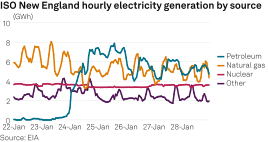
Oil surpassed natural gas-fired generation starting at 10am ET on Jan 24 with 5.8 giga-watt hours (GWh), compared to gas at 3.82 GWh, according to data from the US Energy Information Administration.
"Although petroleum accounts for less than 1% of total US utility-scale electric power generation, regions such as New England rely on oil-fired units during winter periods when cold weather creates high demand," the EIA said in a Jan. 29 statement. "When Winter Storm Fern affected New England this week, petroleum was the predominant energy source starting around midday on Jan. 24 and lasting until early morning on Jan. 26. Since then, petroleum and natural gas have been fluctuating as the primary energy source."
Petroleum-fired generation in New England reached almost 8 GW between Jan. 25-26, exceeding the capacity available from units that predominantly use petroleum, indicating contribution from fuel-switching units, according to the EIA.
New England heavily relies on natural gas, but as gas prices surged over the weekend, the region had to turn to the 818-megawatt (MW) Calpine dual-fuel generators or switch from gas to oil, Ye Tian, power analyst with S&P Global Energy CERA, said Jan. 29.
"Also, Quebec halted the power delivery to New England through the newly operated New England Clean Energy Connect on Jan. 24 and 25, which made things worse," Tian said.
As a precaution, on Jan. 25 the ISO-NE issued its master local control center procedure No. 2, or abnormal conditions alert, due to severe weather. The alert remains active as of Jan. 30.
The Internal Hub on-peak day-ahead locational marginal price hit a record high of $660.37/mega-watt hour (MWh) on Jan. 27 as peakload reached 19.563 GW, according to ISO-NE data. The all-time winter peakload record is 22.818 GW set on Jan. 15, 2004.
"New England has been one of the regions that suffer from the highest electricity retail rate in recent years, regulators have been making efforts to address this issue," Tian said. "Notably on Jan. 22, Massachusetts Governor Maura Healey announced that [Massachusetts] customers will see their February and March electric bills reduced by 25% and gas 10%."
New England's generating capacity of 35.5 GW is about 3% of US capacity, according to the EIA. However, the region holds a disproportionate 20% of the nation's total petroleum-fired capacity. Residual oil-fired boilers account for 58%, or 3.2 GW, of New England total petroleum capacity, with the remaining 2.3 GW coming from combustion turbine generators that primarily fire distillate fuel oil, according to the EIA.
Oil prices
US Atlantic Coast 0.5%S sulfur marine fuel barge prices have risen significantly in the latter half of January, following increased utility demand of the product for power generation.
Platts, part of S&P Global Energy, assessed US Atlantic Coast 0.5% marine fuel bulk value at $494/metric ton on Jan. 29, up $11.75/mt day on day, placing the benchmark at its highest point since closing at $502.50/mt on Sept. 2, 2025.
The price increase followed competitive buy-side market activity observed on multiple days during the month in the Platts Market on Close assessment process, with the latest competitive bid of $482/mt observed on Jan. 28, 2026.
Since then, bullish movement in underlying swap prices has pushed USAC marine fuel 0.5%S bulk value even higher.
Sources attributed the price climb to tighter regional supply driven by higher utility demand for fuel oil as an alternative to more expensive LNG.
"[USAC] power plants [have been] converted to run on LNG, but all the oil fuel [generators are] still sitting there as emergency backup for when [LNG] prices do what they are currently doing," one market participant said.

Editor: