Crude Oil, Refined Products, Chemicals, Energy Transition, Electric Power, Agriculture, Renewables, Olefins, Biofuels, Hydrogen, Carbon, Diesel-Gasoil
September 28, 2026
INSIGHT CONVERSATION: Debangsu Ray, Reliance Industries

Editor:
While India's transport fuel demand is expected to continue growing into the next decade, Reliance Industries Ltd. views the Jamnagar refinery's scale, complexity and integration as the foundation of its resilience amid geopolitical volatility, margin pressure and the energy transition.
In this interview, Reliance Industries Cluster President Debangsu Ray, who heads the company's Jamnagar refinery and petrochemical complex, speaks to S&P Global Energy Editorial Lead Sambit Mohanty about India's competitiveness in the refining industry amid a volatile geopolitical landscape. He discusses how Jamnagar's ability to process a highly diverse crude slate, integrate with petrochemicals and progressively decarbonize through renewables will help keep the refinery competitive and ready to meet future challenges.
How is Reliance leveraging its complex refining configuration to navigate current geopolitical volatility, and what specific advantages or vulnerabilities do Indian refiners face as global trade routes and crude supply flows become more fragmented?
The oil market is global in nature, and supply disruptions have adverse consequences for the world. However, Asia-Pacific, which sources substantial quantities of oil from the Middle East, has seen a larger impact.
The configuration, scale and infrastructure of the Jamnagar refinery provide us with the flexibility to process crude oil with a wide range of API gravity, sulfur content and TAN [total acid number]. The crude oil slate of the Jamnagar refinery has always been diverse. This gave us the ability to source feedstock from different regions and tide over the current crisis, and this can also help to serve us in the future.
India has firmly established itself as a premier global refining hub, balancing vast domestic demand with aggressive clean product export strategies. As the industry faces volatile and tighter global margins, how do you see the competitiveness of Indian complex refiners evolving against emerging state-of-the-art capacity in the Middle East and China?
New refining capacity with higher complexity will increase competition for existing refineries. Our emphasis will continue to be on deep petrochemical integration, optimized logistics, energy self-sufficiency and efficiency, disciplined cost management across the entire value chain, supported by our agility and global footprint in petroleum product marketing.
Our unwavering focus on world-class reliability, real-time optimization, digitalization of work processes, circularity and decarbonization is likely to be the key differentiator that will stand us in good stead in the future.
With the energy transition threatening long-term transport fuel demand, what is Reliance's targeted crude-to-chemicals conversion plan for the future, and which specific high-value petrochemical building blocks are you prioritizing to protect margins?
Several past forecasts of a rapid decline in transport fuel demand have proven to be premature.
Technological pathways to reduce transport fuels and increase petrochemical production are already available and are maturing, with a few small-scale units in operation. These include crude-to-chemicals and multizone catalytic cracking with selectivity toward higher olefinic yields.
However, these options call for multibillion-dollar investments. We will continue to monitor the supply and demand balances, progress on technological pathways and calibrate our strategy. We have plans for value addition through increased petrochemical production. Being a well-established large player in the petrochemical business, we will be able to move quickly.
How is Reliance balancing capital allocation between maintaining its traditional refining edge and scaling up its new energy gigafactories?
The next chapter for Jamnagar is about multidimensional integration. We are transforming the site from a premier fuel factory into a hyper-integrated energy and materials complex. The primary capital allocation shall follow two megatrends: deep petrochemical expansion and world-scale green energy manufacturing.
By placing solar, bioenergy and advanced energy storage ecosystems in close proximity to our refining footprint, we will create a symbiotic loop where clean energy powers low-carbon refining, which in turn yields the high-tech materials needed for the transition.
Given India's push for biofuels and electric vehicles, how do you project the timeline for peak transport fuel demand in India, and how will Reliance shift its product slate between domestic supply and export markets as the peak approaches?
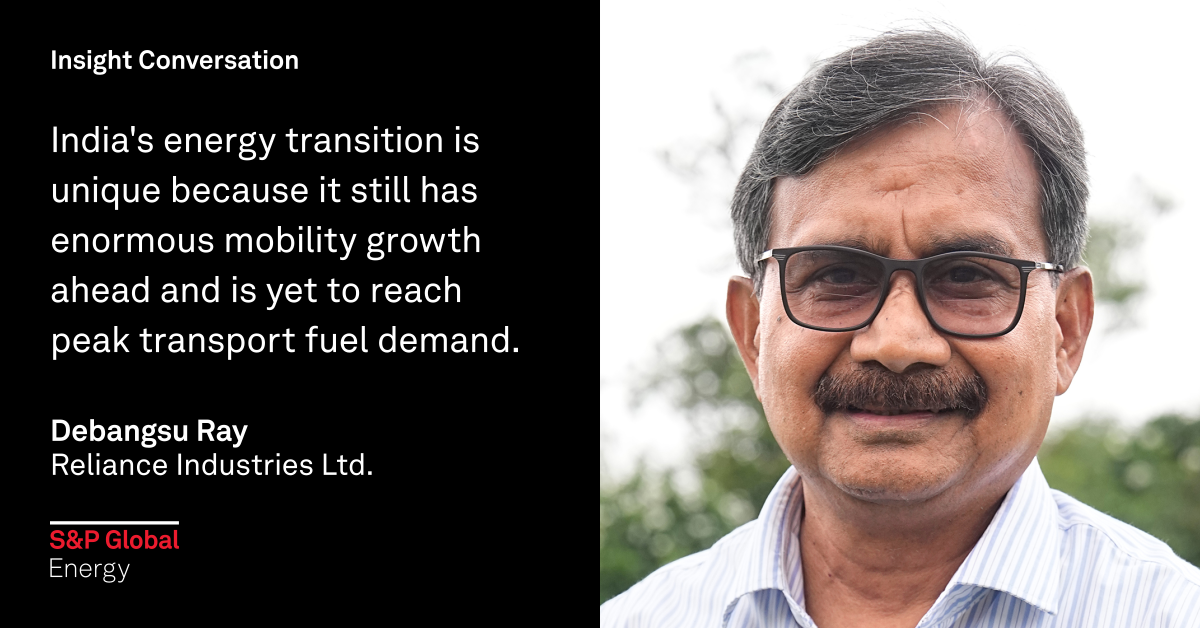
India's energy transition is unique because it still has enormous mobility growth ahead and has yet to reach peak transport fuel demand. Given India's robust GDP growth, we expect absolute domestic demand for conventional transport fuels to continue growing well into the next decade before plateauing.
We are actively co-processing bio and circular feedstocks and scaling up infrastructure to meet the government's accelerated ethanol and biodiesel blending mandates. Through our planned integration of green hydrogen into our hydro-treating blocks and maximizing chemical conversion, we will supplement revenue growth from long-term fossil fuel demand.
Decarbonizing a refining footprint of this scale is a monumental task. Could you highlight the operational milestones Jamnagar is targeting for integrating renewable power, adopting green hydrogen, advancing carbon capture or scaling up co-processing with bio-feedstocks?
Decarbonizing an asset of Jamnagar's scale requires an all-of-the-above engineering approach. We are targeting substantial emissions reductions through three distinct pillars.
First, we will progressively replace internal fossil-based process heating and captive power with renewable power and green hydrogen.
Second, we are scaling up the co-processing of biomass in our gasifiers and retrofitting our hydrotreaters for part processing of renewable bio-oil feed.
Finally, we are laying the technical groundwork for carbon capture and utilization — converting captured carbon dioxide into industrial chemical building blocks.
At what point do you foresee green hydrogen becoming cost-competitive enough to deeply decarbonize your refining operations?
As I mentioned in my previous answer, green hydrogen is one of the green alternatives for our decarbonization efforts. The key to the cost competitiveness of green hydrogen is the convergence of elements like technological breakthroughs, scale of demand and supportive mandates.
Currently, conventional hydrogen produced through steam methane reforming costs $1.50-$2/kg, whereas green hydrogen costs range from $2.50-$4/kg. The rapid adoption of green hydrogen [or ammonia] in countries and regions such as Japan and Europe can help reduce costs.
Also, increased solar energy generation and integration with large grids could cut the production cost of green hydrogen. We are hopeful that green hydrogen costs will be competitive compared with conventional hydrogen costs sooner rather than later.
India's economic growth continues to drive robust diesel and industrial fuel consumption. How does Reliance balance supplying a fast-growing, price-sensitive domestic market against high-premium opportunities in international export markets?
Serving India's fast-expanding domestic market is a core operational priority, and our dual-refinery setup provides the perfect structural blueprint to achieve this. Exports are done after meeting domestic demand.
As both refineries share a world-class infrastructure base, we are able to shift marginal volumes dynamically as local demand patterns shift seasonally.
This interview has been edited for clarity and length. It first appeared in the September 2026 edition of Insights Magazine.
