Crude Oil, Refined Products
September 29, 2026
Canadian oil sands inching toward growth acceleration
In less than 12 months, the conversation about Canadian oil sands production has moved from pessimism to optimism: from questions about peak production to an acceleration of growth.
Over the past decade, the Canadian oil sands have proven to be a resilient source of supply and growth despite periods of low oil prices, regional price volatility, and uncertainty over future Canadian energy and climate policy.
Most of today's installed oil sands production capacity is the result of construction between 2009 and 2017 (2018 when we consider time to bring online some of the last facilities). Since then, the construction of new facilities has been rare. Production growth, however, continued largely through operational efficiency projects.
From 2009 to 2018, production rose at an annual average rate of 170,000 barrels/day. From 2018 to 2026, growth slowed, with average additions just shy of 85,000 b/d. S&P Global Energy expects oil sands production to reach a new record level again in 2026, exceeding 3.5 million b/d, or about 100,000 b/d higher than in 2025.
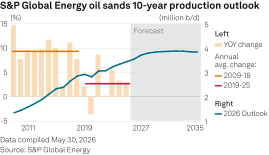
The current S&P Global Energy outlook expects production to reach 3.9 million b/d in the early 2030s, with production levels roughly plateauing around the same time. Most of the growth is expected to come from optimization of existing facilities.
The conditions in Canada, however, are changing rapidly, which could set the stage for a return to higher investment and production in the Canadian oil sands. Therefore, the risk to S&P Global Energy's outlook is increasingly to the upside, beginning around 2030 and accelerating thereafter, given the time it takes to move projects from design to construction, and then into production.
The optimism about a potential acceleration in growth is being driven by alignment between the industry and the Canadian federal and provincial governments that has not been seen in over a decade. To support a growth environment, governments have been whittling away at uncertainties that have long plagued the industry.
Recent announcements have laid out plans to expand pipeline export capacity, clarified, reduced and extended carbon pricing to 2040, committed to accelerating reviews of projects in the national interest and, most recently, committed to exploring changes to fiscal terms for new oil sands projects.
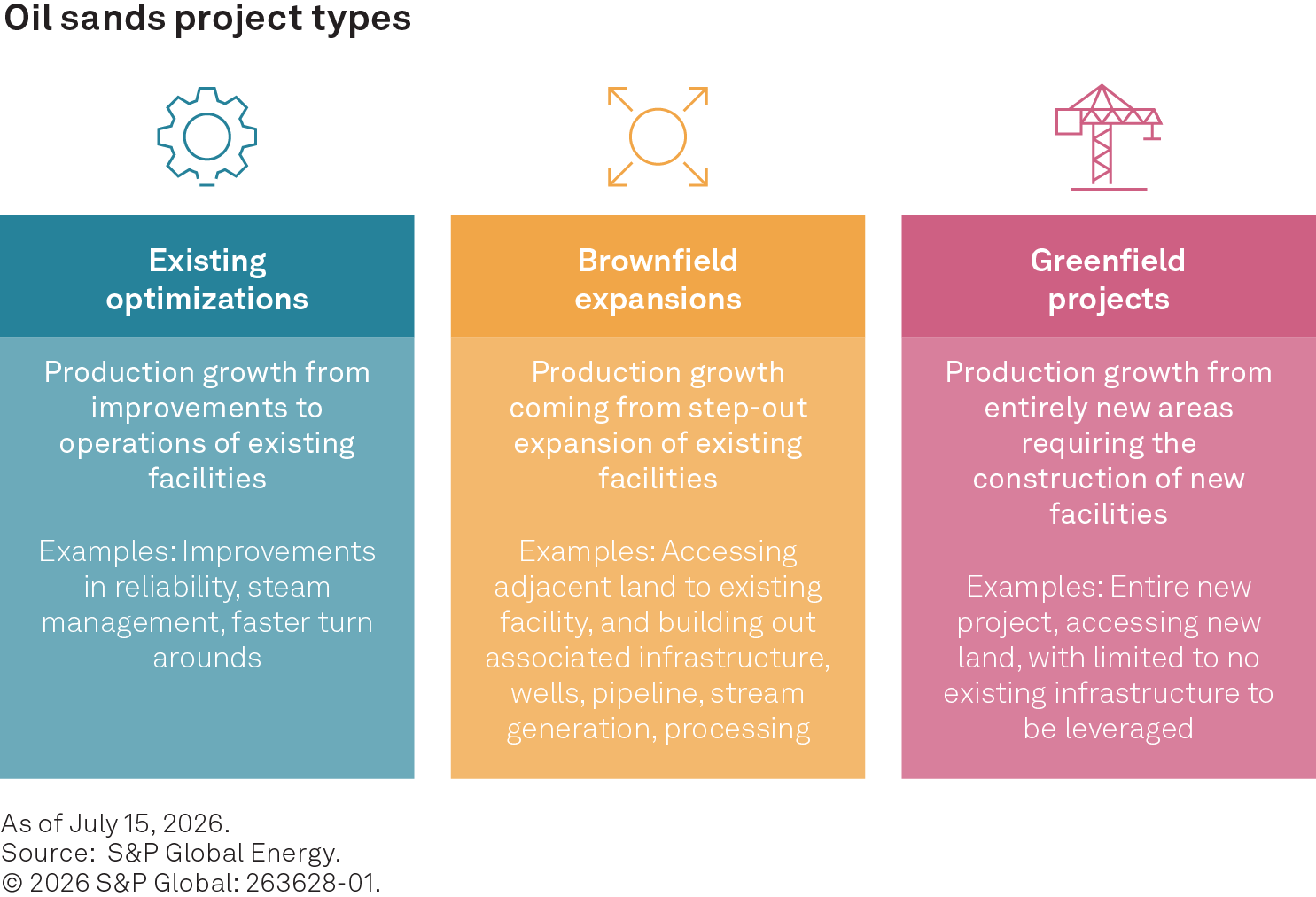
Although government actions have shifted the dialogue toward greater growth, critical details remain unclear. Accelerating growth will require companies to move beyond relatively small-scale optimization projects to once again engage in the construction of brownfield and potentially even greenfield projects. These projects come with larger price tags and longer timelines to bring online.
To sanction these larger-scale projects, companies will need to demonstrate financial performance to shareholders. To do this, companies need to understand how the government's current and planned policy changes will impact project economics. The higher price tag and long construction cycle also make these projects more sensitive to uncertainties, and companies will need to assess the durability of the policies as part of their de-risking. These are all prerequisites before a material uptick in investment should be expected.
Given the optimism in the market today, some companies have already begun to signal the potential for greater additions. Looking at the legacy of past projects, which are extensive, and considering how they have evolved, S&P Global Energy estimates that there is an initial set of potential projects of nearly half a million barrels per day of incremental production capacity that could come forward. This initial tranche is predicated on what may be the most attractive and most expedient. With the right conditions and time, the potential could be greater.
This article contains data, views and forecasts from S&P Global Energy CERA and does not represent reporting by Platts, part of S&P Global Energy.
