Crude Oil, Refined Products, Coal, Natural Gas, LNG, Chemicals, Energy Transition, Electric Power, Diesel-Gasoil, Jet Fuel, Naphtha, Renewables, Hydrogen, Carbon, LPG
September 24, 2026
Why this energy crisis is different
Speaking to the British Parliament in 1913, as First Lord of the Admiralty overseeing the Royal Navy's controversial shift from Welsh coal to foreign oil, Winston Churchill said: "Safety and certainty in oil lie in variety, and variety alone."
More than 110 years later, global oil supply has expanded dramatically and become far more diverse, with major producers across every region. So why did this crisis still come as a shock, especially to oil and gas importers in Asia and Europe?
The largest energy shock in modern times
The early days of COVID-19 showed the fragility of global supply chains when products ranging from masks to microchips and medical equipment and pharmaceuticals were in short supply. Russia's invasion of Ukraine exposed Europe's vulnerability to Russian energy supplies and led to an urgent effort to create new supply chains for LNG, oil and refined products.
Even with diversification of sources, the importance of the Middle East crude oil, refined products and LNG supplies has been well known and understood for decades. The Strait of Hormuz crisis has exposed the scale of this dependence and vulnerability of the global economy to this supply chokepoint.
Vessel traffic across the Strait of Hormuz came to a halt at the start of the conflict on Feb. 28, 2026. Since then, there have been several starts and stops and vessel traffic started to pick up after a memorandum of understanding between the US and Iran was signed in June. The average number of crossings increased from 14 in May to 30 in June but toppled when fighting resumed in early July.
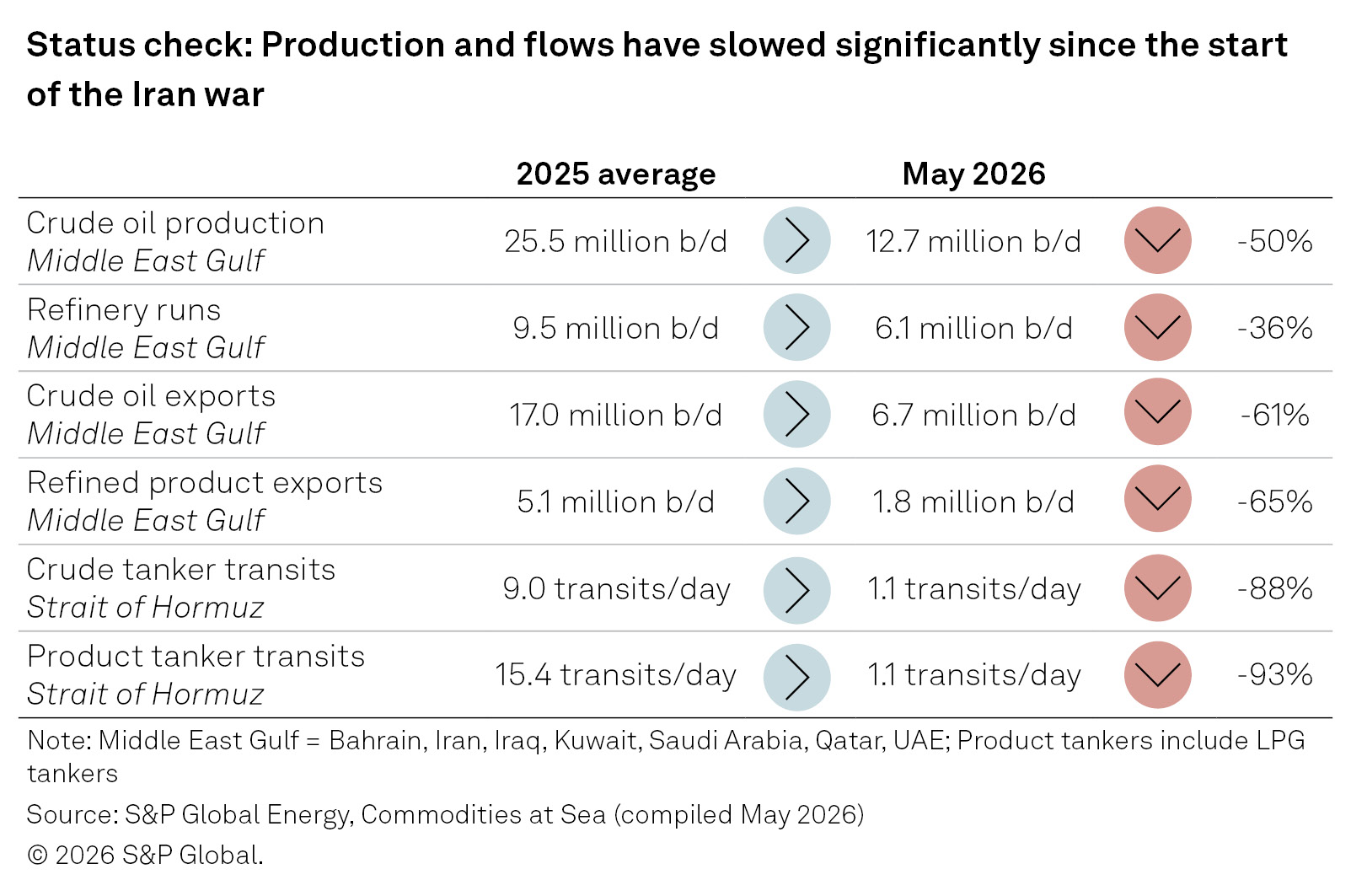
Traffic resumes when talk turns to negotiations and a truce, then tightens again when drones and missiles strike ships, infrastructure and military bases. Restoring confidence will require clearer signs of stability: cleared mines, independent maritime security assessments confirming reduced threats and removal of the area's war-zone designation for insurance purposes. War-risk premiums have not gone away just on announcements alone.
The impact of the crisis has not been limited to oil, refined products and LNG. Over the years, the Strait of Hormuz has become a critical artery for commodities essential to the global economy, particularly in Asia.
Fertilizers, sulfur, helium, automotive diesel and aviation fuel are all building blocks of global trade, and Middle East supplies of these products have been significantly disrupted. For example, before the crisis, 48% of China's naphtha imports, 37% of European jet fuel imports and 21% of Africa's gasoil imports transited the Strait of Hormuz, according to S&P Global Energy analysis.
Hormuz closure is Asia's energy crisis
As Tatsuya Terazawa, chairman and CEO of The Institute of Energy Economics, Japan (Tokyo), wrote in early June, the Iran war and Strait of Hormuz closure constitute a global energy crisis, but one felt most acutely in Asia.
This has been the largest disruption to energy supplies since World War II, cutting crude oil supplies by 27%, refined products by 21% and LNG by 16%, according to S&P Global Energy estimates.
Asian economies have borne the brunt of that impact, especially emerging and developing markets, which hold very low reserves of oil, refined products and gas and have limited capacity to absorb price shocks.
The crisis has underscored the need to diversify supply sources, even at higher costs, and to build strategic reserves of crude oil, refined products and, where feasible, gas.
| Significant share of global commodity exports originated from the Gulf Cooperation Council pre-crisis | |||
| Material | GCC share of global exports 2025 | Primary end-use sectors | Representative product applications |
| Crude oil | ~27% | Refining, petrochemicals, power generation | Transportation fuels, petrochemical feedstocks for plastics and synthetics, asphalt for road construction, heating oils, lubricants |
| Refined products | ~21% | Transportation (road, aviation, maritime), residential and commercial heating, power generation, industrial burn | Motor gasoline, automotive diesel, aviation fuel, marine bunker fuels, LPG for cooking/heating, fuel oil for power generation/industrial boilers |
| LNG | ~16% | Power generation, industrial manufacturing, residential and commercial heating, fertilizer feedstock | Fuel for gas-fired power plants, industrial heating processes and manufacturing, pipeline gas supply for home heating/cooking, LNG marine bunker fuel |
| Fertilizers | ~19% | Agriculture, commercial farming, forestry, horticulture | Urea and ammonia for crop nitrogen supply, DAP/MAP for root development, NPK blends for soil enrichment, specialized green house nutrients |
| Ethylene glycol (ethanediol) | ~49% | Packing, textiles, automative, aerospace, HVAC | PET bottles and food packaging, polyester fibers for clothing and carpet, engine coolants and antifreeze, aircraft de-icing fluid, industrial heat-transfer fluids |
| Sulfur | ~49% | Fertilizers and agriculture, chemicals, energy and refining, metals and mining, rubber | Sulfuric acid production, phosphate and nitrogen fertilizers, petroleum refining (desulfurization), metal leaching and processing, vulcanization of rubber (tires and industrial rubber goods) |
| Diethylene glycol (2,2´Oxydiethanol) | ~43% | Construction, composites, automotive, printing and coating | Unsaturated polyester resins (fiberglass panels, pipes and marine parts), brake fluids, inks, dyes and adhesives |
| Rare gases (NESOI, excluding argon) | ~38% | Semiconductors and electronics, healthcare aerospace and defense, energy-efficient construction | Chip manufacturing (lithography lasers), MRI/NMR/medical imaging, commercial and defense systems, insulated glazing, specialty lighting |
| Note: NESOI = not elsewhere specified or included | |||
| Source: S&P Global Energy (compiled March 10, 2026) | |||
Building resilience
Asian economies rely on resilient energy systems that are affordable, reliable and secure in the face of evolving risks. For most Asian economies, particularly those still industrializing and urbanizing, energy security remains the overriding priority. Resilience in these markets is built on diversified energy systems: a pragmatic mix of renewables, gas, coal, hydropower, and emerging technologies like hydrogen and carbon capture, utilization and storage (CCUS).
Interconnecting regional grids, such as the Vietnam-Laos-Thailand-Malaysia-Singapore link, could deliver more optimized and resilient systems, but success depends on strong political will, aligned policy frameworks and sustained cross-border infrastructure investment.
Policymakers face a balancing act: reducing emissions without compromising affordability, reliability and industrial competitiveness. There are several actions Asian countries can take on their own and with partners.
China and Japan have managed the crisis better than other Asian countries because years of planning left them with substantial reserves of crude oil, refined products and natural gas. Although both countries remain highly dependent on Middle East oil, strategic reserves and commercial inventories have helped cushion them from the supply shock.
Other major Middle East crude importers, including India, Thailand and Pakistan, hold much smaller strategic stocks. These countries, and others in similar positions, need to build larger reserves of key commodities and diversify supply sources. That will require investment and may raise energy costs, but it is a modest price to pay for stronger energy security.
During the Energy Asia Global Leadership Forum (EAGLe) held on the sidelines of Energy Asia in June 2025, the assembled CEOs emphasized the need to collaborate on building interconnected and resilient energy systems across Asia, including cross-border electricity grids, LNG infrastructure, carbon dioxide transport networks and shared resource platforms.
Collaboration in Asia's energy transition cannot remain aspirational. It must be specific, operationalized, cross-sectoral and realistic, involving governments, corporates, financiers and technology providers. That means co-creating investment frameworks, sharing infrastructure such as regional grids and carbon dioxide transport networks, and jointly setting standards for emerging industries such as hydrogen, CCUS and sustainable fuels.
Effective collaboration requires aligned incentives, shared risk-taking and mechanisms to convert regional initiatives into actionable projects.
EAGLe participants emphasized that public-private partnerships and regional cooperation are not optional — they are essential enablers for scaling solutions.
The Strait of Hormuz crisis is a timely reminder to act on these initiatives.
A path to energy security
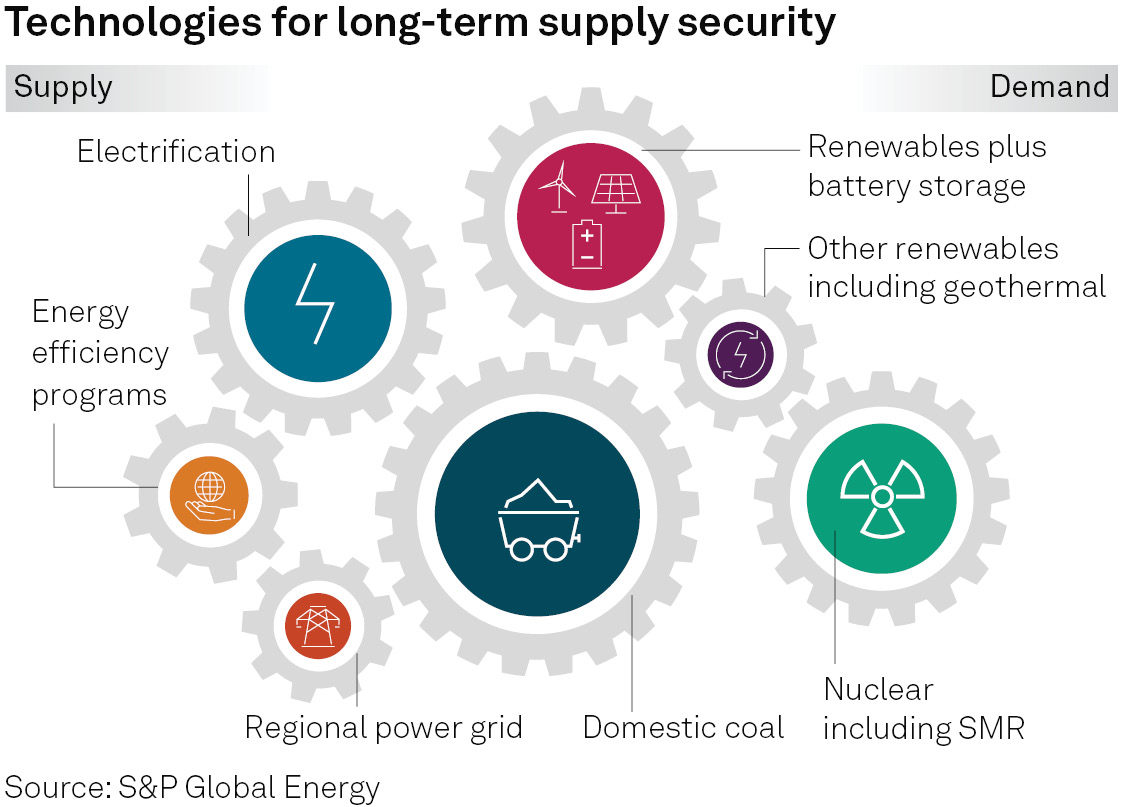
This crisis gives Asia an opportunity to invest in technologies that make better use of domestic resources to secure long-term supply. The priority is not simply to accelerate the energy transition for climate reasons, but to strengthen long-term supply security.
On the demand side, promoting electrification across sectors can shift reliance away from fuel imports.
Furthermore, robust energy efficiency programs are also essential for managing demand.
On the supply side, markets that have domestic coal resources such as India and China may use more coal than previously anticipated. In all countries, building out domestic resources including wind, solar, battery, nuclear and geothermal will also help reduce import dependency.
Countries should also adopt regulatory and fiscal policies that encourage new oil and gas development.
The Strait of Hormuz crisis makes clear that energy security must anchor sound policy in every country.
Sufficient reserves of crude oil, refined products, LPG and other critical commodities must underpin every resilient energy system. Cooperation with partners and neighbors will further strengthen that security.
This article contains data, views and forecasts from S&P Global Energy CERA and does not represent reporting by Platts, part of S&P Global Energy. A version of this article appeared in the September 2026 issue of Insights Magazine.
