Crude Oil, Refined Products, Maritime & Shipping, Electric Power, Naphtha, Gasoline, Jet Fuel
September 17, 2026
Asian refiners rewrite energy security playbook

By Gawoon Vahn
Editor:
When the Middle East war turned the Strait of Hormuz from a familiar artery into a strategic weak spot, Asia's largest crude-importing economies did not wait for the chokepoint to fully seize up. South Korea, China, India, and Japan — the four countries whose refinery systems anchor much of Asia's oil demand — moved quickly to reroute crude, test new supply routes, lean more heavily on reserves, and redefine the meaning of "security of supply."
For decades, the region's refining model relied on scale, term contracts and the assumption that Middle Eastern barrels would move reliably through the Persian Gulf. The disruptions of 2026 challenged that assumption.
What has followed is not a uniform retreat from Middle Eastern crude, but a more sophisticated playbook: bypass the Strait of Hormuz where possible, widen the crude slate, use the Red Sea more aggressively, build inventory buffers and secure optionality from the Americas, Africa, Russia, the Mediterranean and Latin America.
Redefining maritime security, supply routes
Nowhere has that adjustment been more visible than in South Korea. Asia's third-largest crude importer entered the crisis with deep reliance on Middle Eastern sour crude, but it responded by turning maritime logistics into a first line of defense. Since the start of the war, 15 South Korea-bound tankers have safely transited the Red Sea to deliver Arab Light crude, South Korea's Deputy Minister for Trade, Industry and Resources Security Yang Ghi-wuk said at a July 21 press briefing. This has allowed refiners to keep feedstock moving even as Persian Gulf logistics remained uncertain.
The Red Sea is no longer merely an emergency detour for Seoul. South Korean refiners are preparing to keep using the Yanbu-South Korea route for Saudi crude even if the US-Iran war ends and Persian Gulf flows normalize, with industry sources indicating plans to lift at least 6 million barrels/month from Yanbu as part of a broader delivery-route diversification strategy. The government has backed that shift with 24-hour monitoring and real-time communication among ministries, shipping companies and vessels, underscoring how maritime surveillance has become part of crude procurement policy.
South Korea has also leaned heavily into the UAE. Abu Dhabi grades such as Murban, Upper Zakum, Umm Lulu and Das Blend have become crucial because some UAE crude can be moved through infrastructure that bypasses the Strait of Hormuz, giving South Korean refiners a Middle Eastern barrel without the same chokepoint exposure. In May alone, South Korea received 13.15 million barrels of UAE crude, more than double the 6.4 million barrels imported earlier, according to data from state-run Korea National Oil Corp. (KNOC) released on June 26. In the first half, shipments from the UAE to South Korea rose 17% year over year to 70.52 million barrels, KNOC data showed July 27.
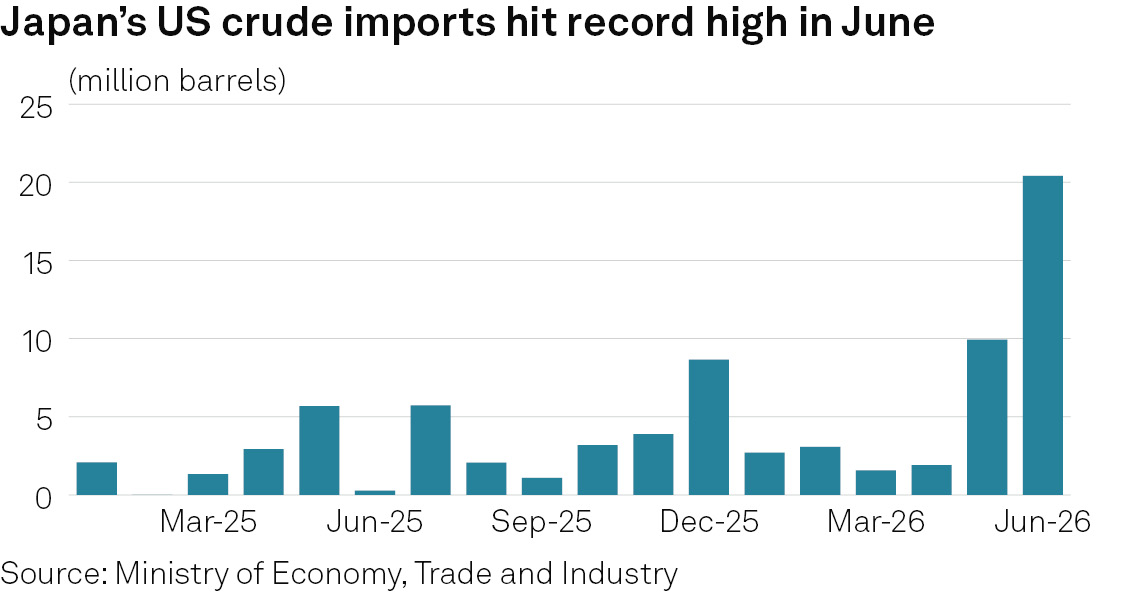
Japan's response has been shaped by a more acute vulnerability: it is almost entirely dependent on Middle Eastern crude. The Middle East accounted for 93.5% of Japan's crude imports in 2025, pushing refiners to accelerate procurement from North America and other regions after the conflict disrupted term supplies. In May, the US became a critical balancing barrel for Japan, with US crude intake reaching a record monthly high of 331,000 barrels/day, according to preliminary data from Japan's Ministry of Finance released July 22, as delayed Persian Gulf arrivals forced refiners to patch their supply slates with alternative cargoes.
Japan also used rare supply sources, including Azeri Light, and received 20,908 b/d of Azeri crude in May, discharged at ENEOS' Negishi refinery. Even as refiners look to restore term Middle Eastern flows, they are expected to maintain diversification because the crisis has made clear that dependence above 90% is no longer a comfortable operating model.
Japan, like South Korea, is also reassessing the Red Sea route. Taiyo Oil continued buying Arab Super Light, a grade typically loaded from Yanbu, because its shipments were not affected by the war, while other Japanese refiners have considered using the Red Sea to bring in 2 million-5 million barrels/month of Arab Light rather than relying almost entirely on the Persian Gulf-Hormuz corridor. For Japanese refiners, the goal is not to abandon the Middle East, but to introduce enough routing and supplier flexibility to prevent a disruption from becoming a refinery-run crisis.
Strategic buffers and the Atlantic pivot
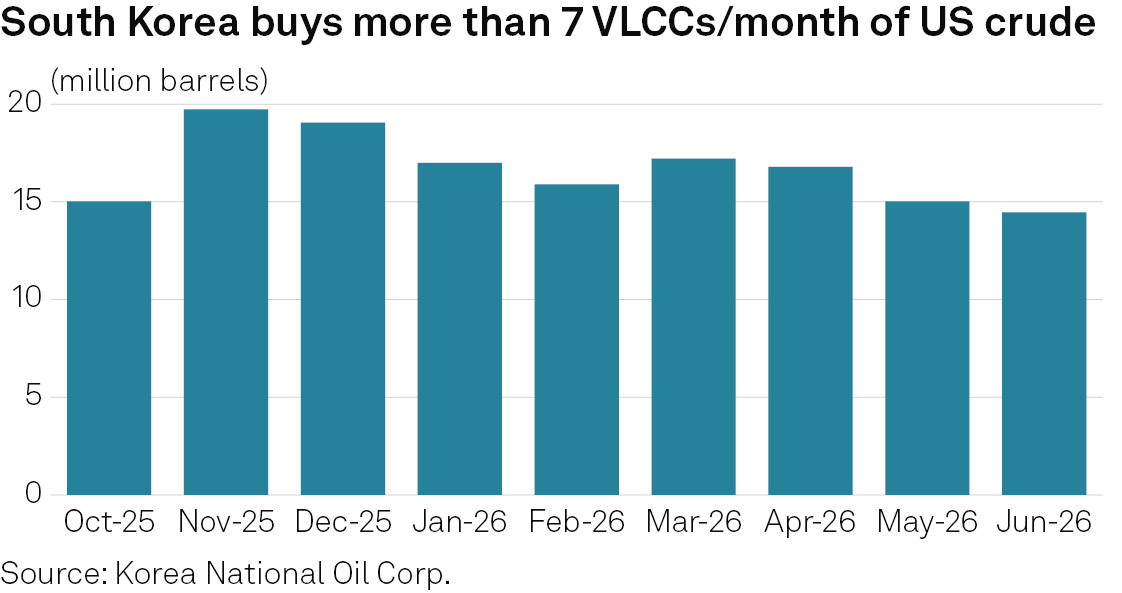
South Korea's strategy is not confined to the Middle East. It purchased 95.9 million barrels of US crude in H1 2026, up 14.2% from a year earlier, according to KNOC data, reinforcing its position as Asia's largest buyer of US barrels. Seoul is also accelerating Canadian heavy sour crude imports, aiming for as much as 16 million barrels in 2026 and potentially 20 million barrels/year over time, helped by customs arrangements with Alberta that simplify origin verification and allow refiners to claim preferential tariff treatment under the Korea-Canada Free Trade Agreement.
African supply has also helped: South Korea imported 8.8 million barrels of African crude in May, more than double the year-earlier volume, with Algeria's Saharan Blend leading the increase.
That combination of light sweet US crude, heavy sour Canadian barrels, African grades and Mediterranean options gives South Korean refiners a more balanced crude slate. African supply has already helped: South Korea imported 26 million barrels of African crude in H1, more than double the prior-year volume, with Algeria's Saharan Blend leading the increase. Seoul is also expanding its strategic petroleum reserve (SPR) capacity by more than 20 million barrels and plans to stockpile naphtha for the first time, after petrochemical feedstock disruptions that exposed a gap in the country's emergency toolkit.
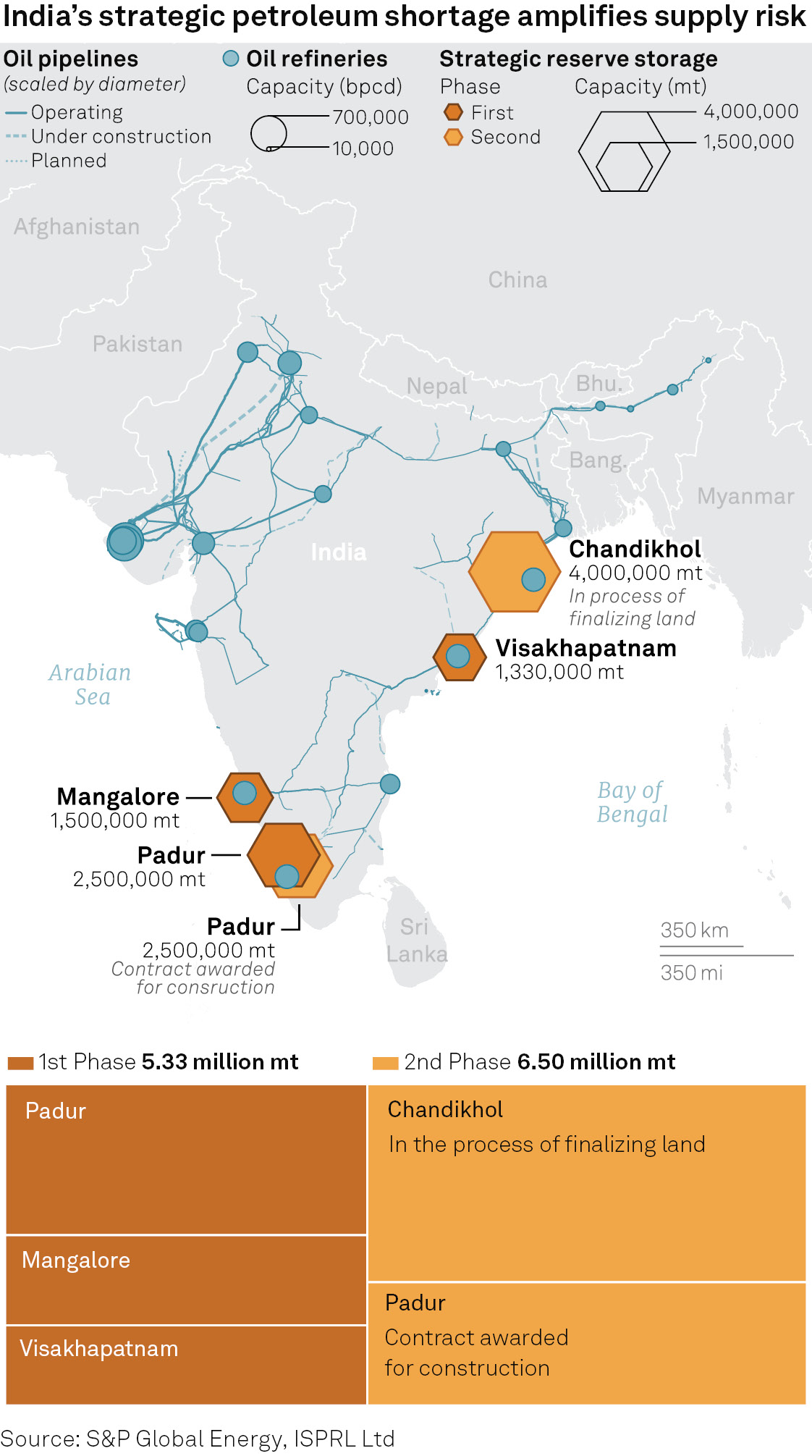
India's strategy is broader and more explicitly strategic: diversify barrels, expand reserves and seek storage outside its coastline. Before the conflict, about 52% of India's roughly 5 million b/d of crude imports passed through the Strait of Hormuz, making the waterway a central vulnerability for the world's fastest-growing major oil consumer.
As of July, India's SPRs cover about 9.5 days of net oil imports, while state-run oil companies hold another 64.5 days of crude and product stocks, leaving total national coverage at roughly 74 days — below the 90-day level required of International Energy Agency members. New Delhi is working to close that gap.
ONGC has been asked to build a new 1.75 million metric ton SPR facility in Mangalore at an estimated cost of $1.6 billion, in addition to India's existing second-phase SPR expansion plans. India is also exploring overseas storage options, including Fujairah in the UAE, a hub outside the Strait of Hormuz, where storage capacity increased from just 0.9 million in March. Indian officials have said New Delhi will explore term oil contracts with Venezuela and upstream investment opportunities, reflecting the country's effort to secure long-term heavy crude alternatives to Middle Eastern grades.
The new HPCL Rajasthan Refinery strengthens this effort. The high-complexity 9 million metric ton/year refinery, which began commercial operations in July, is designed to process a diverse crude basket and includes units that enable it to handle heavier grades. India is also building upstream supply security: BPCL has acquired full ownership of IBV Brasil Petróleo, giving it a stronger foothold in Brazilian oil and gas assets as India seeks more resilient Atlantic Basin supply chains.
China's price discipline
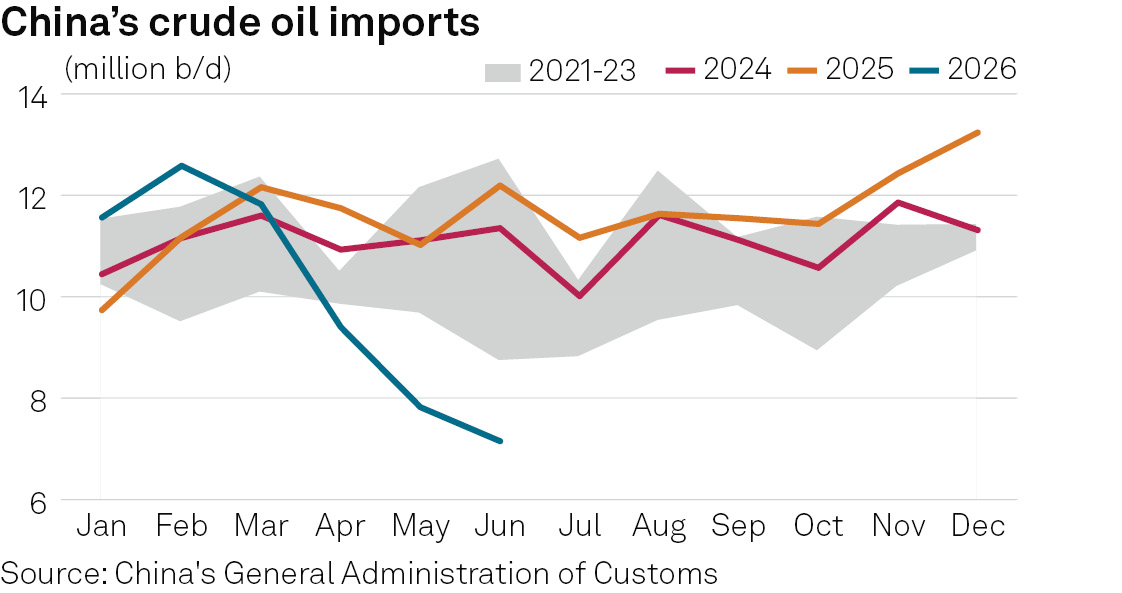
China's adjustment has been different: less frantic, more price-sensitive and shaped by its split between state refiners and Shandong independents. China's crude imports fell near a decade low to 7.15 million b/d in June, according to data from the General Administration of Customs released on July 14, as listed refiners avoided inventory devaluation and Middle Eastern flows were disrupted. Middle Eastern imports, excluding Iranian barrels, slumped 76.1% year over year in June, allowing Ecuador and Congo to rise into China's top 10 crude suppliers.
Independent refiners in Shandong acted opportunistically, buying prompt Russian ESPO cargoes as renewed Middle East tensions raised concern over timely Hormuz deliveries. Yet Chinese buyers have not been willing to chase barrels at any price. Energy think tank Economics & Technology Research Institute (ETRI), a subsidiary of China National Petroleum Corp., said refiners were waiting for lower prices and prioritizing the consumption of feedstocks bought during the high-price period, while weaker demand for transport fuel limited the urgency to restock.
The longer-term Chinese story may be less about crude security and more about the composition of oil demand. ETRI expects electric vehicle charging to displace the equivalent of 932,000 b/d of gasoline demand in 2026, while jet fuel and chemical feedstocks are expected to account for 41% of China's oil demand by 2030. That means China's future crude strategy will be shaped not only by geopolitics, but by the shift away from road-fuel growth toward petrochemicals, aviation and higher-value refining.
Asia's new resilience model
It is clear that Asia has not decoupled from the Middle East, but it has stopped treating Middle Eastern supply as frictionless.
South Korea is institutionalizing Red Sea logistics and deepening UAE ties. Japan is working to reduce its dependence on the Middle East below crisis-prone levels. India is pairing storage diplomacy with diversification toward Venezuela, Brazil and the US. China is using inventories, Russian barrels and price discipline to weather volatility.
Asia's old model optimized for cost, refinery compatibility and term reliability. Its new model adds redundancy, route diversity and geopolitical optionality. In Asia's crude market, resilience has become a feedstock strategy.
This article first appeared in the September 2026 issue of the Insights Magazine.
