Crude Oil, Maritime & Shipping, Energy Transition, Electric Power, Refined Products, Agriculture, Chemicals, Renewables, Fuel Oil, Biofuels, Emissions, Food
September 14, 2026
INSIGHT CONVERSATION: Takeshi Hashimoto, Mitsui O.S.K. Lines

By Mia Pei
Editor:
Geopolitical risks, decarbonization and artificial intelligence (AI) have been reshaping the shipping industry more than ever. For Mitsui O.S.K. Lines Ltd. (MOL), the recent Middle East conflict underscored the importance of resilience in the age of disruption.
MOL Chairman Takeshi Hashimoto speaks with S&P Global Energy Editor Mia Pei on how the company navigated the crisis, the challenges of scaling low-carbon marine fuels, AI's value for the shipping industry and why international cooperation matters for the future of shipping. Hashimoto served as MOL's president and CEO from 2021 and transitioned to his role as chairman of the board earlier this year.
How did the Middle East conflict affect MOL's operations?
Energy shipping is one of MOL's core businesses, so when the conflict broke out, our top priority was the safety of cargoes, vessels and the lives of seafarers. As the situation escalated, we believed it was better to evacuate sooner rather than later.
However, conditions were changing almost every day. Our evacuation program started in March, but the first vessel was only able to leave in early April. It was a very difficult period. Our teams worked almost all around the clock, constantly monitoring developments, conducting risk assessments and deciding evacuation procedures vessel by vessel.
We consulted not only the Japanese government but also other government authorities, specialist consultancies and risk analysis experts.
Fortunately, following the temporary suspension of hostilities and the ceasefire, we managed to evacuate almost all our ships without any serious injuries to seafarers or damage to cargo or vessels. It was an extremely stressful operation, but ultimately successful.
The challenge now is different. The Persian Gulf remains one of the world's most important energy-producing regions. Asian countries such as Japan, China and India depend on reliable energy imports from the region.
So far, we have focused on evacuation. It is still too early to fully resume normal trading. For the time being, we have suspended entering the Gulf, but both energy producers in countries such as Qatar, the UAE and Saudi Arabia, and importers across Asia, want trade to continue.
Our next challenge is determining how to safely restart operations and establish new safety standards under these difficult conditions.
How has this year's crisis changed the way MOL thinks about geopolitical risk?
It is still a little bit too early to say this has changed our long-term strategy.
So far, our response has been operational — protecting our interests and those of our customers. Many people are talking about diversifying energy imports. Some of our vessels have shifted to North America, South America and Australia to transport alternative oil and gas supplies. However, I see this as an operational response rather than a strategic shift.
Over the longer term, I don't believe the global economy can meet total energy demand without the Middle East. We need to reestablish a stable and secure trading route between Gulf producers and major importing regions, especially Asia. International politics will, therefore, remain critical and we will continue monitoring developments carefully.
For now, we are allocating more vessels to alternative trade routes, but this comes at a cost. Longer voyages and higher energy prices ultimately increase costs for importing countries such as Japan, South Korea, China and India.
I sincerely hope a lasting ceasefire and peace can be achieved in the Middle East. If not, we will have to continue exploring alternative solutions.
What is MOL's approach to alternative marine fuels? What remains the biggest obstacle to scaling them?
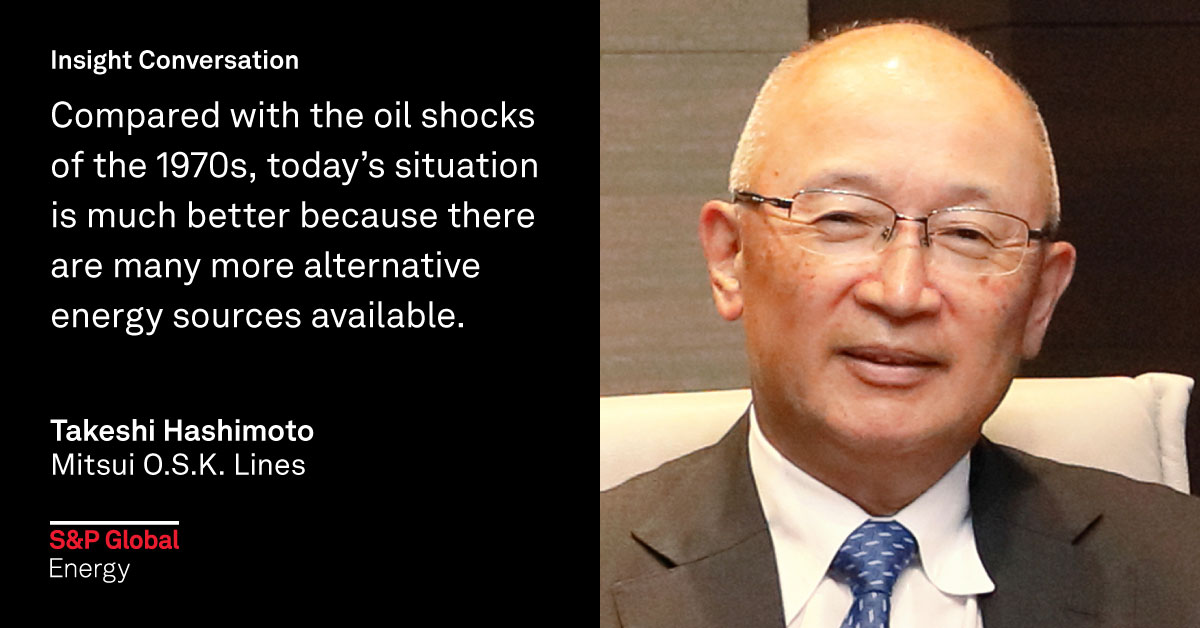
Compared with the so-called 'oil shocks' of the 1970s, today's situation is much better because there are many more alternative energy sources available.
Countries including China, India and Japan have significantly expanded renewable energy over the past 10 to 20 years, including solar and wind. Although the situation has been challenging, the global economy has continued operating without the major disruption many feared when the conflict began.
This demonstrates that countries have become more resilient. Alternative energy development, alongside energy efficiency improvements and strategic petroleum reserves, particularly in Japan, has strengthened resilience.
The biggest challenge in scaling alternative marine fuels is the lack of industry consensus on which fuel will ultimately become dominant.
There are many promising options — biodiesel, biomethane, green and blue ammonia, green and blue methanol — but we still don't know which can be supplied in sufficient volume.
Volume is extremely important. We have to think of an alternative to several hundred million tons of fuel oil. Today, many projects produce only half a million to two million tons of alternative fuels, which is far from sufficient.
Logistics is another challenge. We need reliable supply chains that can deliver these fuels wherever our vessels operate. At present, production capacity and logistics remain at an early stage, making it difficult to identify the most feasible long-term candidate.
Our strategy, therefore, is to reduce greenhouse gas emissions with every available option. Whenever biodiesel or green methanol becomes available, we will use it. At the same time, we are improving operational excellence through AI, reducing fuel consumption and deploying technologies such as wind-assist propulsion.
Together, these measures could reduce our emissions by 40%-50% compared with several years ago. There is still a long journey toward our 2050 net-zero target. I hope that within the next 10 to 15 years, the industry will identify a mainstream fuel.
Green ammonia and green methanol appear to be strong candidates today, but it is still too early to determine which will ultimately prove to be the most competitive and practical.
For the next five years, our priority is to maximize emissions reductions by combining every available solution.
How is AI creating value for MOL?
Even before AI, we had already begun collecting and analyzing operational data from our fleet of around 900 vessels worldwide.
We use that information to determine the most efficient route for each voyage and reduce energy consumption. AI can significantly improve this process by automating data collection and analysis. This allows us to process much larger amounts of information much more quickly and with fewer people.
Looking ahead, if we could analyze data not only from our own fleet but all the vessels worldwide, AI could identify even better navigation patterns by incorporating trade flows, weather conditions and many other variables.
We highly expect AI to help us further reduce fuel consumption and improve efficiency.
However, safety must always come first. Sometimes the most fuel-efficient route is not the safest. We may need to avoid typhoons or hurricanes, by accepting additional fuel consumption. AI should support decision-making but it should not replace human judgment. Critical operational decisions must ultimately be made by experienced professionals.
Beyond conventional shipping, where does MOL see its biggest growth opportunities?
We believe offshore industries have enormous growth potential. Historically, the offshore business has centered on oil and gas, including FPSOs [floating production, storage and offloading vessels], FLNGs [floating liquefied natural gas vessels] and FSRUs [floating storage and regasification units], where we have invested heavily and developed strong expertise.
In the future, however, we want to apply those offshore technologies beyond oil and gas. Examples include floating power plants, which we have already commenced as our business, floating data centers, floating offshore wind facilities and even floating nuclear power stations.
As land becomes scarcer and greater flexibility is needed, floating infrastructure will become increasingly valuable. Our long-term vision is to transform MOL into a broader social infrastructure company, expanding our offshore capabilities into renewable energy, alternative energy and other power-related sectors.
Looking ahead, what do you hope will have changed for MOL and the global shipping industry?
Above all, I hope the world experiences less geopolitical tension. Shipping depends on international trade. While regional conflicts can temporarily increase shipping demand or create alternative trade routes, that is not sustainable growth.
Our objective is long-term, sustainable growth. That requires making major investments, but today's political uncertainty makes long-term investment decisions much more difficult because we cannot predict what the world will look like in three or five years. I hope we see a more stable international environment.
Today, many countries understandably prioritize their own national interests. However, major global challenges — energy security, food supply, population issues and climate change — cannot be solved by individual countries or companies acting alone. International cooperation is essential.
MOL serves customers around the world. We want to see stable global economic growth, lower geopolitical tensions, and stronger international collaboration. That collaborative approach will also be essential for advancing decarbonization, developing alternative industries and addressing the world's biggest challenges.
This interview has been edited for clarity and length.
This article first appeared in the September 2026 edition of Insights Magazine.
