Crude Oil, Maritime & Shipping
September 14, 2026
From oil to AI, APPEC focuses on Asia's need to build energy resilience, manage risks
The mood at APPEC 2026 was shaped by a market under pressure — and by a growing sense that the disruptions facing global supplies could persist well beyond a typical short-term shock.
Across discussions on crude oil, shipping, refining, artificial intelligence and electric vehicles, one theme kept returning: energy security is no longer a secondary consideration. It is increasingly influencing how refiners are planning crude purchases, how they configure assets, how shipowners price risk and how governments prepare for a more fragmented trading environment.
Asia is at the center of this key concern. From oil traders and refiners to shipowners and technology companies, speakers at APPEC, hosted by S&P Global Energy over Sept. 7-10 in Singapore, described an industry adapting to a world of disrupted routes, tighter availability, higher operating risks and costs, and volatile changes in energy demand patterns.
Vitol CEO Russell Hardy said the region is facing both higher prices and physical supply shortages as geopolitical tensions disrupted oil flows.
"In Europe and the US, unlike Asia, it's really a price problem. It's not an availability problem. The rest of Asia has had a tough time since March," Hardy said.
The distinction between price and availability captured the anxiety running through the conference. A market can often absorb higher prices, but the absence of cargoes, ships or viable alternative routes presents a more fundamental challenge — particularly for economies in a region that depends heavily on imported energy.
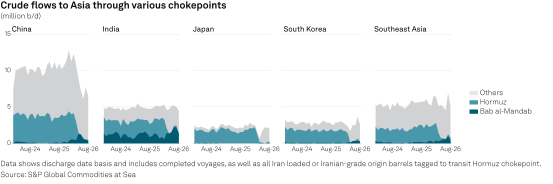
About 75% of Asia's crude imports from the Middle East transited the Strait of Hormuz in 2025, according to S&P Global Energy CERA. By the third quarter of 2026, that share had fallen sharply, fluctuating between 10% and 20%, based on ship-tracking data from S&P Global Commodities at Sea.
For India, the crisis highlighted the value of refining flexibility and diversified procurement.
"The crude oil slate of the Jamnagar refinery has always been diverse. This gave us the ability to source feedstock from different regions and tide us over the current crisis, and it can also help to serve us in the future," Debangsu Ray, cluster president and head of Reliance Industries Ltd.'s Jamnagar refinery and petrochemical supersite, told Platts, during the conference. Platts is part of S&P Global Energy.
Related content: Insight Conversation: Debangsu Ray, Reliance Industries Ltd.
Divergent strategies
Andrea Pescatori, deputy division chief of the International Monetary Fund's Asia-Pacific Department, said the Hormuz crisis tested Asia's divergent energy resilience strategies.
"China cut crude imports sharply and accounted for more than half of the fall in Asian imports, with almost no diversion to non-Gulf sources. It ran inventories and compressed refinery runs instead. India replaced Gulf barrels almost fully, buying Russian, Venezuelan, Angolan and Brazilian barrels," Pescatori said.
The differing responses underscored a central lesson from the crisis: supply diversification matters, but so do logistics, refining configuration, inventories and the ability to rapidly redirect trade flows. Countries with access to multiple sources can absorb a disruption more easily, while those without that flexibility may have to ration demand through lower refinery activity or by drawing down on reserves.
That lesson was also visible in shipping markets. Prolonged uncertainty around the Strait of Hormuz has reduced available tonnage and raised insurance and war-risk costs, while altered trade routes and sustained energy demand have supported tanker rates.
For Asyad Shipping, the conditions have justified greater exposure to the spot market and plans to renew and expand its crude and products tanker fleet. CEO Ibrahim Al Nadhairi said freight rates could remain firm or rise further over the medium term.
"The energy market, in terms of shipping of energy, is going to be on the higher side within the short term or even in the midterm," he said. Even the prospect of additional VLCC capacity later in the decade may not return freight rates to pre-crisis levels, Nadhairi said.
For veteran commodities analyst Jeff Currie, who built his reputation leading commodities research at Goldman Sachs for nearly two decades, the market has not yet fully reflected the scale or duration of the risks.
"I would argue that the security premium in energy markets is not temporary. We are moving into a more dangerous phase of deglobalization and energy security will command a significant premium," Currie said.
That view gave the mood at APPEC a distinct tone. The issue was not simply whether oil prices would rise or fall in response to the latest headlines. It was whether companies and governments needed to plan for a world in which energy flows remain vulnerable to simultaneous disruptions across several trade routes.
AI, energy transition
APPEC was not solely focused on physical supply risks. The conference also reflected the industry's effort to modernize the systems used to manage increasingly complex markets.
Speakers said energy companies were moving beyond artificial intelligence experiments and proof-of-concept projects, seeking instead to integrate AI into everyday work in trading, risk management, operations and decision-making. The objective is practical: process large volumes of structured and unstructured data, automate routine tasks, and help employees identify market and operational risks more quickly.
"One oil trader needed about 10 switches between three systems, five email roundtrips and three people just to resolve a single quantity discrepancy before invoicing," Tasja Botha, CEO of VAKT Global, told the conference. "Applying the right approach, that same fix can drop to as few as eight manual actions, and the industry is working hard to get it lower still."
At the same time, the longer-term transition away from oil was also visible in discussions about China's EV market. Fairy Wang, vice president of Sinopec's Economics & Development Research Institute, said EV penetration could reach 75%-80% of new vehicle sales in China by 2030, up from more than 60% currently.
Taken together, the conversations at APPEC reflected an industry navigating two forces at once. In the near term, geopolitical turmoil is making reliable supplies, flexible refineries, secure shipping and diversified sourcing more valuable. Over the longer term, electrification and changing demand patterns are forcing companies to rethink what they produce and how they operate.
"This crisis presents an opportunity for Asia to double down on technologies that can better utilize domestic resources for long-term supply security. This isn't necessarily about accelerating the energy transition purely for climate goals, but primarily about strengthening long-term supply security," said Atul Arya, chief energy strategist at S&P Global Energy.
