Crude Oil, Fertilizers, Chemicals, Metals & Mining, Agriculture, Non-Ferrous, Rice, Meat, Food
May 12, 2026
COMMODITY TRACKER: 5 chart to watch this week

By Staff
Editor:
China's crude imports fell to a 45-month low amid the Middle East disruptions, while sulfur prices doubled on supply constraints. Indonesian aluminum exports, Indian rice prices and US beef trimming imports are also in focus this week.
1. China's crude imports fall to 45-month low
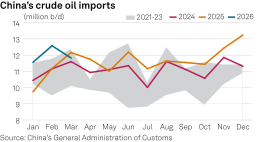
What's happening? China's crude imports fell to a 45-month low of 9.4 million barrels/day in April, data from the General Administration of Customs showed May 9. Imports were the lowest since 8.83 million b/d in July 2022. The 20% year-over-year decline and 23% month over month drop came amid supply disruptions in the Middle East due to the war between the US, Israel and Iran since late February. Independent refineries' crude imports reached a 46-month low of 3.16 million b/d in April, down 1.16 million b/d from March, according to Platts data. This suggested imports by state-run refineries fell 1.51 million b/d from the previous month. Platts is part of S&P Global Energy.
What's next? Market analysts said the weaker-than-expected inflows imply stock draws of about 11 million barrels in April, despite Chinese refiners slashing crude throughput. China's onshore crude inventory reached a record high of 1.36 billion barrels, according to Ursa Space data. China's crude import demand could drop by as much as 2.5 million b/d year over year in 2026 as the country halts stockbuilds and cuts refinery runs by 1.7 million b/d amid EV penetration and a clean oil product export ban, a market analyst estimated. Chinese oil product exports in April fell to 3.12 million mt, down 38% year over year, the lowest since 3.11 million mt in May 2025, following the government's mid-March requirement to suspend clean oil product exports, GAC data showed.
2. Sulfur prices double amid Middle East disruptions
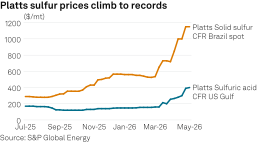
What's happening? Global sulfuric acid and elemental sulfur prices increased in April due to supply disruptions in the Middle East and stricter Chinese export restrictions, according to S&P Global Energy CERA analysts. Platts assessed sulfuric acid CFR US Gulf at $400/metric ton on May 6, up from $155/mt on Feb. 25. Sulfur FOB US Gulf rose to $1,060/mt from $650/mt when it launched April 2. The CFR Brazil sulfur increased to $1,150/mt May 7, more than double the prewar level of $525/mt on Feb. 26. The Middle East typically accounts for nearly half of global seaborne sulfur exports. China imposed new restrictions on sulfuric acid exports, effective May 1, affecting smelter- and sulfur-burner-based acid.
What's next? The Chinese export ban is expected to push the market into a significant deficit. China shipped about 4.6 million metric tons of sulfuric acid in 2025, according to S&P Global Market Intelligence's Global Trade Atlas. Brazilian sulfuric acid imports jumped roughly 800% year over year in March to 90,594 mt as buyers sought European cargoes. However, Europe is now effectively sold out until June, leaving buyers with few immediate options. Alternative sulfur supplies from Canada, which exported a record 628,000 mt in February, have proven insufficient to offset lost Middle Eastern volumes, CERA analysts said in a May 1 report. The sulfur crisis directly threatens Brazil's import-dependent fertilizer chain ahead of the country's key planting season, with sources warning that skipping conventional sulfur-based fertilizers could devastate the 2026-27 harvest.
3. Indonesian aluminum exports weigh on Asian premiums
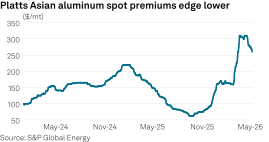
What's happening? Asian aluminum spot premiums are declining as Indonesian exports rise and Chinese supply increases amid weak regional demand. Platts assessed the CIF main Asian ports spot premium for 99.7% P1020/1020A aluminum ingot at $260/mt plus LME cash on May 11, down $5/mt from the previous day and $15/mt from the week. Indonesia exported 88,554 mt of unwrought aluminum in March, up 164% from February and 51.6% year over year, according to Badan Pusat Statistik Indonesia. The Weda Bay region recorded its first aluminum product exports, including 18,500 mt to the US, 10,000 mt to China, and 8,000 mt to South Korea.
What's next? Indonesia is expected to significantly increase aluminum production as new projects come online. PT Kalimantan Aluminum Industry obtained export approval in early May and may begin shipments in June, according to regional sources. China's Tsingshan Holding Group has applied for aluminum from its Hua Chin smelting joint venture in Indonesia, which has 480,000 mt annual capacity, to be approved as deliverable on the London Metal Exchange. The global aluminum market could post a deficit of 764,000 mt in 2026, compared with a surplus of 37,000 mt in 2025, according to a CERA report from April.
4. Indian non-basmati rice prices hit multiyear lows
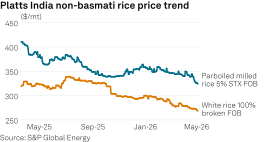
What's happening? Indian non-basmati rice prices hit multiyear lows amid subdued domestic demand, as changing import policies in key African destinations like Senegal, Benin, and Burkina Faso, combined with new crop arrivals, weighed on the market. Platts-assessed India Parboiled 5% rice fell by $44/mt since 2021 and $82/mt from 2018 to $324/mt FOB on May 5. Platts-assessed 100% broken WR fell by $54/mt year over year at $269/mt FOB on May 5. Benin's policy shift led to a lack of demand for parboiled 5% in the local Indian market, prompting exporters to halt shipments. Burkina Faso banned rice imports, while Senegal restricted imports, allowing only selected companies to hold import quotas.
What's next? Indian exporters anticipate parboiled 5% prices to further come down as new crop arrivals exert pressure. New crop paddy prices fell by Rupee 5,000/mt in Chhattisgarh local mandi, with new IR paddy being offered at Rupee 17,000-17,500/mt as of May 4, according to Mukesh Jain, president of The Rice Exporters Association of Chhattisgarh. Indian rice exports dropped in January and February 2026 to 2.87 million metric tons, down 15% year over year, according to India's Agricultural and Processed Food Products Export Development Authority. The Rice Exporters Association of Chhattisgarh sought immediate government intervention, citing order cancellations, payment delays, and inventory pile-ups.
5. US beef trimming imports rise on tight domestic supply
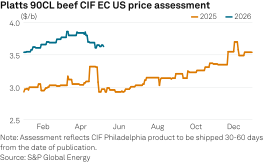
What's happening? US beef trimming imports totaled 18,988 metric tons for the week ended May 2, down 10.3% week over week but up 2.2% year over year, according to US Department of Agriculture data. Through May 2, total imports reached 335,609 mt, up 16.6% from 2025 and 39.2% from 2024. Australia supplied 27.3% of weekly imports, followed by Brazil at 24.4% and New Zealand at 22.1%. The rise in imports reflects tight domestic supply, with bull and cow slaughter -- the main source of lean trimmings -- down 5.5% year over year at 1.816 million head through May 2. Platts assessed 90CL beef CIF East Coast at $3.63/lb May 7, down 21 cents month over month.
What's next? Imports are expected to accelerate after July as Australia and Brazil redirect beef from China to the US once they reach Chinese quotas at the end of June. Despite current drought conditions in US cattle areas, analysts don't anticipate increased beef cow culling, as the US beef cow herd is already at a 75-year low. Caleb Hurst, cattle and beef principal analyst for CERA, said domestic 90s pricing will likely be influenced by import prices going forward, particularly as additional Australian and Brazilian product hits the market after July. The wide price spread between domestic fresh beef at $4.63/lb and Brazilian frozen at $3.52/lb is prompting grinders to increase frozen beef proportions in their blends.
Reporting and analysis by Oceana Zhou, Marina Lima Silveira, Lucy Tang, Louissa Liau, Namarita Kathait and Sergio Alvarado.
