Agriculture, Meat
May 08, 2026
US beef trimming imports rise amid slow domestic cow slaughter

Editor:
HIGHLIGHTS
US beef imports rise 16.6% year over year
Domestic cow slaughter slides to record lows
Price gap widens between the US, imports
US beef trimming imports remain above year-ago levels amid a slow pace of slaughter of bulls and cows, the main source of lean beef trimmings.
The US Department of Agriculture said in the May 8 Imported Meat Passed for Entry in the US report that total US imports of beef trimmings for the week ended May 2 were 18,988 metric tons, down 10.3% week over week, but up 2.2% from the week ending May 3, 2025.
Of the total US imports of beef trimmings during the week ending May 2, 27.3% were from Australia, 24.4% from Brazil, 22.1% from New Zealand, 9.5% from Canada, and 5.9% from Uruguay, USDA data showed.
US imports of Australian beef trimmings climbed 0.1% to 5,186 mt during the week; imports from Brazil dropped 26.4% to 4,633 mt, and from New Zealand rose 9% to 4,199 mt.
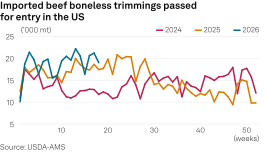
The USDA reported that about 335,609 mt of beef trimmings have been imported through May 2, up 16.6% from the same period in 2025, and 39.2% from the same period in 2024.
Of the total lean beef trimmings imported, 27.5% was imported from Australia, 23.4% from Brazil, 19.2% from New Zealand, and 11% from Uruguay.
According to lean beef traders, imports are expected to accelerate after July, as Australia and Brazil could redirect beef from China to the US once they reach their quotas there at the end of June.
Tight US domestic supply
Import volumes have been pulled by the limited US domestic supply of lean beef trimmings.
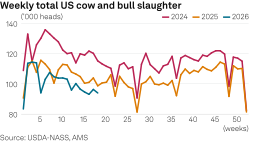
So far in 2026, 1.816 million heads of bulls and cows, the main source of lean trims, have been slaughtered up to May 2, down 5.5% from the same period of 2025 and 17.9% from the same period of 2024, according to the latest estimations from the US Department of Agriculture in its Daily Livestock and Poultry Slaughter reports and its Weekly Actual Slaughter reports.
The last weekly slaughter figure estimate was at 94,000 head, down 2.4% from the previous week, down 2.2% from the previous six-week average, down 4.7% from the corresponding week of 2025, and down 18.4% from the corresponding week in 2024.
According to S&P Global Energy data, most lift in the non-fed slaughter numbers has come from Dairy Cows. During 2026, about 54% of the non-fed production was from dairy cows, compared with about 48% for the same period the previous year.
"There is much more [lean beef] product, globally, to focus on bringing into the US, especially with culling rates for beef cows at record lows about 5.2%," Caleb Hurst, cattle and beef principal analyst for S&P Global Energy CERA, said. "This certainly aids in the fact that retention is fully here from a beef cow perspective."
"On the dairy side, producer margins have been maintained at a strong level, lessening the desire to cull cows as well," Hurst added. "Both these scenarios lend themselves to weaker non-fed slaughter levels."
Despite the current drought conditions on US beef cattle areas, Hurst doesn't see a possible increase on beef cow culling as "We're already at 75-year lows for the US beef cow herd numbers."
"I don't see drying conditions leading to more liquidation as there is still grass available for the cattle we do have," Hurts said. "The dryness we're seeing is not as drastic as the 3-4 year span that caused the bulk of the liquidation, and if you'll remember, we had more cows in all of those years than we do currently."
Lean beef price support
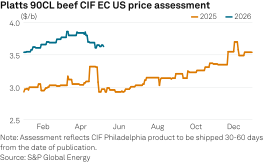
The limited domestic supply has been reflected in import volumes and prices. Platts, part of S&P Global Energy, assessed the 90CL beef CIF East Coast for a 30- to 60-day shipment period at $3.63/pound May 7, as the last values heard were at those levels for Australia origin. The May 7 assessment was down 2 cents day over day, unchanged week over week, but down 21 cents month over month.
According to beef traders and end users, sellers and buyers have covered their programs, so there has not been a significant push from either side to move prices.
"Pipeline is pretty healthy given this recent flush of cattle in Australia and New Zealand, but continuing to buy as we see bargains given the firm US [domestic] 90s pricing," an end user said.
The 90CL beef FCA East Coast for a 16- to 60-day delivery period was assessed at $3.52/lb May 6, as the last FOB port of entry, Philadelphia, values from South America were at those levels. The May 7 assessment was down 1 cent day over day, unchanged week over week, and up 2 cents month over month.
According to the USDA, 90Cls spot delivered in the US, Domestic is about $4.63/lb at US central packing plants, while according to beef traders, Australia/New Zealand origin is about $3.80/lb FOB port of entry, Philadelphia spot, and Brazil origin is about $3.52/lb, a difference of $1.11/lb between domestic fresh and Brazilian frozen.
"Personally, I think domestic 90s will be more at the mercy of what import prices do [going forward] than the other way about. Sure, we still have lighter production levels that will keep us underpinned, especially leading up to the 4th of July," Cale Hurst added. "However, that additional product from Australia and Brazil that will start hitting import levels after July will have an impact on all markets, in my opinion."
According to other beef traders, the beef grinders are looking for and finding ways to increase the proportion of frozen beef on their blends due to the wide price spread between domestic fresh and frozen imports.
