Refined Products, Chemicals, Crude Oil, Natural Gas, LPG
May 05, 2026
COMMODITY TRACKER: 5 charts to watch this week

By Staff
Editor:
Indian markets are in focus this week as refiners ramp up LPG output amid issues with the Middle East cargo flows, while bunker demand slows on tight credit. Russian gas flows via TurkStream declined in April, while Venezuela's crude exports reached a six-year high.
1. Indian refiners boost LPG output amid import disruptions
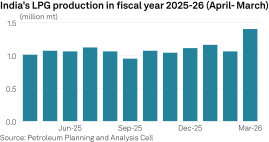
What's happening? Indian refiners increased LPG production by 30.8% year over year and 32% month over month to 1.4 million metric tons in March, according to Petroleum Planning and Analysis Cell data released May 4. The rise came as cargo flow disruptions through the Strait of Hormuz, caused by the Middle East conflict, forced domestic refiners to accelerate output to prevent cooking gas shortages. Over January-March, India's LPG production rose 11% year over year to 3.62 million mt, while full-year output for fiscal 2025-26 stood at 13 million mt, up 2.5% year over year. Overall LPG demand in FY 2025-26 reached 33.2 million mt, up 6% year over year. India relies on the Gulf region for about 60% of its LPG consumption.
What's next? Domestic LPG production in April and May could rise further as refiners have been directed not to divert propane and butane for petrochemical use, according to analysts. DLN Sastri, former director of refining at the Federation of Indian Petroleum Industry, said the rising domestic production trend could continue for several more months. However, if the Middle East war persists, India may need to rely more on long-haul spot cargoes, potentially raising freight costs and impacting domestic prices. Diverting LPG components from high-value petrochemical feedstocks and gasoline blending could significantly erode petrochemical unit margins, according to S&P Global Energy CERA analysts. The petroleum ministry confirmed all refineries are operating at high capacity with adequate crude inventories.
2. India's bunker demand slows amid tight credit
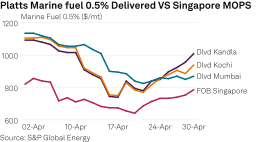
What's happening? Bunker demand across India's west and east coasts slowed in April compared with March amid tight credit and ongoing market uncertainty due to the Middle East war, while supply remained moderate, according to traders and suppliers on May 4. Elevated March prices quickly exhausted buyers' credit lines, limiting purchases to one or two stems and keeping many out of the market until limits reset. In Mumbai, demand was moderate with average volumes at around 4,000-5,000 mt for high sulfur fuel oil and about 20,000 mt for very low sulfur fuel oil, a source close to a major refinery said. East coast ports, including Haldia, Chennai and New Mangalore, recorded lower volumes despite good product availability.
What's next? Traders expect demand to improve in May, as many April requirements were pre-booked in March due to voyage uncertainty. A Paradip-based supplier said the port is expecting nearly 10,000 mt in May after resolving pipeline issues and supplying 6,000 mt in April. However, a Dubai-based supplier for Kochi noted that May started slowly, though more interest is expected in the coming weeks.
3. Russian gas flows via TurkStream drop in April
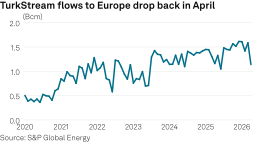
What's happening?Russian gas flows to Europe via the TurkStream pipeline fell in April, totaling 1.14 billion cubic meters, according to a May 1 analysis based on ENTSOG data compiled by CERA. Deliveries via TurkStream at the Strandzha 2 entry point on the Turkey-Bulgaria border averaged 38 million cu m/d in April, down from 51 million cu m/d in March. Deliveries averaged above 50 million cu m/d in each of the first three months of 2026 during the peak demand season. A similar drop occurred in April 2025, when flows fell to 1.16 Bcm, or 39 million cu m/d, after strong first-quarter supplies.
What's next? The 15.75 Bcm/year-capacity European string of TurkStream remains the sole pipeline route for Russian gas supplies to Europe after Ukraine halted Russian gas transit at the start of 2025, following the expiry of its five-year transit agreement with Moscow. Through March and into April, Russia's Gazprom reported a string of repelled attacks by unmanned aerial vehicles against compressor stations, with the latest reported on April 2, though no impact on flows has been reported. Hungary, Slovakia and non-EU Serbia are among the primary recipients of gas via TurkStream. The EU approved legislation in January to ban all Russian pipeline gas imports by late 2027.
4. Venezuela's crude exports reach six-year high
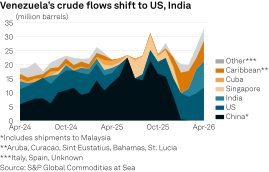
What's happening?Venezuela's crude exports climbed to 1.1 million barrels/day in April 2026, the highest level in over six and a half years, according to S&P Global Commodities at Sea data assessed May 1. This represents a significant increase from 904,000 b/d in March and 600,000-700,000 barrels/day between December 2025 and February 2026. The US and India emerged as top buyers. State-owned PDVSA reported production reached 1.2 million b/d in April, while major oil companies, including Chevron, ExxonMobil, Repsol and TotalEnergies, expanded operations and signed agreements with PDVSA to develop heavy crude resources in the Orinoco Belt.
What's next? PDVSA expects crude oil production to reach 1.37 million b/d by December, an increase of 430,000 b/d from the 940,000 b/d recorded in January, according to executive vice president Jovanny Martinez on April 27. Repsol plans to triple gross crude production in Venezuela within three years and increase output by 50% at the Petroquiriquire asset within 12 months. TotalEnergies is developing a trading scheme to supply Venezuelan heavy crude to its Port Arthur refinery on the US Gulf Coast. However, a Ministry of Hydrocarbons official noted on May 1 that while agreements have been signed, formal commercial contracts remain pending due to taxation uncertainties.
5. EU GMO detection pressures Argentine meal basis
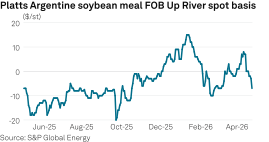
What's happening? The EU detected traces of the unapproved genetically modified organism HB4 in Argentine soybean meal shipments arriving in the Netherlands, triggering market concerns about potential rejections and export disruptions from Argentina, the world's largest soybean meal exporter, with projected shipments of 29.50 million mt in 2025-26, according to CERA. On April 27, Platts, part of S&P Global Energy, assessed the FOB Up River basis for June delivery at a $7/short ton discount to CBOT, the lowest since March 7.
What's next? Market participants suggest the situation could redirect European demand for soybean meal to the US if the issue escalates, though traders note no EU buyers are currently switching to US supplies. One trader said the EU would likely fix its regulations before changing sourcing strategies. The US soybean meal market faces tight supplies amid the crushing plant maintenance season, expected to continue through May. With soybean meal supply already under pressure across the EU, this development has further increased prices.
Reporting and analysis by Sambit Mohanty, Sai Deepak Tarlada, Abhishek Anupam, Stuart Elliot, Binish Azhar, Jose Roberto Gomes, Nanditha Kinavoor Madathil, Elizabeth Machuca and Paola Caballeros.
