Agriculture, Crude Oil, Refined Products, Maritime & Shipping, Biofuels, Gasoline, Sugar, Grains, Beverages
October 15, 2026
Asia steps up ethanol blending amid Middle East war

By Rishab Joshi
Editor:
Renewed volatility in global crude oil markets due to the Middle East conflict has reinforced ethanol's role across Asia, not only as a decarbonization tool but also as a key pillar of energy security.
Amid higher oil prices and freight costs, governments in the region are increasingly viewing ethanol blending as a way to reduce exposure to imported petroleum and cushion the impact of future supply disruptions.
"The supply shock and price volatility brought about by the Middle East conflict have sent a strong policy signal to Asian governments to reduce energy import dependence and turn into internal energy security," said Wei Jun Chua, principal analyst for biofuels at S&P Global Energy CERA.
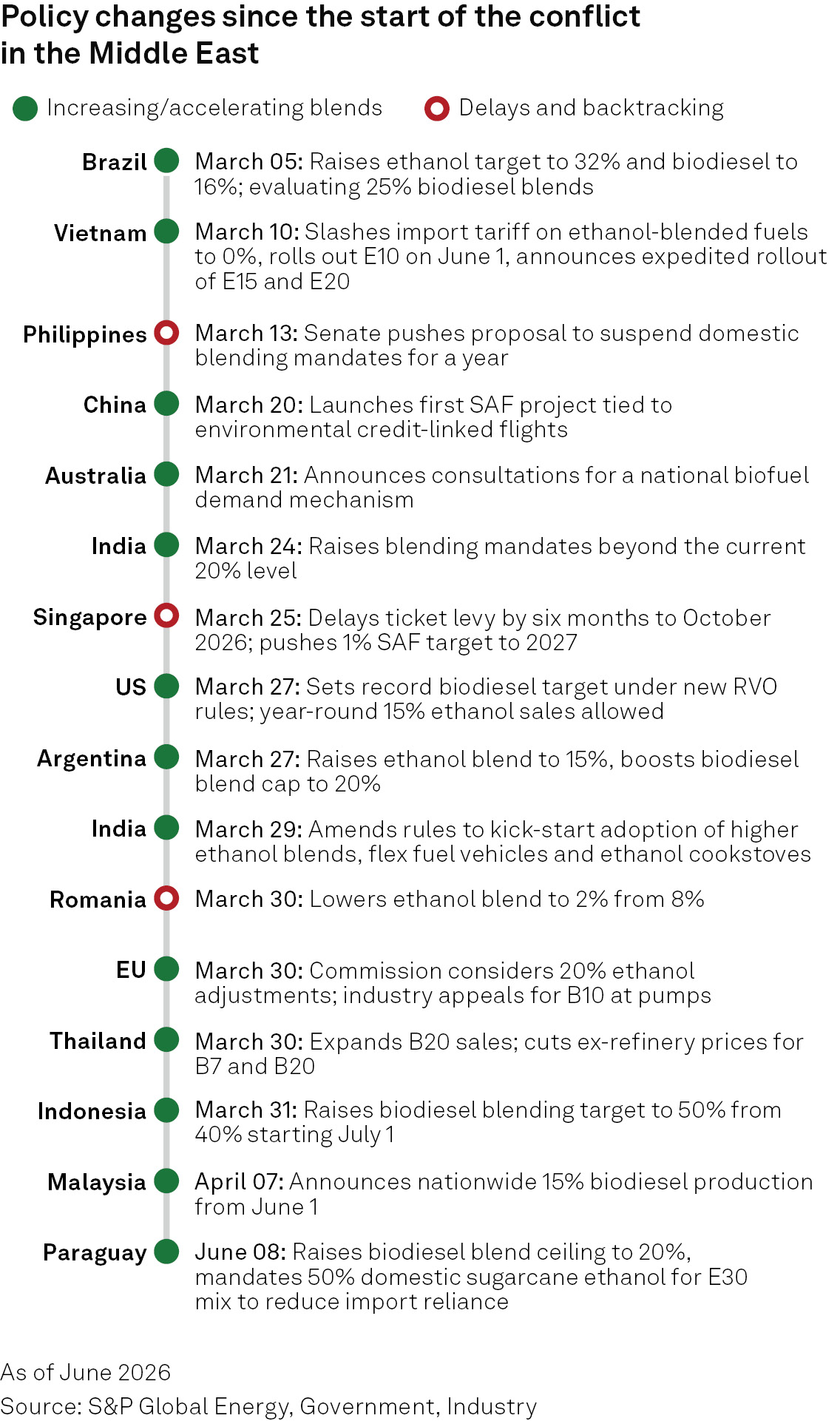
Blending mandates accelerate
India blended 1.02 billion liters of fuel ethanol in May, maintaining its E20 status since achieving the milestone in June 2025 ahead of its 2026 deadline. India's total consumption of fuel ethanol accelerated from 7.6 billion liters in 2024 to 10.55 billion liters in 2025.
India's blending program mandates the use of locally sourced ethanol to reduce dependence on crude imports.
Expanding on the E20 success, the government in May asked the Automotive Research Association of India to study the impact of E25 fuel on vehicles, even as the Bureau of Indian Standards has formalized specifications for E22, E25, E27 and E30 gasoline blends.
Vietnam has also accelerated its transition by bringing forward to June the nationwide rollout of E10 gasoline, initially slated for July, offering it alongside the E5 standard, which will be discontinued in 2030. Vietnam is increasing its focus on adding domestic ethanol production capacity to meet local blending demand, while imports continue to support its energy transition efforts.
The Philippines already mandates E10 and a higher E20 blend has been permitted on a voluntary basis since 2024. After the Middle East crisis broke out, Philippine lawmakers weighed a proposal to suspend domestic biofuel mandates to limit consumers' exposure to volatile global oil prices.
Japan, another key crude importer in Asia, released in 2025 its plan to introduce E10 blending by 2030 to cut domestic emissions and limit its exposure to crude price fluctuations. However, infrastructure limitations and import dependence are potential constraints to a nationwide rollout.
Indonesia has also mandated the implementation of E5 blends from July, with plans of expanding it to 10% between 2028 and 2030, starting at key demand centers like East Java, Jakarta, West Java, Banten, Central Java, Yogyakarta and Bali.
As Asia's ethanol demand rises to meet these mandates via a mix of domestic and imported ethanol, the region is also expected to face hurdles ranging from feedstock availability to logistics to pricing.
Supply challenges
A rapid shift toward higher blends reveals supply gaps in ethanol and feedstocks, S&P Global Energy Horizons said in a July report.
The global sugar balance for 2025-26 was reduced by 845,000 metric tons to a surplus of 3.3 million mt, according to the Horizons report, driven primarily by a downward revision to the CS Brazil crop. The 2026-27 surplus increased marginally to 2.6 million mt. Initial estimates for 2027-28 point to a modest surplus of 0.7 million mt, amid expectations of a stronger global consumption growth and a weaker Asian production outlook. El Niño conditions are likely to lead to a drop in Thailand's sugar production in 2026-27.
In the World Agricultural Supply and Demand Estimates report released July 10, the US Department of Agriculture forecast US corn production at 16 billion bushels in MY 2026-27, down 6% year over year, with yields seen at 183 bu/acre, down 1.9% year over year.
The Philippines' 2026 biofuels demand under the E10 mandate is estimated at 830 million liters of ethanol. Local ethanol capacity stands at 468 million liters, with an allocated production of 403 million liters in 2025.
This leaves a gap of more than 400 million liters of ethanol, which is made up by imports permitted only after domestic production allocations are met.
Similarly, Horizons estimates that Vietnam will require 420 million liters of ethanol in 2026, with the E10 mandate rolled out. Introducing E10RON95 alongside the existing E5RON92, ethanol demand is projected to reach 760 million liters in 2027.
According to Vietnam's Ministry of Industry and Trade, the country's annual ethanol production is estimated at around 300 million liters in 2026, against a national nameplate capacity of 490 million liters. This is further constrained by the limited supply of cassava, the main ethanol feedstock, for domestic ethanol producers.
Indonesia's ethanol demand to meet its 2026 E5 target is expected to be 540 million liters, rising to 1.14 billion liters in 2027, according to Horizons. The government will increase the blend rate from E5 to E10, requiring a total volume of 2.3 billion liters to meet its 2028 blending target.
Meanwhile, India's production capacity is reported to exceed 20 billion liters annually, with domestic blending demand hovering between 10.5 and 11 billion liters. Other industries like alcoholic beverages, paints and pharmaceuticals consume about another 3 billion liters. Despite reduced operating rates, India continues to run a net surplus.
Prices on rise
Asian anhydrous fuel ethanol prices have closely tracked the volatility in the global CME Chicago ethanol (Platts) futures and crude prices. Since the start of the year, Chicago ethanol futures rose by over 20% through July. At the start of the year, the CME Chicago ethanol Platts front month was assessed at $1.5825/gal, rising to $1.905/gal by July 29.
Platts CIF Philippines fuel grade ethanol peaked at $705/cubic meter May 6, following a sharp uptick in ethanol futures.
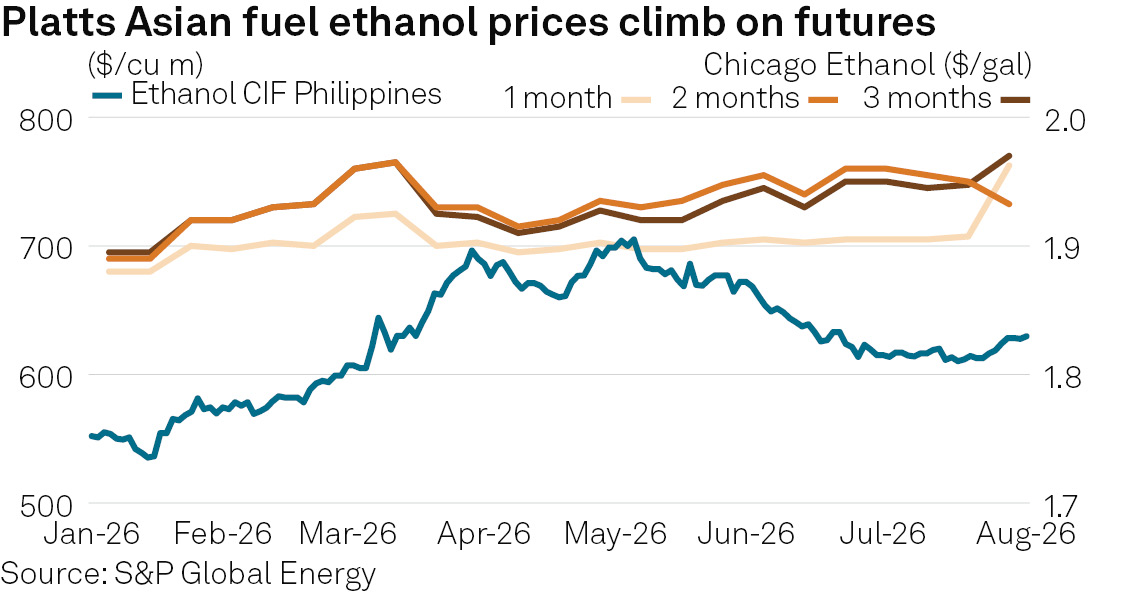
In the US, fuel prices were supported by higher crude oil and gasoline prices amid the Middle East conflict as well as a sharp jump in D6 RINs (Renewable Identification Number) that boosted US biofuel pricing.
Cautious buying
Despite announcements and expansions of ethanol blending mandates in Asia, total ethanol imports by Asian nations appear to be declining.
Total ethanol imports for Japan, South Korea, the Philippines and India totaled around 1.34 billion liters from January through May, down around 11% in the same months last year, according to S&P Global Energy data.
Asian buyers cited a cautious approach — volatile freight costs due to the Middle East conflict have kept them mostly in a wait-and-watch mode.
An Asian-based trader said, "Most of the buyers are waiting until the last minute to purchase." Meanwhile, Indian imports were reported down around 23% at 255 million liters over January to
May as Indian buyers source ethanol locally. Indian buyers reported that the drop in Indian imports is due to elevated ethanol futures, which have led to significantly higher import offers.
With competitive domestic prices and availability, Indian buyers turned to locally sourced materials, leading to a decline in import volumes. Despite increased gasoline demand, Asian traders reported that buying remains very prompt.
The Middle East conflict prompted Southeast Asian governments to reassess and restructure their domestic fuel markets, using local resources to strengthen energy security and reduce exposure to price volatility.
"Key fuel segments like gasoline can be replaced by fuel ethanol where agricultural products such as maize and sugarcane can be turned into fuel to cushion energy import dependence," Chua said.
"Developing and signaling strong political direction has been key to developing domestic biofuels markets through infrastructure upgrades and boosting producer confidence."
This article first appeared in the September 2026 edition of Insights Magazine.
