Agriculture, Refined Products, Crude Oil, Energy Transition, Biofuels, Jet Fuel, Renewables
September 18, 2026
SAF: Global prices firm amid fossil complex volatility

By Staff
Editor:
Global sustainable aviation fuel (SAF) prices have remained elevated through 2026, supported by geopolitical volatility and expanding compliance obligations, amid growing supply capacities from Asia.
While SAF markets have generally tracked gains in the wider aviation fuel complex, price movements have been tempered by unique supply-and-demand dynamics. Unlike conventional jet fuel, SAF pricing is increasingly influenced by blending mandates, certification requirements and the availability of eligible feedstocks and production capacity. As Europe's compliance market matures and Asia emerges as a key export hub, regional developments are playing an increasingly important role in global price formation.
Geopolitical tensions
Aviation fuel prices strengthened in the first half, following heightened geopolitical tensions in the Middle East and concerns over energy supply security.
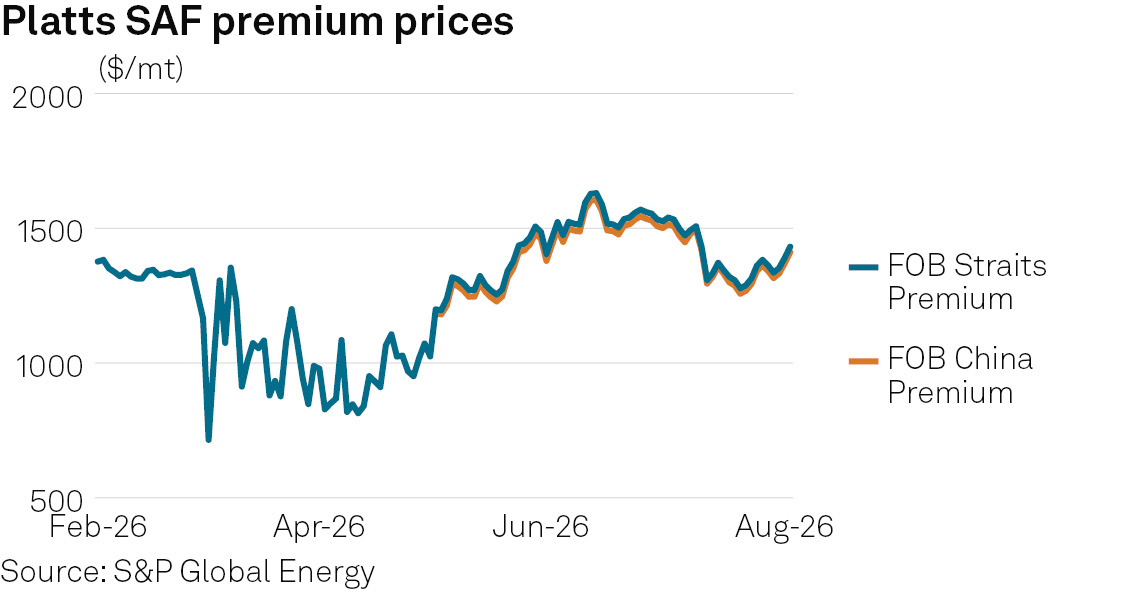
The escalation of volatility surrounding the Strait of Hormuz supported prices across the refining complex, with jet fuel markets responding particularly strongly to concerns over regional supply disruptions. SAF prices also moved higher, although gains generally lagged those seen in conventional aviation fuels. By the end of H1, Platts had assessed the FOB Straits SAF outright price at $2,435/mt, while the FOB China SAF outright price was assessed at $2,410/mt. Platts is part of S&P Global Energy.
Market participants noted that SAF continued to trade within a separate set of fundamentals, influenced by feedstock costs, renewable fuel economics and compliance demand rather than crude oil and geopolitics alone.
The differing response highlights the increasingly complex nature of SAF pricing. While conventional jet fuel remains highly sensitive to geopolitical events, SAF values are also shaped by the availability of renewable feedstocks, certification requirements and the pace of mandated consumption growth.
As a result, geopolitical disruptions have continued to provide underlying support to SAF prices, while reinforcing the strategic importance of diversified supply chains and regional production capacity.
Europe's compliance market
Europe continues to act as the primary demand center for SAF, supported by the implementation of the ReFuelEU aviation framework and growing pressure on airlines and fuel suppliers to secure compliant volumes.
The EU's SAF mandate entered into effect in 2025, requiring aviation fuel suppliers to incorporate SAF into conventional jet fuel supplied at EU airports. The program establishes progressively higher blending obligations through 2050, creating a long-term source of demand for SAF producers globally.
The response has been varied so far in 2026. Some buyers increased procurement activity as conventional jet fuel values rose, narrowing the relative premium of SAF. Others delayed purchases and focused on managing fossil fuel exposure amid uncertainty in broader energy markets. Despite these differing strategies, market sentiment suggests significant compliance volumes remain secured later in the year.
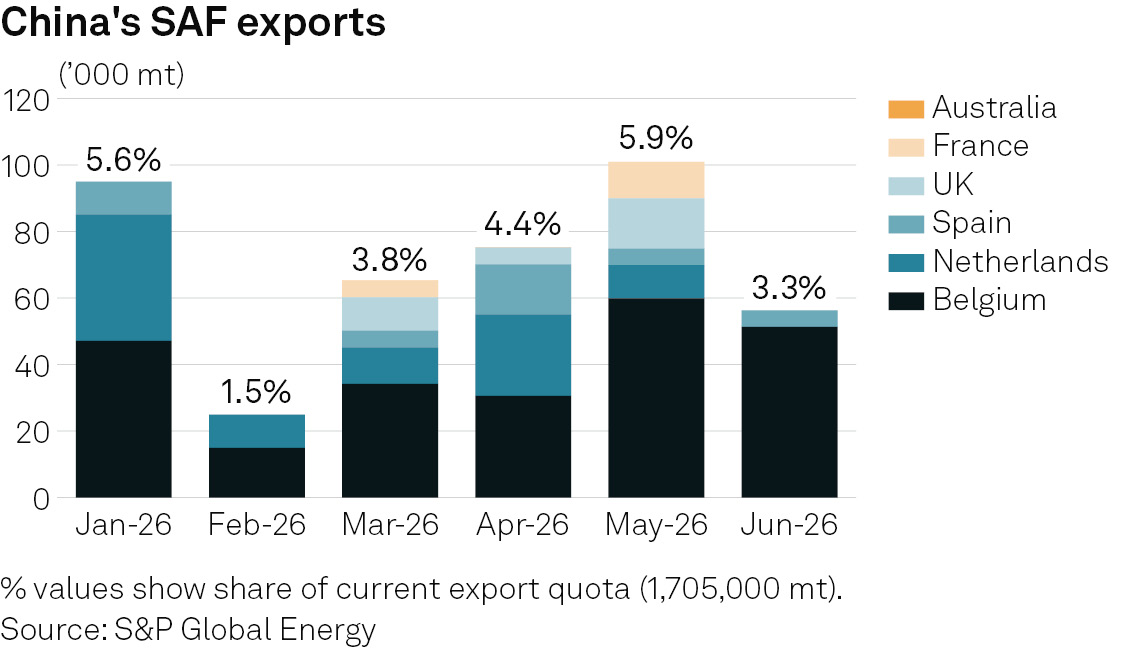
Supply availability has also been tighter than expected. European participants pointed to lower-than-anticipated SAF imports from China during parts of the year, limiting prompt availability despite expectations of growing Asian exports. Recently approved additions to China's export whitelist are expected to increase supply during the second half of 2026, although market participants continue to monitor the pace at which these additional volumes reach international markets.
Logistical challenges have added further complexity. Persistently low water levels along the the Rhine disrupted inland transportation routes across parts of Germany during the summer, forcing some market participants to explore alternative delivery options and contributing to regional supply concerns.
Asia as a key supplier
The role of Asia in global SAF supply has been on the rise.
Expanded production capacity across the Straits region, combined with rising exports from China, has increased Asia's influence over international SAF balances. What was once viewed primarily as an emerging demand center is increasingly becoming a major source of supply for compliance-driven markets abroad.
Customs data show China exported almost 418,000 mt of SAF in H1, with the vast majority of those volumes delivered to European destinations, including Belgium, the Netherlands, Spain, the UK and France. Belgium alone accounted for roughly two-thirds of all Chinese SAF exports in H1.
China has been particularly influential. Market participants have closely tracked developments surrounding the country's SAF export framework, with incremental export volumes capable of significantly altering regional balances. European buyers have increasingly looked toward Asia to supplement domestic supply, making Chinese export decisions an important variable for international price formation.
At the same time, domestic demand signals within Asia continue to strengthen. Governments across the region are advancing aviation decarbonization goals through blending targets and policy initiatives. Singapore is targeting a 1% SAF blending requirement by 2027, rising to between 3% and 5% by 2030, while Japan aims for a 5% SAF blend from 2030 at seven airports. Similar initiatives are being pursued elsewhere in Asia as countries seek to reduce aviation emissions while strengthening long-term energy security.
These developments are gradually creating a more interconnected SAF market, with policy decisions in Asia increasingly influencing price expectations and supply availability far beyond the region.
A new phase of price discovery
Despite significant investment and policy support, SAF production remains well below the volumes required to meet long-term aviation decarbonization targets.
The International Air Transport Association estimates global SAF production will reach approximately 2.4 million metric tons in 2026, accounting for just 0.8% of total aviation fuel consumption.
This limited availability continues to support prices at a time when demand obligations are increasing. Unlike conventional aviation fuels, SAF markets are influenced by a combination of energy fundamentals, feedstock economics, government policy and certification frameworks. The interaction of these drivers has created a pricing environment that is increasingly global in nature.
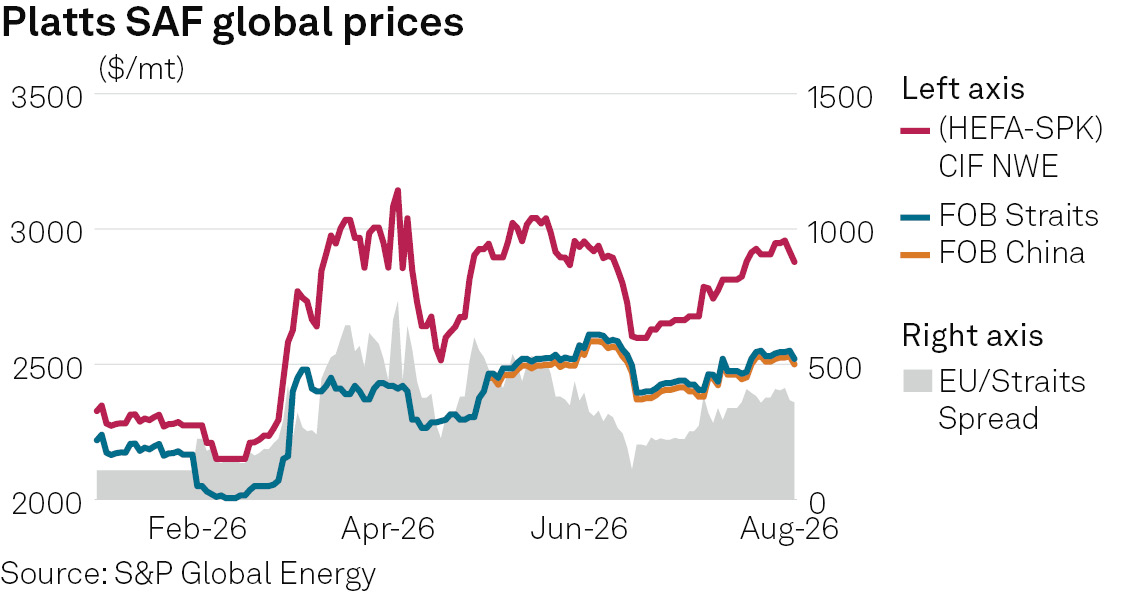
As Europe expands compliance demand and Asia continues to increase production capacity, SAF benchmarks are becoming an increasingly important tool for airlines, producers and traders seeking transparency in a rapidly evolving market. For market participants, understanding regional supply shifts and policy developments may prove just as important as tracking movements in the underlying jet fuel complex.
This article first appeared in the September 2026 issue of the Insights Magazine.
