Agriculture, Chemicals, Energy Transition, Maritime & Shipping, Rice, Polymers, Renewables, Pesticides, Grains
September 09, 2026
Asian rice exporters assess impact of Europe’s new packaging regulations
By Ayushi Baloni and Muskan Agarwal
Editor:
Asian rice exporters face a compliance test as the EU's new packaging rules take effect. India, Thailand, Vietnam, Pakistan, Myanmar and Cambodia collectively supply nearly 80% of the EU's rice imports, according to data from the European Commission.
The EU's Packaging and Packaging Waste Regulation (PPWR) entered into force on Feb. 11, 2025, with general mandatory application starting on Aug. 12, according to the European Commission. The regulation mandates that all packaging placed on the EU market must be recyclable by 2030, with minimum recycled content requirements for plastics, according to the commission.
The regulation restricts single-use packaging and enforces clear labeling and traceability requirements to promote sustainability and reduce waste, according to the European Commission.
The regulation comes as the EU continues to maintain one of the world's most stringent import-control systems. Analysis of Rapid Alert System for Food and Feed (RASFF) notifications released by the European Commission shows that about 300 rice-related notifications involving India, Pakistan, Thailand, Vietnam and Cambodia were issued between January 2024 and August 2026. Pesticide residues and mycotoxin contamination accounted for most cases.
While packaging-related issues have represented only a small share of notifications, industry participants said the PPWR could broaden compliance requirements for exporters. The regulation extends beyond food-safety standards to include packaging design, recyclability and material sourcing requirements.
India and Pakistan account for more than 90% of rice-related RASFF notifications during this period, according to the European Commission. These origins may now need to be scrutinized not just for pesticide controls but also for packaging materials, traceability and recyclability requirements to maintain market access.
What PPWR requires
The EU PPWR, part of the EU's Green Deal, updates and replaces the existing Packaging Waste Directive. According to key measures outlined in the regulation, all packaging in the EU must be fully recyclable by 2030, with rising targets for recycled content in plastics through 2040.
The regulation bans excessive and unnecessary packaging, promotes lightweight designs and strengthens deposit-return and refill systems. Single-use plastics will be restricted and brands using harmful materials will pay cleanup costs, according to the EU Commission. Hazardous "forever chemicals" in packaging will be limited, ensuring safer, more sustainable products for the EU market.
This means that Asian rice exporters must sooner or later upgrade their packaging to meet EU recyclability and recycled-content standards. Failure to comply could result in shipment rejections, higher costs and potential loss of market access.
Asia-EU rice trade flows
The EU remains a key destination for Asian rice exporters. The region consistently supplies around four-fifths of the bloc's import needs.
In marketing year 2024-25 (September-August), the EU imported 2.32 million metric tons of rice from all origins, according to the European Commission's rice trade data. Of this total, 1.86 million mt, or 80%, came from Myanmar, Cambodia, India, Pakistan, Thailand and Vietnam alone, according to the data.
Myanmar was the largest supplier at 670,930 mt, according to the commission. Cambodia followed with 314,840 mt, India with 311,380 mt and Pakistan with 256,070 mt during the same period.
The dominance of Asian origins has continued into MY 2025-26, with imports from the six suppliers reaching about 1.36 million mt between September 2025 and June 2026.
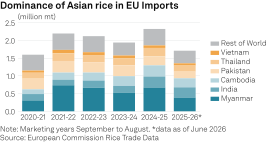
The scale of these trade flows underscores the EU's importance as a destination market for Asian exporters. It highlights how regulations such as the PPWR could influence supply chain and packaging practices far beyond Europe.
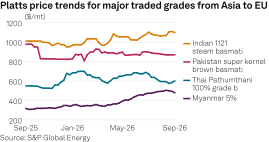
EU buyers sourcing rice from key Asian origins typically focus on a mix of premium and value-oriented varieties, depending on end-market demand.
Platts assessed major varieties prominently bought by the EU include India's 1121 Steam Basmati, Pakistan's Super Kernel Brown Basmati, Thailand's Pathum Thani 100% Grade B, Myanmar's long grain 5% WR and Cambodia's Phka Malis variety.
Industry response varies
Compliance with PPWR could require changes to packaging specifications, greater use of recyclable materials and more detailed documentation for shipments bound for the EU. However, the cost implications remain difficult to quantify, with many suppliers still assessing the regulation's full impact.
A European broker said he does not see the new EU PPWR regulation as a major concern, particularly regarding EU trade flows from Myanmar. The broker explained that the EU imports most of its rice from Myanmar in bulk, packed in liner bags. Since liner bags use less plastic by weight than individual-bag packaging, he expects the regulation to have a limited effect on these shipments.
The broker added that freight is the bigger driver. The EU has been experiencing higher freight costs from Asia due to geopolitical tensions, which have reduced demand in the EU, the broker said. In response, EU buyers have sourced from nearby regions and South America, where freight has been lower than in parts of Asia.
Higher freight rates, driven by geopolitical tensions and longer shipping routes, together with price volatility, continue to pose a bigger challenge than potential packaging changes, the broker said.
The recyclable materials are already used for many EU-bound cargoes, limiting the immediate scale of adjustment required, the broker said.
Exporters in Pakistan, Myanmar and Cambodia broadly agreed that Europe is becoming an increasingly compliance-heavy market. Stricter regulations, more frequent testing and growing documentation requirements are steadily adding to operating costs and administrative burdens.
"They [EU] are already clamping down on packaging, requiring MOAH/MOSH tests to ensure goods will be EU compliant for mineral oils. I wouldn't be surprised if they implemented the same rule for Indian and Pakistani-origin rice. EU laws become tougher to comply with each year," an exporter based in Karachi said.
MOAH (Mineral Oil Aromatic Hydrocarbons) and MOSH (Mineral Oil Saturated Hydrocarbons) are mineral oil contaminants from packaging that can migrate into food, according to the European Food Safety Authority.
Meanwhile, some European buyers said it remains too early to quantify the overall cost impact, as the industry is still assessing how the rules will apply across different packaging formats.
The PPWR would primarily affect packaging rather than the bulk rice loads themselves. As a result, bulk shipments may face limited direct impact, one EU rice buyer said.
Rice imported in large bags, liner bags and small packs is likely to face higher compliance and production costs, another EU importer said.
For now, PPWR is not widely viewed as a stand-alone trigger for a major redirection of Asian rice exports. However, it adds another layer of uncertainty to shipments destined for a market already affected by soft demand, elevated freight costs and tightening import standards.
"We have not yet seen our customers asking for any specific packaging type yet, so it should not be much of an issue," said a Cambodia-based exporter.
For Asian exporters, particularly smaller players in Myanmar and Cambodia, compliance could mean overhauling packaging lines. It could also require sourcing compliant materials and ensuring greater traceability across supply chains. Industry sources said that smaller exporters may face disproportionately higher compliance costs and more limited access to certified packaging suppliers.
Way forward
The EU's regulatory landscape is evolving rapidly. For Asian rice exporters, the challenge extends beyond compliance to competition.
While PPWR may not immediately alter trade flows, it signals the direction for one of the world's most important premium food-import markets. Exporters who invest early in compliant, eco-friendly packaging and transparent supply chains will be better positioned to capture market share. They can build lasting relationships with European buyers as sustainability expectations continue to rise.
