Agriculture, Maritime & Shipping, Oilseeds, Biofuels, Meat, Vegetable Oils, Livestock
August 14, 2026
Soybean markets at a crossroads: China's protein trends, Brazil's expansion and US uncertainty

Editor:
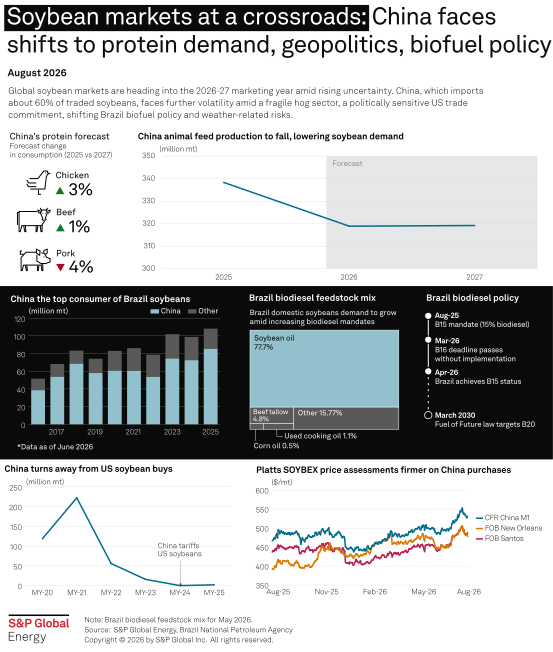
Global soybean markets are entering the 2026-27 marketing year under mounting uncertainty. China, which absorbs about 60% of all traded soybeans, is navigating a fragile hog sector, a geopolitically charged US trade commitment, Brazil's domestic biodiesel policy and weather — all converging at once.
China: Soybean crushing robust yet imports cautious
China is the single most important demand driver in the market.
Despite negative margins, China's crushing activity remained robust, averaging 2.47 million metric ton/week in July, 21% above the five-year average.
However, expectations for imports in the upcoming marketing year are mixed. The US Department of Agriculture's July World Agricultural Supply and Demand Estimates (WASDE) forecasts imports at 115 million mt, 2 million mt higher than its 2025-26 estimate. S&P Global Energy CERA has taken a more bearish stance, cutting its forecast from 115.2 million mt in May to 108 million mt in July.
CERA's outlook is shaped by expectations of a gradual slowdown in crush activity in China as Brazilian arrivals decline, crushers undergo summer maintenance and soymeal stocks build.
China's hog sector continues to face profitability pressures, according to CERA's July outlook report. The decline comes despite a policy-led push to reduce the number of breeding sows. The Ministry of Agriculture and Rural Affairs set a sow herd target of 37.5 million head in May. By end-June the herd had fallen to 37.8 million head, approaching the government's desired level.
At the Trump-Xi summit in Busan, South Korea, in October 2025, China committed to purchasing 25 million mt of US soybeans annually for three years. Last May in Beijing, China pledged to purchase $17.1 billion of US agricultural goods per year from 2026 to 2028. However, China has been slow to execute the purchases. As of Aug. 6, China's US soybean purchases stood at just over 4 million mt, or 16% of the target volume. China's Sinograin has been conducting weekly state reserve auctions and US-based traders said these could help free storage space for additional US soybeans.
China's tariff on US soybeans is flagged by many as a key obstacle but as Xi is scheduled to visit the US in September, the industry awaits announcements on potential reductions that would spur more buying.
Brazil: Bearish production 2026-27, B16 delay
CERA's July outlook pegs Brazil's 2026-27 soybean crop at 177 million mt, 2.7% lower than 2025-26 production and 9 million mt below the USDA July WASDE forecast, as farmer margins come under pressure from high fertilizer costs, El Niño concerns and elevated interest rates.
The National Oceanic and Atmospheric Administration indicated a nearly 90% chance of at least a strong El Niño occurring during Brazil's soybean planting season in September to November. This will impact 2026-27 soybean production yields. Although Brazil's acreage expansion could soften the blow, that too is uncertain. Any production loss would likely translate directly into lower exports and tighter crush margins.
In domestic demand, Brazil raised the biodiesel mandate from B14 to B15 in August 2025. B16 implementation was planned this year, but the move was delayed in March due to incomplete feasibility testing, dampening hopes for domestic demand.
Brazil's Fuel of the Future law targets B20 by 2030 and the long-term impact will support soybean crushing.
Meanwhile, Brazil is also the world's largest exporter of chicken and beef and the third-largest exporter of pork. The Platts Brazil beef front forequarter eight-cut price assessment has trended steadily higher since its 2024 launch, supported by strong Chinese and US imports. China, the world's largest beef importer, has seen its demand driven by rising incomes and a shift toward beef as a perceived healthier protein — all of which supports the livestock feed demand in Brazil.
However, in the spot market, China's demand for Brazil beef has come under pressure as 2026 import quotas are exhausted but US demand is resilient.
Brazil's logistics network has strengthened significantly, with Northern Arc ports now accounting for around 36% of soybean exports, double their share a decade ago. This expansion has helped ease dependence on the traditional export hubs of Santos and Paranaguá, improving export efficiency and market access. But as production and exports continue to rise, structural bottlenecks remain, particularly in storage capacity, heavy reliance on road transportation and seasonal congestion during peak export periods.
Argentina: Strike disruption
Argentina, the world's largest soybean meal exporter, and its meal sector dynamics have an impact on Brazil's soybean health.
Early-2026 harvest delays and the threatened strike in Rosario/Parana export corridor disrupted supply, supporting Brazil meal and crush margins. On Aug. 1, a strike by Argentine river pilots paralyzed exports and at least 140 vessels were stuck, with the backlog growing. The bottlenecks have already prompted some shipowners to redirect cargoes to ports in Uruguay and southern Brazil, according to the reports. Although the strike was resolved three days later, market conditions took time to recalibrate.
In 2025, Brazil overtook Argentina soybean meal sales to the EU for the first time in six years. This year, between January and June, Brazil continued to dominate the EU market with about 27% higher sales than Argentina, according to S&P Global Energy Commodities at Sea data.
US: Fundamentals remain strong
US soybean sales have been constrained by geopolitical tension with China in recent years. With Chinese commercial demand subdued, the primary US market drivers are acreage, biofuel policy and weather forecasts.
In July, CERA estimated 85.4 million acres of soybeans would be planted in the US in 2026-27, up from 81.1 million acres in 2025-26. CERA attributes the increase to two factors: crop rotations and higher soybean insurance prices relative to other row crops. With favorable weather, CERA forecast yields of 54 bushels/acre, above USDA's 53 bu/ac.
US crush margins remain high so far in 2026, with soybean meal demand supported by both strong domestic consumption and elevated export volumes to the Philippines, Mexico, Colombia and other markets. Soybean oil retains a premium over global vegetable oils, underpinned by the Renewable Volume Obligation (RVO).
The US Environmental Protection Agency released the final RVO for biofuels for 2026 and 2027 on March 27, which included increases considered bullish by sources for soybean oil and soybeans. Bio-based diesel volumes, which have soybean oil as a primary feedstock, were set at 8.86 billion Renewable Identification Numbers for 2026 and 8.95 billion in 2027.
Finally, China is not simply the world's largest soybean importer; it is becoming an increasingly important processor and exporter within global agricultural supply chains. It is now the world's fifth-largest exporter of chicken breast, and Chinese soybean meal exports to Southeast Asia are emerging.
Learn more: Platts Global Soybean Price Assessments Explained
