Crude Oil, Maritime & Shipping, Refined Products, Dry Freight, Wet Freight, Fuel Oil, Bunker Fuel
October 29, 2025
INTERVIEW: Cargill sees higher freight and bunker use in US-China port fee tussle

By Max Lin
HIGHLIGHTS
Higher freight rates and bunker consumption due to US-China port fees
Inefficient ship deployments leading to higher costs and emissions
Lack of clarity on China's port fee rules creates uncertainty
Cargill is seeing higher freight rates and bunker consumption after China and the US imposed reciprocal port fees on ships linked to each other, according to its top maritime executive, as the major US trader evaluates how the fees could affect its shipping costs.
The world's two largest economies have begun charging ship operators the high levies since Oct. 14, which industry participants suggest is driving US ships away from Chinese ports and Chinese ships from US ports.
"We're getting more and more inefficient," Cargill Ocean Transportation's President Jan Dieleman told Platts in a recent interview. "We have a fleet that can't really go to China. We have a fleet that can't really go to the US."
Merchant ships would consequently need to travel longer distances because vessel operators could not deploy them in the most efficient way, leading to higher freight costs, fuel use and associated greenhouse gas emissions, according to Dieleman.
"That will have impact on [freight] prices. It will have impact on [freight] economics. It will have impact on emissions," the executive added.
The US Trade Representative announced most parts of their port fee regime in April, which, according to some industry participants, provided shipping companies ample time to prepare and limited market impact.
On the contrary, the Chinese transport ministry announced their port fees on Oct. 10, prompting a scramble for tonnage and spikes in freight rates as US-linked ships steered away from the world's largest seaborne trading nation.
"In the US, there was a consultation period ... [while Chinese port fees] create a lot of anxiety and to some extent, maybe even a little bit of panic in the markets," Dieleman said.
S&P Global Energy estimates 712 tankers, or nearly 10% of the global fleet, could be exposed to the Chinese port fees, including 129 Suezmaxes, 112 Aframax/LR2 tankers and 97 VLCCs.
On the dry bulk side, 4.5% of the Capesize fleet, 5.5% of Panamax, 4.2% of Supramaxes and 3% of Handysizes might need to face the levies, according to Energy.
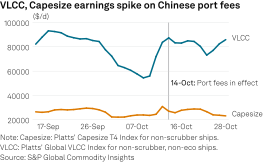
Platts' Capesize T4 Index for non-scrubber ships jumped from $22,266/d Oct. 1 to $30,844/d Oct. 13, before easing back to $23,170/d Oct. 28. The Global VLCC Index for non-scrubber, non-eco ships rose from $54,405/d Oct. 8 to $87,323/d Oct. 14, before edging down to $85,849/d Oct. 28.
Regulatory clarity
Cargill has a chartered fleet of nearly 600 dry bulk carriers transporting cargoes both for itself and external clients, while offering tanker freight services for crude, petroleum products and gas.
China's port fees apply to ships built or flagged in the US, or those owned or operated by entities in which US companies, organizations, or individuals directly or indirectly hold 25% or more of the equity.
Dieleman said Cargill is still assessing the regulation's impact on its expenses, as Beijing has not yet provided clear definitions of shipowners, ship operators and rules on determining equity structure.
While some ships in Cargill's fleet could be defined as US-linked vessels, the company's direct exposure could be limited as it is not the holder of document of compliance, according to Dieleman.
Shipping industry participants can often refer to a ship's operator as its charterer or technical manager, the latter of which may be its DOC holder.
"Some of the items are quite complicated. We haven't got an exact clarification," Dieleman said.
Decarbonization
Meanwhile, Dieleman expects less investments in producing sustainable marine fuels amid demand uncertainty after International Maritime Organization member states voted to delay the adoption of new decarbonization rules in mid-October.
The UN agency's Net-Zero Framework is designed to place a cost on maritime GHG emissions from 2028 to reduce the price gap between green and conventional, oil-based fuels, which many shipping professionals say is essential to accelerate the uptake of low-carbon energy.
"Personally, it's a disappointment. I think it is creating a period when it's difficult to make investment decisions," Dieleman said.
Prospective producers were waiting for shipping companies to commit to long-term offtake deals before investing in production plants. "[But] in the current environment, you're not going to get these projects going ... you delay everything," the executive added.
National and regional governments could start developing their own emissions regulations if the IMO does not adopt the new rules, which would not be preferred by the industry where ships trade globally, according to Dieleman.
Still, such a development could open up some new opportunities on bilateral deals around green corridors, promoting the use of low-carbon marine fuels to some extent, the executive added.
"If going global is not possible, then I think we're just going to go regional, and it's going to get more complicated," Dieleman said. "But at the end of the day, it will also help us in the energy transition."
