Maritime & Shipping, Refined Products, LNG, Electric Power, Energy Transition, Wet Freight, Fuel Oil, Bunker Fuel, Diesel-Gasoil, Renewables
October 21, 2025
Oil, LNG scores victory against green bunkers amid stalling IMO talks

By Max Lin
HIGHLIGHTS
Net-Zero Framework's future fate uncertiain
Fossil fuels remain preferred marine energy
Uncertainty looms over shipping's energy transition
Fossil fuels could remain the preferred marine energy at the expense of low-carbon fuels, with the International Maritime Organization's new decarbonization rules hanging in the balance, according to industry participants.
Supporters of the UN agency's Net-Zero Framework were hoping the regulatory piece could kickstart the industry's energy transition from conventional, oil-based fuels to methanol or ammonia with much lower greenhouse gas emissions intensity.
But IMO member states earlier this month voted to delay the framework's adoption by a year, and those involved in the talks said its implementation could be rescheduled towards the end of this decade -- if it ever occurred.
"The delay will in reality lead to a reopening of text because a revision of dates is required," Danish Maritime Authority's Chief Advisor Thomas Blomgren-Hansen said, as the regulation can only enter into force 16 months after adoption based on international law.
"That could lead a complete renegotiation, putting the whole deal at risk [and] delaying the transition for an even longer period," Blomgren-Hansen said on LinkedIn.
S&P Global Energy estimates oil-based fuels made up 97% of the global bunker mix in 2024, followed by LNG at 2%.
The new IMO regulation, which would place a cost on bunker fuels' GHG from 2028, is designed to reduce the price gap between conventional and sustainable fuels.
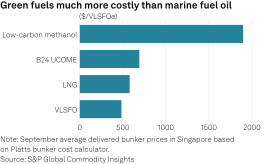
The monthly average delivered bunker price for 0.5% sulfur fuel oil, the most common bunker type, was $483.73/metric ton in Singapore in September, compared with $579.17/mt very low sulfur fuel oil equivalent for LNG, $691.92/mtVLSFOe for B24 biobunker fuel with 24% used cooking oil methyl ester, and $1,897.44/mtVLSFOe for 100% sustainable methanol, according to the Platts bunker cost calculator.
The IMO's decision to delay the adoption has created uncertainties among shipping and bunker companies in pursuit of a low-carbon transition, even though member states will have a chance to improve the framework's design, many industry participants said.
"After what happened ... I can understand why people don't want to double down on net-zero fuels," Cargill's shipping head, Jan Dieleman, said during the Global Maritime Forum on Oct. 21.
Delayed adoption
In April, EU member states, Singapore, Brazil and some others won a 63-16 vote to approve the new rules, which still need to be adopted based on the IMO's regulatory process.
The US, Russia, Venezuela and some Middle Eastern oil-producing countries have maintained their opposition to the framework, which they argue is attached with punitively high carbon costs, overly stringent decarbonization requirements, and harsh on transition fuel consumers.
Saudi Arabia proposed to postpone the framework's adoption amid the deep rift, and its motion is backed by a slim majority including China, India and some major flag states like Panama and Liberia that supported it in April.
Despite an EU mandate to adopt the IMO regulation, Greece and Cyprus -- two EU members that are among the world's top shipowning nations -- abstained from the postponement vote.
Vassilis Kikilias, Greece's Minister of Shipping, said after the vote that the framework has "unfair treatment of LNG fuel" and would likely cause serious disruptions in global trade and lead to inflation.
IMO member states will continue to develop implementation guidelines to address concerns over the framework, including how the carbon revenue would be used and a lifecycle assessment methodology for GHG, according Secretary-General Arsenio Dominguez.
"The framework is in place, what we need to do is to develop the guideline," Dominguez told the GMF. "What we paused is the adoption itself, not further work."
Classification DNV estimates LNG could be a non-compliant fuel at the turn of this decade based on the current regulatory design, but IMO member states could in theory prolong its use by setting a low default emissions factor.
"LNG just got another improvement in its relative competitiveness versus the fully green fuels," consultancy Vespucci Maritime CEO Lars Jensen said, citing increased uncertainty over the investment case for green fuel production due to the framework's delayed adoption.
Outlook
LNG can reduce emissions by 20%-30% compared with oil-based fuels, and its supporters said ships with LNG-capable propulsion can later switch to bio-LNG or e-LNG for deep decarbonization when the low-carbon fuels become widely available.
"The methane pathway is currently the only practical, realistic and scalable solution to the decarbonization of the global maritime industry," according to a statement from SEA-LNG, an industry association set up to promote marine LNG with Shell and TotalEnergies among its members.
The association will work with others to "continue to develop meaningful, scientific studies to support the IMO's critical work" in the coming year, SEA-LNG said following the postponement vote.
In a recent study commissioned by SEA-LNG, Rystad Energy estimates the well-to-tank GHG intensity of LNG bunker at 13.9 grams of CO2e/megajoule in 2024, compared with 18.8 grams of CO2e/Mj in 2019.
But some industry participants said whether the IMO regulation is adopted or not could depend on geopolitics, rather than its content per se.
The US has threatened countries that support the IMO regulation with visa restrictions, sanctions, port ban and fees, among other measures, as President Donald Trump repeatedly questioned the existence of climate changes in contrary to UN scientists.
"The world we're living in today is very different from the one just a few years ago," Maria Skipper Schwenn, director of public affairs at Bunker Holding, said on Linkedin. "I think it would be fair to say that the opponents' reasoning had very little to do with shipping."
