Refined Products, Maritime & Shipping, Fuel Oil, Bunker Fuel, Wet Freight
July 09, 2025
Greek ship sinks in Red Sea after attacks, Houthis claim to 'rescue' seafarers

By Max Lin
HIGHLIGHTS
Eternity C becomes likely second total loss in recent days
Renewed Houthi attacks underscore Red Sea transit risks
Security outlook uncertain despite joint industry calls
The Greek dry bulk carrier Eternity C has sunk in the Red Sea after being attacked by Houthi fighters, likely the second total loss of a ship in recent days, and the Yemen-based rebel group claimed to have "rescued" some seafarers.
On July 7, the UK Maritime Trade Operations reported the 36,830-dwt Eternity C sustained significant damage and lost power after being approached by multiple small craft and hit by five rocket-propelled grenades, 51 nautical miles west of the Yemeni port Al Hodeidah.
Eunavfor Aspides, the EU's naval operations in the region, confirmed the Handysize sank following the Houthi attacks, and six crew members were rescued while 19 are missing. Earlier reports suggested at least three were killed and two injured.
The Houthis said they sank the ship with an unmanned boat and six cruise and ballistic missiles, and that they saved "a number of the ship's crew" and transported them to "a safe location."
Shipowner Cosmoship, which is based in Piraeus, was not immediately available to comment.
The Iran-backed rebel group claimed responsibility for the July 6 attack on another Greek bulk carrier called Magic Seas, which they said sank. The sinking has not been confirmed by Western navy forces.
Houthis have attacked more than 130 merchant ships they believe to be linked to Israel, the US and the UK since the Gaza war broke out in October 2023. The Magic Seas and the Eternity C, both flagged in Liberia, were the only merchant ships attacked this year.
In 2024, the 32,211-dwt general cargo ship Rubymar and the 82,400-dwt bulk carrier Tutor sank, while three seafarers were killed aboard the 50,448-dwt bulk carrier True Confidence.
Most ship operators have diverted their ships away from the Red Sea since the initial months of the Israel-Hamas conflict to sail around Africa, supporting bunker use and ton-mile demand for vessels.
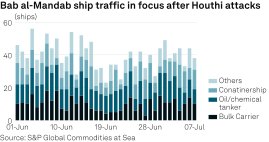
While ship traffic via the Bab al-Mandab Strait has yet to slow down further due to the latest attacks, marine insurance premiums for Red Sea transits have more than doubled this week due to heightened operational risks, according to industry participants.
S&P Global Commodities at Sea data shows Greek operators still sending tankers with Indian products through the strait as of July 9. A total of 40 ships sailed through the strait on July 8, compared with 38 on July 7. Daily transits averaged 39 in June.
Security outlook
The ships recently attacked were managed by Greek firms that traded in Israel and fell within the Houthis' target profile.
"These events do not signal a change in intent," and the Houthis were using similar weapons in an area where they often operated, said Robert Peters, director for risk analytics at security consultancy Ambrey.
"There is limited evidence of a significant change in capability per se," Peters told Platts. "Nevertheless, the early indications are that the impact of an attack has worsened.
"This is assessed to be likely because the Houthis have the time to perform sustained operations. The time to act has likely changed due to the disposition of naval forces."
Following the attacks, several of the world's largest shipping industry groups jointly called on "all stakeholders" to ensure seafarers' safety in Red Sea passage.
"This tragedy illuminates the need for nations to maintain robust support in protecting shipping and vital sea lanes," said a joint statement by the International Chamber of Shipping, BIMCO, European Shipowners, Intercargo and Intertanko.
"We urge that the international standards of freedom of navigation and the sanctity of human life are recognised, upheld and defended," the groups said.
It is not immediately known whether Western navies will enhance their security measures in the region. Aspides said it did not have any naval assets in the proximity of the incidents. The US Department of State condemned the "unprovoked Houthi terror" attacks and said Washington will "continue to take necessary action to protect freedom of navigation and commercial shipping," without elaborating.
The Houthis agreed to a ceasefire deal with Washington on May 6 to halt attacks on US ships through the Red Sea, but warned June 21 that if the US joined Israel's fight against Iran, they would target US ships and US warships in the Red Sea.
The US subsequently launched strikes against Iranian nuclear targets, but Iran and Israel agreed to a ceasefire soon after.
