Refined Products, Maritime & Shipping, Fuel Oil, Bunker Fuel, Wet Freight, Dry Freight
July 08, 2025
Houthi attacks boost insurance rates, ship traffic not yet affected

By Max Lin
HIGHLIGHTS
AWRP doubles on renewed Houthi attacks after months of hiatus
Armed guards 'ineffective' in dealing with recent attacks: Dryad
Ship transits continue via Bab al-Mandab
Marine insurance premiums for Red Sea transits have increased significantly after renewed Houthi attacks resulted in casualties, even as ship traffic via the Bab al-Mandab Strait is not yet affected, according to industry data and participants.
On July 6-7, the Yemen-based rebel group shot missiles, drones and grenades at two Greek bulk carriers in the southern Red Sea, of which one apparently sank, and the other was left adrift while three of its crew were killed.
Consequently, the additional war risk premium for a ship moving through the key waterway rose to at least 0.7% of hull value from 0.3% before the attacks, an insurance source told Platts.
While the ships fit with Houthis' target profile as their managers operate in Israel, some industry participants said overall maritime risks are rising fast, as recent attacks were the first since end-2024 and among the worst.
"At risk are vessels transiting the region that belong to fleets with a history of Israeli port calls," risk consultancy Windward said in a web post, estimating that over 15,000 ships -- or one in six ships globally -- would meet this criterion.
Armed guards were deployed aboard the Ultramax Magic Seas and the Handysize Eternity C, the two ships recently attacked. But consultancy Dryad Global CEO Corey Ranslem said, "We don't feel there is a low risk to any ship moving through this region" and "security teams have proven to be ineffective in dealing with the current threat."
The Houthi fighters have attacked more than 130 merchant ships they believe to be linked to Israel, the US and the UK since the Gaza war broke out in October 2023. Most of the vessels did not suffer heavy damage.
However, the 32,211-dwt general cargo ship Rubymar and the 82,400-dwt bulk carrier Tutor sank last year, while three seafarers were killed aboard the 50,448-dwt bulk carrier True Confidence.
Seaborne flows
Most ship operators have diverted their ships away from the Red Sea since the initial months of the Israel-Hamas conflict to sail around Africa, supporting bunker use and ton-mile demand for vessels.
"There is continuing volatility and uncertainty within this region, and we expect it to continue for the foreseeable future," Ranslem said. "The only way a vessel can mitigate the threat is to transit around the Cape."
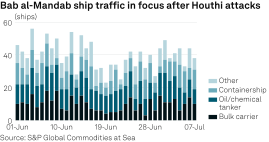
Amid the persistent safety concerns, ship traffic through the Bab al-Mandab Strait has slumped by two-thirds from the normal level and has stayed low since the first quarter of last year. The latest threats have yet to affect transit volumes further.
S&P Global Commodities at Sea data shows 20 ships were sailing through the strait as of midday on July 8, compared with 38 on July 7, including 12 containerships, 10 dry bulk carriers, and nine oil/chemical tankers. Daily transits averaged 39 in June.
However, a growing proportion of the ships sailing through the Red Sea are broadcasting their Chinese affiliation, sending out messages like "ALL CHINESE," "CHINA CREW_OWNER" and "CHINESE OWNERSHIP," according to CAS. The Houthis are backed by Iran, whose largest trading partner is China.
