Metals & Mining Theme, Non-Ferrous
October 17, 2025
TRADE REVIEW: Supply surplus anticipated to weigh on alumina market in Q4

By Zuyu Tian
HIGHLIGHTS
Indonesian capacity ramp-up looms over Q4 outlook
Market eyes Chinese imports amid broader price weakness
Chinese imports cautious amid dynamic arbitrages, domestic surplus pressure
This report is part of the S&P Global Energy Metals Trade Review series, where we dig through datasets and digest some of the key trends in iron ore, metallurgical coal, copper, alumina, cobalt, lithium, nickel and steel and scrap. We also explore what the next few months could bring, from supply and demand shifts to new arbitrages, and to quality spread fluctuations.
The FOB Australian alumina market is expected to face continued pressure in the fourth quarter of 2025, mainly due to increasing Indonesian and Chinese domestic supply.
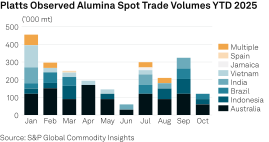
Spot trading volumes from Indonesia rose 4.75% year over year from January to September as new refinery capacities increased, according to Platts observed data.
"The ramp-up in production from Indonesia is a critical factor influencing the rising surpluses we anticipate in the near to medium term. This influx of supply is likely to create a competitive landscape, exerting downward pressure on prices," said S&P Global Energy Metals and Mining Research analysts Karen Norton and April Kaye Soriano, forecasting an average price of FOB Australia alumina price at $395 per metric ton in 2025.
Market sentiment remained cautious as participants closely monitored the dynamics of Chinese import parity amid potential production cuts in response to the oversupply situation.
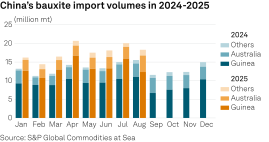
Additionally, Guinean bauxite shipments to China after the rainy season continued to be a key factor driving both domestic and seaborne alumina markets.
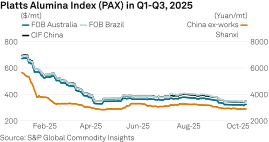
Platts, part of Energy, assessed the FOB Australia alumina price at $319/mt on Oct. 16. It averaged $356.85/mt in Q3, up 0.36% from Q2 but down 30.79% from Q1.
CIF China alumina was assessed at $342.3/mt on Oct. 16, with Q3 prices averaging at $380/mt, up 0.79% quarter over quarter, but down 29.12% from Q1.
Chinese domestic alumina was assessed at Yuan 2,850/mt ex-works Shanxi on Oct. 16. Q3 prices averaged Yuan 3,123.79/mt, up 2.48% from Q2 but down 16.87% from Q1.
Additionally, the weekly Brazilian alumina premium to Australian material was assessed at $24/mt FOB on Oct. 16. Q3 premium averaged $27.92/mt, up 29.18% quarter over quarter and 44.26% from Q1, supported by widening regional disparity amid Pacific supply surpluses.
New Indonesian smelters may ease alumina supply pressure
Further capacity additions of about 1 million mt/year are planned for Q4 2025 to early 2026, but detailed commissioning schedules are still pending and depend on market price levels, industry sources with knowledge of the matter said.
Meanwhile, the increasing pressure from supply side might get some relief with Indonesia's expanding smelting capacity.
Market participants reported that an Indonesian greenfield aluminum smelter project, which began operations in Q3, is currently running at below half of its planned Phase I capacity of 500,000 mt/year. The ramp-up process is expected to continue through Q4 and into 2026, they added.
A second facility with Phase I capacity of 500,000 mt/year is scheduled for commissioning between Q4 2025 and early Q1 2026, sources said. The greenfield smelter will be operated by PT Kalimantan Aluminum Industry (KAI), a joint venture led by PT Alamtri Resources Indonesia (formerly PT Adaro Energy Indonesia), along with Harita Group and Lygend Resources & Technology.
While Indonesia's emerging smelting capacity could help ease the supply overhang, market sentiment remained bearish as alumina capacity additions continued to outpace smelting growth in Q4, several Pacific-based market participants said.
"The new aluminum capacity additions are unlikely to provide significant support to alumina prices," an Indonesia-based market participant said. "The market impact of a handful of Chinese import cargoes can be more significant than that of the smelting capacity expansions."
China imports arbitrage under spotlight
As the Chinese domestic price remained under pressure due to increased local supply, the market was closely watching for signs of production adjustments that could help stabilize prices moving forward.
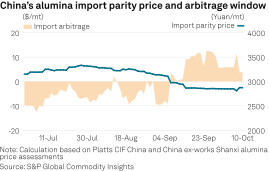
Although the price gap between FOB Australia and domestic Chinese alumina created potential arbitrage opportunities as seaborne prices declined, actual import volumes remained volatile as market participants balanced import parity with domestic price changes.
Market participants also observed a regional price difference, with South China showing larger potential for import arbitrages while North China remained close to seaborne prices.
"While import arbitrage works on paper, buyers are increasingly cautious amid falling prices," a Pacific-based producer source said.
Q4 term contracts for standard-grade Guinean bauxite were negotiated at around $74/dmt on a CIF China basis, down $1/dmt from Q3 levels, according to China-based market participants, while noting that spot prices were softening currently, pressured by rising Guinean supply and weaker alumina prices.

Editor: