Metals & Mining Theme, Non-Ferrous
October 15, 2025
TRADE REVIEW: Asian cobalt market to face continued pressure in Q4 on DRC export concerns
By Litian Wang and Leah Chen
HIGHLIGHTS
DRC’s export ban and quota system tip cobalt market into supply deficit
Cobalt metal considered as alternative feedstock for cobalt hydroxide
Q4 cobalt value chain product prices expected to remain elevated
This report is part of the S&P Global Energy Metals Trade Review series, where we dig through datasets and digest some of the key trends in iron ore, metallurgical coal, copper, alumina, cobalt, lithium, nickel and steel and scrap. We also explore what the next few months could bring, from supply and demand shifts to new arbitrages, and to quality spread fluctuations.
Asia's cobalt market enters the fourth quarter of 2025 under continued supply pressure as the Democratic Republic of Congo prepares to replace its cobalt export ban with an annual quota system from Oct. 16. Exports of cobalt have been halted since the ban took effect on Feb. 22, and inventories have been depleting.
The market has been consuming available inventories and gradually slipping into a supply deficit, which became more obvious in Q3 and is now expected to worsen through Q4 and beyond, market sources said.
With Chinese refiners facing tightening feedstock supply, sentiment remains bullish ahead of new quota shipments expected around late December 2025 or early January 2026.
DRC to lift export ban, introduce quota
The DRC's Authority for the Regulation and Control of Strategic Mineral Substances announced Sept. 21 that the cobalt export ban will be extended until Oct. 15, after which an annual quota system will take effect.
The total quota for cobalt exports is set at 18,125 metric tons for the remainder of 2025 and 96,600 mt per year for 2026 and 2027, including 9,600 mt of discretionary strategic quota. Allocations will be based on historical export levels, excluding small-scale miners and inactive refiners.
"The quotas for 2026 and 2027 imply a substantial reduction in monthly exports, equating to 7,250 to 8,050 mt per month, or 43% to 48% of the monthly export volumes in 2024," according to a S&P Global Energy Metals and Mining analytics report. "We expect these quotas to shift the cobalt market into a sizable deficit of 15,000 mt in 2026 and 9,000 mt in 2027," the report said, adding that the allocation of quotas among producers such as China Molybdenum (CMOC) remains unclear.
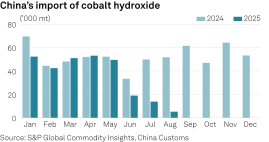
China cobalt hydroxide imports down amid DRC ban
Supply from the DRC -- the world's largest cobalt producer -- has been severely disrupted since February. China's cobalt hydroxide imports plunged to 5,241 mt in August 2025, down 62% month over month and 89.9% year over year, according to China Customs data.
IXM, the trading arm of CMOC, which handles most of the company's cobalt sales, declared force majeure on June 30, while another major European trader also reported no cargoes available for term contract deliveries from August onward.
Consequently, spot liquidity has largely dried up since the export ban in February, as lower export volumes steadily eroded refiners' inventories. Chinese refiners have stepped up stockpiling to secure feedstock, while sellers have largely held back offers.
The severe shortage quickly drove up cobalt hydroxide prices. Platts assessed 30% Co hydroxide prices at $20.7/lb CIF China on Oct. 14, up 76.9% from July 1.
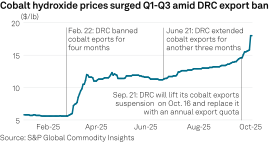
Cobalt production falls, refiners eye substitution potential
Tight feedstock supply has also weighed heavily on downstream cobalt metal production. China's cobalt metal output has fallen sharply from over 5,000 mt/month before the DRC's export suspension to slightly above 1,000 mt/month as of October, a European trader said.
However, inventories of cobalt metal in China and bonded warehouses remain relatively high at an estimated 10,000-20,000 mt as of early October -- a result of an earlier oversupply situation before the ban, when domestic metal production surged while demand stayed weak, according to a Shanghai-based trader.
With spot hydroxide supply tight and metal inventory ample, refiners are now evaluating the economics of using cobalt metal as an alternative feedstock for cobalt salts production. Some refiners were heard considering this switch as the price spread between cobalt metal and salts has exceeded refining costs of cobalt sulfate from cobalt hydroxide, making the substitution profitable.
Market participants said the timing of this shift will be an important indicator of whether tightness in raw materials starts to ease.
Platts assessed 99.95% Co cobalt metal at Yuan 363,000/mt ex warehouse Shanghai on Oct. 14, up 37.5% from Sept. 1 when Platts first launched the assessment.
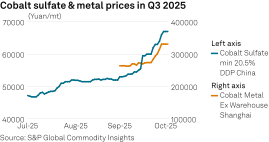
Tepid battery demand limits cobalt sulfate price
Cobalt sulfate prices were largely propelled by the uptrend observed in its feedstock, cobalt hydroxide prices, throughout Q3. Platts-assessed cobalt sulfate prices hit Yuan 70,000/mt ($9,852/mt) Oct. 8, up 48.3% from Yuan 47,200/mt DDP China at the start of the quarter.
However, demand from the battery sector remained tepid, with nickel-manganese-cobalt (NMC) batteries continuing to occupy a small market share when compared with lithium iron phosphate (LFP) batteries.
NMC batteries held a 22.1% market share in August at 30.9 GWh, with a year-over-year growth of 23.1%. LFP batteries occupied the remaining 77.8% of the market, with a 42.2% year-over-year growth, according to China Automotive Battery Innovation Alliance data.
Market participants are expecting demand to be slightly elevated entering the traditionally bullish season in September and October, although some were more cautious given that NMC has consistently occupied a low market share of 20%-30% in the past two years within the Chinese domestic market.
"NMC planned production for September is good, especially for mid-nickel series 6," said a Chinese consumer, although he added that prices didn't rebound as much as expected.
"NMC demand isn't so great in general, even for mid-nickel NMC battery," a South Korean battery maker said about the seaborne market.
Supply shortfall to persist
Moving into Q4, although the DRC's export ban will be lifted from Oct. 16, market participants are expecting the earliest cargoes could reach China by late December 2025 to early January 2026, given the long shipping period and customs clearance timelines.
With cobalt hydroxide inventory nearly exhausted and refiners yet to switch to using metal as feedstock, market sources are expecting prices to edge higher in the near term, market sources said. Hydroxide prices are likely to exceed $18/lb and Chinese cobalt metal prices to rise above Yuan 350,000/mt in Q4, before easing slightly once shipments start to arrive, the sources added.
In the meantime, the cobalt market remains focused on how the DRC authorities will allocate export quotas, which could reshape supply distribution in the following years.

Editor: