


Crude Oil
July 24, 2025
Iran-Europe nuclear talks a starting point, but deal still distant: experts

By Kate Winston
HIGHLIGHTS
May open door to inspections
US, Iran still at odds on enrichment
European nuclear talks with Iran slated for July 25 are expected to reestablish lines of communication and potentially open the door to renewed inspections, but a deal that could win US buy-in and oil sanctions relief is still a long way off, experts say.
The talks in Turkey were scheduled after the UK, France and Germany, known as the E3 nations, threatened to soon reimpose UN sanctions lifted under the 2015 Iran nuclear deal if there was no progress on a nuclear deal.
The likely goal of the upcoming talks is simply to restart dialogue after the recent Israel-Iran conflict, said Ellen Wald, president of Transversal Consulting.
"After America's involvement in the recent military strikes on Iranian nuclear facilities, the best avenue for re-establishing communication with Iran is for European powers to take the lead without the US present," Wald said.
There is little doubt that US officials not only agreed for the E3 to take the lead in reestablishing communications but also encouraged it behind the scenes, Wald said.
It is too soon to consider what it would take to get the US to sign onto a deal because other powers, including China, would need to be brought in once the talks get anywhere close to a deal, Wald said.
"Any 'deal' without the US and China is not worthwhile to Iran and doesn't make sense for European powers since technically they are still operating within the 2015 deal," Wald said.
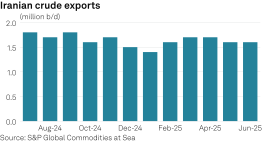
While the Trump administration has returned to so-called maximum pressure sanctions on Tehran, Iran's crude exports have continued largely unabated. Iran exported nearly 1.6 million b/d of crude in June, up from 1.4 million b/d in January, according to data from S&P Global Commodities at Sea.
Mounting tensions
The talks are less about a breakthrough in negotiations and more about avoiding a diplomatic collapse amid mounting tensions, said Alex Vatanka, a senior fellow at the Middle East Institute.
"Iran views the activation of the UN snapback mechanism not just as legal aggression but as a de facto act of war," Vatanka said. "Europe's proposal to delay snapback may be the last diplomatic off-ramp before Iran considers withdrawing from the [nuclear nonproliferation treaty]."
Prior US-Iran talks made little progress because the two countries are at loggerheads on enrichment capacity, with the US demanding a stop to all enrichment and Iran insisting it has a right to continue enrichment for peaceful purposes.
The E3-Iran talks are meant to demonstrate the European nations' firmness in pursuing snapback sanctions, but they are unlikely to bridge the gap on enrichment, said David Goldwyn, chair of the Atlantic Council Global Energy Center's Energy Advisory Group
As a result, snapback of sanctions and tougher enforcement of existing restrictions are much more likely than a deal, Goldwyn said.
"At best, they will secure an Iranian commitment to enhanced inspections and perhaps a more minimal level of enrichment," Goldwyn said regarding the E3 talks.
The meeting is unlikely to have a meaningful impact on the market, and diplomatic efforts are likely to continue as Iran seeks to avoid snapback sanctions, said Rachel Ziemba, a senior adviser with Horizon Engage.
A UN sanctions snapback would put other countries in a position where they might have to reduce trade with Iran, Ziemba said. But the big question would be the Chinese response, she said. "So far, China does not admit to buying oil products from Iran, so it's unlikely the trade would fall much."
US coordination
The US should coordinate with Europe on imposing snapback sanctions, said Daniel Shapiro, who served as US ambassador to Israel during the Obama administration.
"I think it's very important that that leverage be used to try to move Iran in the direction we need them to go, which is to relinquish their highly enriched uranium and any residual enrichment capability," Shapiro said during a July 23 hearing of a panel of the US Senate Foreign Relations Committee.
The US should also increase efforts to scale back Iranian oil exports to China and make clear that additional military strikes by Israel or the US are possible, Shapiro told the Subcommittee on Near East, South Asia, Central Asia and Counterterrorism.
Brian Hook, who served as the US special representative for Iran during the first Trump administration, said he had supported a sanctions snapback in 2019 and 2020 because he believed Iran was in sufficient breach of its nuclear obligations.
"The E3 were not with us then. I am very heartened to see them with us now," Hook told the panel.
Senator Tim Kaine, Democrat-Virginia, noted that the US had already pulled out of the Iran nuclear deal by that time, so it was hard to convince the E3 nations to use the snapback.
"I agree with you, it would have been better had they done it earlier, but at least it is a tool, so we will cross our fingers that maybe the discussions might be helpful," Kaine said.

Editor: