


Crude Oil, Refined Products, Maritime & Shipping
October 07, 2025
COMMODITY TRACKER: 5 charts to watch this week
This week, Russian crude exports increased, particularly to India and Turkey. Simultaneously, the US rig count has increased amid price pressures, and Brazil has renewed antidumping duties on steel imports to safeguard its market.
1. Russian crude exports rise amid challenges
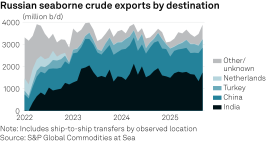
What's happening? In September, Russian crude exports rose to 3.88 million b/d, the highest since April 2024, according to S&P Global Commodities at Sea. The increase was driven by shipments to India, up 29% to 1.73 million b/d, and Turkey, up 11% to 375,000 b/d. Exports to China fell 12% to 1.12 million b/d. This comes after Ukrainian drone attacks targeting refining infrastructure in Russia and amid international pressure; the G7 finance ministers have agreed to intensify pressure on Russian oil exports with a new price cap of $47.60/b effective Sept. 3. Platts, part of S&P Global Energy, assessed Urals crude discount at Primorsk to Dated Brent at $11.48/b in September.
What's next? Russian oil product exports decreased to 1.87 million b/d, the lowest since the conflict began, due to drone attacks and refinery downtime, according to CAS data. Refinery downtime reached 1.86 million b/d as of Sept. 19. The Russian energy ministry plans to extend its gasoline export ban. With damage to fuel loading facilities and retail station closures, especially in southern regions and Crimea, the industry faces a deepening fuel crisis. This situation is expected to persist as drone attacks continue to impact operations.
2. US rig count rises with price pressure
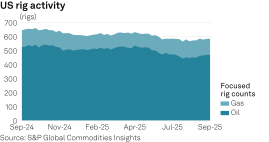
What's happening? The US oil and natural gas drilling rig count rose to 582 for the week ending Sept. 24, according to S&P Global Energy data released on Oct. 2. This increase reflects a slowdown in activity as lower prices impact producers. The count includes 466 oil-focused rigs and 116 gas-focused rigs, significantly down by 68 from the same week in 2024. Gas-focused rigs led the decline, with the Haynesville shale losing six rigs to a total of 42. The Utica basin saw a reduction of one rig, leaving 10 active, while Marcellus remained unchanged at 22. The Permian and DJ Basin held steady at 253 and 13 rigs, respectively, while the Bakken lost two to reach 30.
What's next? Producers have warned that this oil price purgatory is not conducive for investment. Analyst Phil Flynn noted concerns about a potential peak in US oil production. Meanwhile, analysts at Macquarie Group forecast a well-supplied market through year-end and into 2026, lowering their 2025 WTI price forecast to an average of $64/b from $67/b.
3. US clean energy capacity grows
What's happening? The US installed 8.753 GW of wind, solar and battery storage capacity in the second quarter, with Arizona dominating clean power additions, while Texas leads the US in total capacity. US clean energy capacity increased by 16.7% year over year, reaching a total of 333.968 GW by the end of Q2, marking a 2.7% increase from Q1. Notably, 22 states added solar capacity while 11 states expanded their energy storage capacity. In contrast, only three states, Texas, Kansas and Maine, added wind capacity during this period, according to data from S&P Global Market Intelligence.
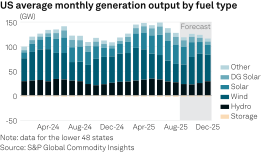
What's next? In the coming months, the focus will be on how many clean energy projects commence construction, according to analysts. Tax credit eligibility requires projects to commence within the next nine months. Solar output across the Lower 48 states is forecast to average about 38.7 GW in Q3, up 31% from a year ago, while wind output is forecast to rise 2.4% to average 39.8 GW, according to Energy data.
4. Wheat market sees price rises
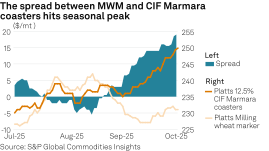
What's happening? The Platts CIF Marmara 12.5% wheat coaster price has increased to a five-month high at $250/ metric ton as of Oct. 2, due to adverse weather in the Kerch Strait causing vessel delays up to 10 days, and increased freight rates from $44/mt to $55/mt in a week. These delays have widened the price spread to the Milling Wheat Marker by a $19/mt premium. Turkey's wheat imports from Russia totaled 1.86 million mt from July to September, with season estimates at 7.5 million mt, up from last year's 3.3 million mt.
What's next? High freight rates are projected to continue for three to four weeks, potentially extending through December due to cold weather, according to a Turkish broker. The Don River's water level has dropped to 2.8 meters, impacting transport. Demand for imported wheat remains strong until the Turkish Grain Board releases its stocks in one to two weeks. Turkey's flour exports have declined to 564,000 mt since June, down from 676,000 mt last year, due to high CIF prices and import curbs. Iraq, facing a 2 million mt wheat harvest reduction, is increasing imports from Turkey, with projections reaching 3 million mt, according to the US Department of Agriculture.
5. Brazil extends antidumping duties on steel
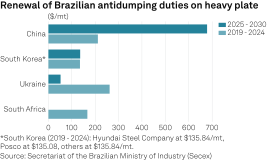
What's happening? Brazil has renewed its antidumping duties for another five years on heavy plate imports from China, South Korea and Ukraine, reinforcing trade protection for domestic steelmakers. Duties on Chinese-origin plate were sharply increased from $211/mt to $678.51/mt, while those on South Korean and Ukrainian plate remain at $135.84/mt and $52.02/mt, respectively, according to the country's official gazette. Brazil's heavy plate import volumes have fluctuated sharply in recent years, peaking at 219,582 mt in 2018, falling to just 11,810 mt in 2020, and totalling 20,285 mt as of August 2025, trade data showed.
What's next? The renewal of antidumping duties highlights Brazil's ongoing efforts to safeguard its domestic steel industry from import pressures. Despite the renewal being seen as a non-impactful continuation by some market observers, it underscores the country's broader trade defence strategy in the flat steel segment. Ongoing investigations into hot-rolled, cold-rolled and coated steel products are expected to conclude in the coming months, extending Brazil's trade defense framework. Despite the protection, domestic fundamentals remain weak, with apparent demand at around 50% of installed capacity, a trader said.
Reporting and analysis by Thomas Washington, Binish Azhar, Kassia Micek, Vivian Iroanya, Camila Martinez

Editor: