


Maritime & Shipping, Refined Products, Chemicals, Agriculture, Energy Transition, Dry Freight, Diesel-Gasoil, Jet Fuel, Polymers, Biofuel, Renewables
September 30, 2025
COMMODITY TRACKER: 5 charts to watch this week
COMMODITY TRACKER: 5 charts to watch this week
Amid drone attacks, Russia tightens diesel export restrictions to bolster domestic fuel supplies. Global biomass and e-fuels are on track for aviation's net-zero goals, while European polystyrene prices fall to a four-year low, prompting reduced imports and increased local production efforts.
1. Russia extends diesel export restrictions amid drone attacks
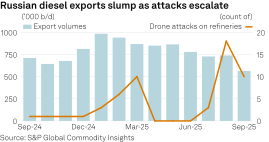
What's happening? Russia is extending its diesel export restrictions due to energy security concerns following Ukrainian drone attacks on key oil infrastructure. These attacks have led to reduced crude runs by about 1 million b/d. New regulations restrict diesel exports from small refineries and traders until the end of 2025, exempting larger refineries. Gasoline export restrictions have also been extended through 2025.
What's next? The restrictions aim to ensure sufficient domestic fuel supplies amid rising prices and shortages exacerbated by drone attacks. Russian Deputy Prime Minister Alexander Novak stated that the measures address a small deficit in the retail market.
2. Sufficient sustainable aviation fuel feedstocks available to meet net-zero goals: study
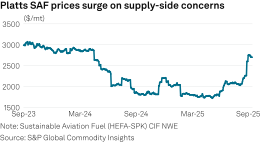
What's happening? Global biomass and power-to-liquid feedstocks are poised to meet aviation's net-zero emissions target by 2050, which requires approximately 500 million metric ton of SAF annually. Biomass residues could account for 300 million mt, while e-fuels would supply the remainder, according to a recent study released by the International Air Transport Association in collaboration with Worley Consulting. The real constraint is slow technology rollout and infrastructure buildout, not feedstock, according to the study. Platts assessed the SAF (HEFA-SPK) CIF Northwest Europe premium at Eur1,662.12/mt Sept. 29.
What's next? IATA has mapped over 300 SAF/renewable fuel projects, with 160 expected online by 2030 or roughly 55 million mt of capacity. But conversion yields and financing gaps mean actual SAF output will fall short. S&P Global Energy projects SAF demand to rise from 1.76 million mt in 2025 to 2.9 million mt in 2026, shifting share from Europe to Asia and the US.
3. Imports decline as European polystyrene prices reach four-year low
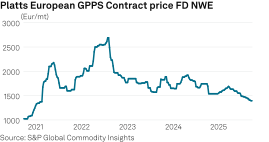
What's happening? With the declining upstream styrene monomer contract price, the European general-purpose polystyrene contract price fell to its lowest value in four years. Platts assessed the general polystyrene contract price FD Northwest Europe at Eur1,395/mt Sept.24. Until the end of June, large imports were seen arriving in Europe from Asia due to competitive pricing, according to a producer.
What's next? Producers and distributors anticipated a spike in demand for domestic material. Market participants believe European PS producers would be able to increase their operating run rates, which, according to a polystyrene producer, have been currently heard to be at around 60%.
4. South Africa opens logistics sector to private investment
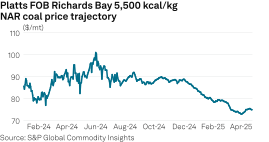
What's happening? The South African government has opened its logistics sector to private investment to enhance coal exports. As of Aug. 22, Transnet SOC Ltd. announced that 11 shortlisted train operating companies will negotiate for access to 41 routes and six corridors for up to 10 years. espite a fall in Platts-assessed FOB Richards Bay coal prices from $429.90/mt in March 2022 to $65.50/mt in July 2025, Transnet's recovery plan, launched in 2023, has improved logistics and led to an increase in coal exports in 2024.
What's next? The inclusion of private players is expected to boost South African coal exports and will enhance rail capacity and competitiveness for both the company and the sector, according to Vuslat Bayoglu, managing director of mining company Menar. This change may enable suppliers to lower operational costs, allowing them to price competitively and potentially expand their market share.
5. Myanmar 5% white rice prices hit record low on low demand, supply pressure
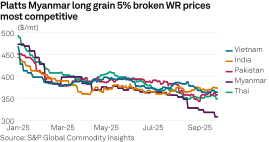
What's happening? Myanmar's 5% white rice prices have fallen, driven by supply pressures from the impending harvest, excess old stocks in warehouses and weak demand. Platts last assessed Myanmar 5% white rice price at $309/mt FOB FCL on Sept. 19, down $190/mt year over year. This was the lowest price since the assessment was launched April 13, 2017. Currently, prices are the lowest among major Asian origins, with significant discounts compared to Thailand, Pakistan, Vietnam and India.
What's next? The monsoon crop harvest, which, according to the US Department of Agriculture, constitutes approximately 70-80% of Myanmar's total harvest, is expected to begin in October, potentially creating additional supply pressure on prices. However, market participants dealing in Myanmar rice anticipate an increase in demand from key importers in the coming weeks, particularly due to heightened interest from Africa for year-end shipments. Furthermore, the rice import ban in the Philippines is set to conclude on Oct. 30, and buyers are expected to return to the market.
Reporting and analysis by Elza Turner, Samyak Pandey, Akul Gupta, Vaibhav Chakraborty, Shivangi Mittal, Chirag Aggarwal and Muskan Agarwal
