Agriculture, Energy Transition, Refined Products, Biofuel, Renewables, Jet Fuel
September 23, 2025
Feedstock availability not limiting factor for aviation net zero by 2050: IATA

HIGHLIGHTS
Sustainable aviation fuel feedstocks enable net zero
Slow tech rollout, infrastructure gaps limit scaling
500 million mt of SAF needed annually by 2050
Sufficient sustainable aviation fuel feedstocks exist to enable the airline industry to achieve net zero carbon emissions by 2050, according to a new study by the International Air Transport Association in partnership with Worley Consulting.
The report released on Sept. 23 identifies slow technology rollout and infrastructure gaps, rather than feedstock scarcity, as the main obstacles to scaling SAF production.
Airlines will require approximately 500 million metric tons of SAF annually by 2050 to meet IATA's Net Zero Roadmaps. Biomass feedstocks, including used cooking oil and other sustainable residues, could supply over 300 million mt of bio-SAF, while power-to-liquid (PtL) e-fuels would bridge the remaining demand.
All feedstocks considered meet strict sustainability criteria and avoid land-use change.
"Feedstock availability is no longer the limiting factor. The challenge is turning this potential into commercial SAF at scale," said Willie Walsh, IATA Director General. "We need shovels in the ground now to accelerate technology rollout."
The report calls for improvements in conversion efficiencies, expansion of production infrastructure, and regional coordination to unlock SAF at scale.
Key markets identified include North America, Europe, Brazil, India, China and ASEAN nations.
IATA's findings coincide with recent industry initiatives aimed at boosting SAF deployment.
The airline alliance oneworld, in partnership with Breakthrough Energy Ventures, launched a $150-million fund to accelerate early-stage SAF technologies, focusing on cost-effective feedstocks and novel production pathways.
The fund, backed by major carriers including American Airlines, Alaska Airlines and Singapore Airlines, aims to scale SAF production and reduce lifecycle emissions by up to 80% compared with conventional jet fuel.
On the regulatory side, IATA has extended its Q3 2025 Carbon Offsetting and Reduction Scheme for International Aviation (CORSIA) auction to Oct. 3, enabling airlines to procure emissions credits while SAF supply scales up.
The auction, featuring Guyana Jurisdictional REDD+ credits, underscores the continued role of carbon markets in bridging emission reductions until SAF volumes become sufficient.
Marie Owens Thomsen, IATA Senior Vice President of Sustainability and Chief Economist, emphasized the broader economic and energy security benefits of SAF. "Governments, investors, and energy producers must work together to de-risk investment, accelerate rollout, and support regional supply chains. SAF can deliver jobs, economic growth, and energy security alongside decarbonization," she said.
IATA has mapped over 300 SAF and renewable fuel projects worldwide, with 160 expected to be operational by 2030, representing an aggregate capacity of roughly 55 million mt—but not all will yield SAF.
"With the right policies and investments, SAF has the potential to supply over 65% of aviation's emission reduction needs by 2050," Walsh said. "The conclusion of this study is an urgent call to action. We have just 25 years to turn this proven potential into reality."
S&P Global Energy analysts forecast global SAF demand to reach 39,000 b/d, or 1.76 million mt, in 2025, with 59% in Europe, 28% in the US and 14% in the rest of the world. In 2026, global demand is expected to rise to 61,000 b/d, with Europe's share falling to 54%, the US at 19% and the rest of the world jumping to 27%.
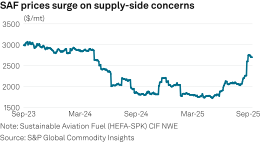
Platts assessed the SAF (HEFA-SPK) CIF Northwest Europe premium at Eur1,676.506/mt Sept. 22, up Eur22.968/mt from Sept. 19.
